


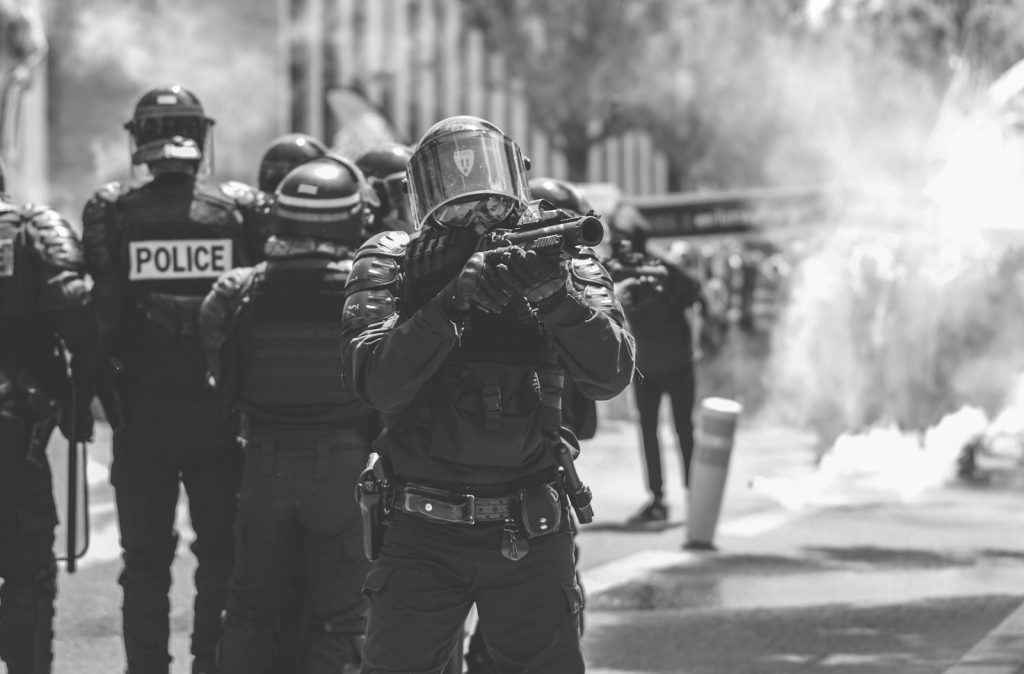
Parents in Minneapolis say a routine drive home from a middle school basketball game turned into a nightmare when federal immigration agents fired tear gas that rolled under their SUV with six children strapped inside. Their account, now circulating widely on social media and in local reporting, describes a family suddenly engulfed in chemical gas, airbags blown, doors locked and a 6‑month‑old baby who stopped breathing. The clash has intensified scrutiny of how Immigration and Customs Enforcement conducts operations in crowded neighborhoods where families are simply trying to get home.
The parents’ story is not unfolding in isolation but against the backdrop of a broader confrontation between ICE and protesters in north Minneapolis, where flash bangs, tear gas and gunfire have already sent children to the hospital. As officials sort through what happened on that block and why a family vehicle became a casualty, the case is rapidly becoming a test of accountability for federal agents operating in residential streets.


The family’s drive home turns into chaos
The evening began with the kind of routine that anchors family life: a middle schooler’s basketball game, siblings piled into the back of an SUV, and parents focused on getting everyone home in the Twin Cities traffic. Destiny Jackson, 26, has said she was driving her family, including her husband and six children ranging from a 6‑month‑old infant to older siblings, when they turned toward their north Minneapolis neighborhood and suddenly encountered a blocked street and a line of federal agents. She has described realizing in that moment that something was wrong and that the area was not safe for a car full of kids.
According to Jackson, she started to see federal agents ahead and tried to turn around, but the family’s path intersected with an ongoing ICE operation and protests that had drawn crowds into the street. In her account, the family was not part of the demonstration but became trapped in the middle of it as agents deployed tear gas and flash devices near their vehicle. She has said that as she attempted to maneuver away, the situation escalated so quickly that the family had no chance to leave before a canister rolled under their SUV and the interior began to fill with gas, a sequence later echoed in a detailed report that noted how She started to see federal agents and then found the vehicle suddenly auto locked, trapping them inside.
Parents say ICE threw tear gas under their SUV
At the heart of the parents’ allegation is a specific claim: that an ICE agent intentionally threw or launched a tear gas canister under their SUV while all six children were inside. In their telling, the device rolled beneath the vehicle, detonated, and sent a blast that rocked the SUV before gas poured into the cabin. They describe hearing a loud explosion, feeling the vehicle jolt and then watching a dense cloud of chemical irritant rise around them, turning a family car into a sealed chamber of choking fumes.
Video and interviews shared by the family capture their description of the moment the canister went off, with Jan recounting how the blast triggered the airbags and caused all of the doors to lock at once, leaving the children screaming that they could not breathe. In one recorded account, the parent describes how “all of our airbags deployed, all of our doors locked, and tear gas just started forming a ball of gas” around the SUV, a description consistent with what has been reported about the canister that detonated under their vehicle in the Jan interview. The family’s assertion that the canister was placed directly under their car is now central to calls for an independent review of ICE’s tactics that night.
Inside the SUV as gas and flash bangs explode
From the inside, the parents say, the chaos was immediate and overwhelming. Moments after they saw flash bangs go off nearby, a tear gas canister rolled underneath the vehicle and detonated, rocking the SUV and filling it with smoke. The children, strapped into car seats and seat belts, began coughing and crying as the gas seeped through the vents and door seals, while the parents struggled to understand why their airbags had suddenly deployed and why the doors had locked on their own.
Social media clips have amplified the family’s description of those seconds, with Jan describing how the SUV was rocked by a blast and how the gas formed a visible cloud around the vehicle before seeping inside. One widely shared video recounts how flash bangs went off nearby and then a canister rolled under the SUV, which was then rocked by a blast as the gas spread, a sequence captured in a Jan reel that has drawn national attention. For the children, the parents say, the experience was not an abstract policy debate but a terrifying sensory shock of noise, light and burning lungs.
A 6‑month‑old stops breathing
The most harrowing part of the family’s account centers on their youngest child, a 6‑month‑old baby who, according to Destiny Jackson, stopped breathing after inhaling the gas. Jackson has said that as the SUV filled with fumes, the infant’s cries faded, his body went limp and his lips began to change color. In the scramble to escape the locked vehicle, she and her husband focused on getting the baby out first, fearing that the chemical exposure was shutting down his tiny airways.
Once outside, Jackson has described performing CPR on the baby on the street while other children coughed and cried nearby, a scene that underscores how quickly a crowd-control tactic can become a life‑or‑death emergency for the youngest bystanders. Reports from the scene state that the 6‑month‑old was revived with CPR after tear gas flooded the family’s SUV amid ICE protests, with the infant’s condition serious enough that emergency responders rushed him to medical care, as detailed in coverage of the 6‑month‑old revived after exposure. For many observers, the image of a parent giving chest compressions to a baby on a Minneapolis street has become the defining symbol of the incident.
Children hospitalized and a city on edge
The family’s ordeal unfolded in a neighborhood already rattled by violence linked to an ICE operation and protests in north Minneapolis. Local officials have confirmed that children were among those injured as federal agents deployed tear gas and flash devices during the confrontation, with at least two young patients, including an Infant, hospitalized after exposure. The fact that children were sent to the hospital from the same area where the Jackson family says their SUV was gassed has intensified concerns that the operation was conducted with too little regard for nearby families.
Live updates from the scene have noted that Two children, including an Infant, were hospitalized after federal agents deployed tear gas in Minneapolis, although their exact conditions were not immediately available, according to live updates from the north side. The combination of hospitalized children, a baby revived with CPR and a family alleging that their car was directly targeted has left Minneapolis residents demanding answers about how an immigration enforcement action escalated into a scene where kids in car seats became casualties.
What Destiny Jackson says happened that night
Destiny Jackson has emerged as the central voice describing what happened inside the SUV, offering a detailed narrative of the family’s movements and the moment the gas hit. She has said that the family was driving home from her middle schooler’s basketball game when they reached a blocked‑off street near the ICE operation and protests, and that she tried to turn around once she saw the federal agents ahead. In her account, the family was not part of the demonstration but simply trying to navigate home when they were suddenly caught in the middle of the clash.
Jackson has described how her kids began crying and screaming that they could not breathe as the gas filled the SUV, prompting her to rush to unlock the doors and get them out even as the airbags hung limp and the cabin reeked of chemicals. She has said that she focused on pulling the children from their seats and then performing CPR on the 6‑month‑old to revive him, recounting later that she had simply been “on my way home” when the gas hit, as reported in coverage that quotes Destiny Jackson describing the blocked‑off street and her shock at being gassed while still in her vehicle. Her insistence that the family was uninvolved in the protest has become a key point in the public debate over whether ICE followed its own guidelines for minimizing harm to bystanders.
How local reporting and national outlets framed the incident
As Jackson’s story spread, local and national outlets began piecing together a fuller picture of the night’s events, drawing on interviews, video and statements from officials. One detailed account noted that a Minnesota woman said she and her family were tear gassed by ICE agents while attempting to get home from her son’s game, emphasizing that the SUV was not part of the protest but was instead trying to navigate around the operation. That reporting highlighted that the family included six children and that the mother believed the canister had been thrown directly under their vehicle, underscoring the parents’ sense that they were not simply collateral damage but targets of a specific tactical decision.
Further coverage focused on Destiny Jackson by name, identifying her as a 26‑year‑old mother who said the tear gas caused her 6‑month‑old baby to stop breathing and required CPR to revive him. One profile, written by Toria Sheffield and credited in part to Toria Shef, framed Jackson’s account as part of a broader pattern of families caught in the crossfire of aggressive immigration enforcement, noting that she had been driving in Minnesota when the ICE operation and protests converged around her SUV, as described in a piece that emphasized the Destiny Jackson narrative. Another segment from the same reporting stream noted that, in a statement to a national outlet, ICE defended its broader operation while the family continued to insist that agents had endangered their children, a tension captured in coverage that summarized what readers NEED to KNOW about the clash.
ICE tactics, flash bangs and the question of proportional force
The Minneapolis incident is forcing a closer look at how ICE and other federal agencies deploy crowd‑control tools like tear gas and flash bangs in dense urban neighborhoods. The parents’ account that a canister was placed directly under their SUV, triggering airbags and locking doors, raises questions about whether agents were adequately trained to assess the risks to bystanders, especially children strapped into car seats. The use of devices that can both explode with concussive force and release chemical irritants near occupied vehicles has drawn criticism from civil rights advocates who argue that such tactics are inherently indiscriminate in tight residential streets.
Local reporting from north Minneapolis has already documented how Children were hurt in a protest linked to a Minneapolis ICE operation, including accounts of a flash bang hitting a van and kids being struck by tear gas. Those reports, which also note that Minneapolis Mayor Jacob Frey and Mi officials have been briefed on the situation, describe a scene where families in vehicles and on sidewalks were exposed to the same tools used to disperse protesters, as detailed in coverage of the Minneapolis ICE shooting and its impact on Children. The Jackson family’s allegation that their SUV was directly targeted fits into this broader pattern of questions about whether ICE’s tactical playbook is compatible with the realities of crowded city blocks.
Community outrage, official responses and what comes next
Why this case could reshape expectations for ICE operations
More from Decluttering Mom: