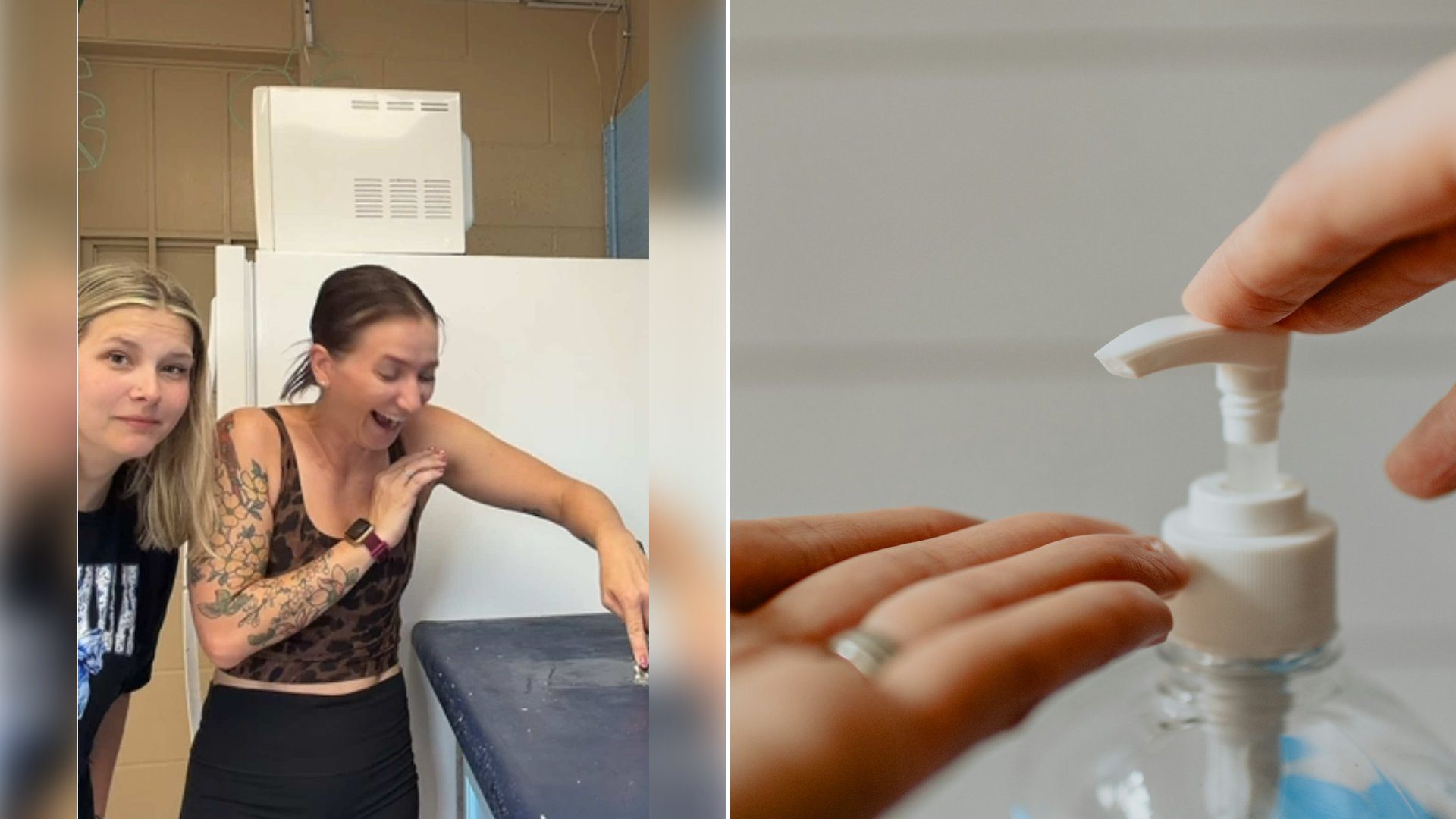
Two days before a birthday party, Sierra Zagarri stood behind a navy blue counter that was still tacky with contact paper adhesive and told the camera, “I completely forgot that I started this project.” Her plan for the day was a bottle of alcohol based hand sanitizer and a squeegee borrowed from the kids.
@sierra_zagarri posted the clip on September 25, 2026, with the caption “I kinda forgot how sticky this counter is” and the tag #smallbusinessowner. The counter sits in a back room against a blue pegboard wall with a rainbow sign on it. In the opening frames she spreads sanitizer across the dark surface with a small white and blue squeegee.
The squeegee has a backstory. “This is the squeegee that I stole off of the playroom floor,” she says. “It was a pretend window squeegee for the kids.” She adds that they needed it more, and that it will not be going back out to the children once it has been through this job. She pushes the gel across the counter in long strokes, says “I think this is working,” and explains the plan: let it soak in, then squeegee everything up. A row of white towels goes down along the counter while it sits.
The smell arrives first. “Smells like a dive bar back here now,” she says, then points out that there is a door between the back room and the play area. “The children and the playroom will never even know that we’re working on this project.”
After “about 10 minutes” of soaking, she says she has to get some airflow in before checking the result, and the next shot shows her opening a window. Then comes the test. A close shot follows a cloth dragging across the navy surface, with cloudy, gummy patches of residue still stuck to it. “This might have made it worse,” she says. “It is starting to slowly peel off, but unfortunately it’s just very slow. This might take all day.”
The video then cuts to her in a different outfit, rubbing the counter with a rag while the pump bottle of sanitizer and the squeegee sit beside her. “Okay, I made a small mistake,” she says, and lays out the deadline: the counter has to be done by Saturday, and she goes out of town tomorrow. “It’s fine. Everything’s fine.” A second woman leans into the frame near the end, someone adds “And she’s leaving for vacation,” and Sierra signs off with “I’m gonna come back later and do this.” The clip stops there, so it does not show whether the counter was cleared before the party.
What the Liner Maker and the FDA Say About Her Method
Kittrich, which makes adhesive shelf liner, gives removal directions for its own product that use a different solvent than the one Sierra grabbed. Its instructions say to peel the liner off the surface piece by piece, then apply a citrus based solvent where the paper was, let it sit for about 5 minutes, and scrub with a sponge, rinsing the sponge in clean water and wiping away the excess solvent. For stubborn pieces, Kittrich says to warm the surface first with a hair dryer on a low setting to loosen the adhesive, and then repeat the solvent steps.
Her instinct to open the window matches federal advice. The U.S. Food and Drug Administration states that “hand sanitizer is flammable,” tells people to keep it away from heat and flames, and advises using it in a well ventilated area. The FDA also says the sanitizers it recommends contain at least 60 percent alcohol. That guidance is written for a squirt on your hands; in this video a whole counter was coated and left to soak in a back room.
Those two sets of instructions collide in one place. Kittrich’s fix for stubborn adhesive is heat from a hair dryer, and the FDA’s warning is to keep sanitizer away from heat. Anyone who has already soaked a counter in sanitizer, as Sierra did, should wipe it all off and let the surface dry completely before switching to the hair dryer step.
The surface matters as well. Formica’s guide to cleaning its laminate says contact adhesive should be cleaned with a nonabrasive cotton cloth and an adhesive solvent, and it lists rubbing alcohol and acetone among the cleansers for tough stains. The video never says what Sierra’s counter is made of, so the safe move with any counter is to find the care guide from the company that made it before soaking it in anything.
Getting Contact Paper Glue Off a Counter Before a Deadline
Test before you commit the day. Sierra found out only after 10 minutes of soaking that her method was “very slow.” Try your solvent on a patch the size of your hand first, time how long it takes to lift, and multiply by the length of the counter so you know whether the job fits before your event.
Open the window before you start, not halfway through. Keep a closed door between the work area and the kids, and keep the room clear of anything that heats up while alcohol based products are out.
Follow the order in the liner maker’s directions: peel what is left piece by piece, apply a citrus based solvent, wait about 5 minutes, scrub with a sponge, rinse the sponge in clean water, and wipe away the extra solvent. Repeat on the spots that stay tacky rather than flooding the whole counter at once.
Use something soft to push the softened glue. Her toy squeegee was plastic and flat, and a cotton cloth fits Formica’s advice to avoid abrasives. Keep whatever tool you use out of the children’s toy bins afterward, as she says she will with hers.
Save heat for last, and only on a dry surface. If the residue still will not budge, wipe off every trace of sanitizer or solvent, let it dry, then warm the area with a hair dryer on low as Kittrich describes and go back to the solvent.
More from Decluttering Mom
- Parent Holds a Green Squishy Toy Coated in Hair Under the Kitchen Faucet and Begs for Cleaning Tips After Corn Starch, Baby Powder and Coconut Oil All Failed to Stop It Getting Hairy
- Cleaning Creator Sprays Cinnamon Water Inside Her Outdoor Bin to Keep Ants and Flies Away Then Buffs Shaving Cream Onto Her Oven in Five Home Hacks She Says No One Teaches You
- 11 Cleaning Habits That Can Actually Make Your House Dirtier