


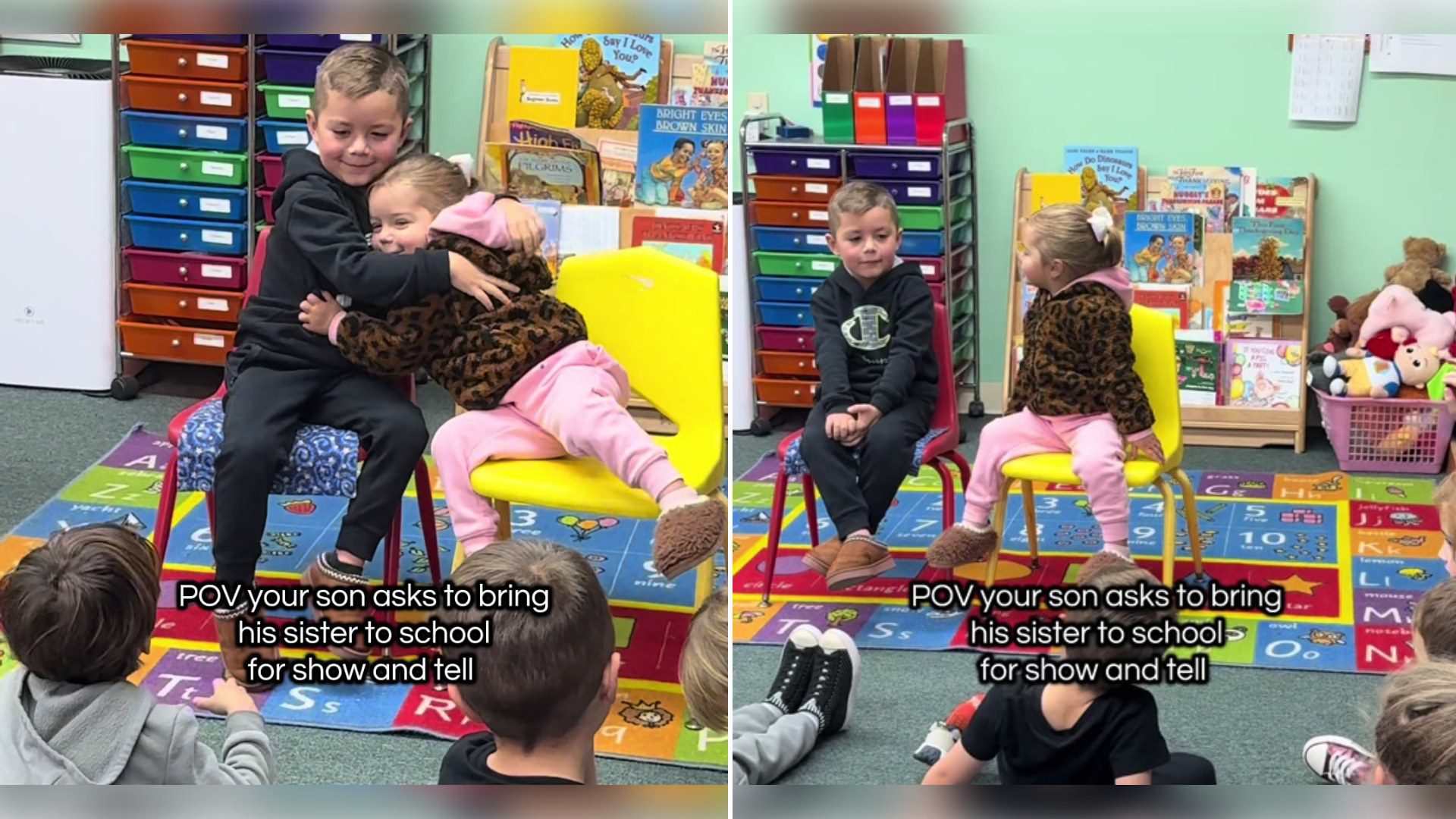
A resurfacing TikTok from @stephdeross shows mom Stephanie DeRoss capturing the moment her preschool-age son decided the most special thing he could bring for show-and-tell wasn’t a toy, it was his baby sister.
@stephdeross Rich in life cause I’m their mom 🥹😭 #siblings #brother #sister #momlife #toddlersoftiktok ♬ original sound – Mom bun
According to DeRoss, her son’s class had a show-and-tell assignment asking kids to bring in something special, and rather than reaching for a favorite toy or object, he chose to bring his little sister to introduce to his classmates. The video captures the arrival and the interaction between the siblings as he shows her off to the class.
This clip is being treated as an older post that is resurfacing now rather than a brand-new upload, since the coverage bringing renewed attention to it is more recent than the original video itself. There’s no indication in the available material of a new update from the family beyond the original moment being recirculated.
What makes the story land, even on a rewatch, is the simplicity of a young child’s logic: asked to bring in something special, he skipped right past toys and possessions and went straight to a person he clearly considers the most important thing in his world. DeRoss’s own reaction in the video, visibly moved by her son’s choice, adds to the emotional weight of the clip.
Show-and-tell has long been a small but reliable source of unscripted, camera-ready moments precisely because young children haven’t yet learned to perform for an audience the way adults sometimes do. A prompt as open-ended as “bring something special” leaves room for a wide range of answers, from a favorite stuffed animal to, in this case, a sibling, and it’s often in that gap between what adults expect and what a child actually chooses that the most memorable family clips are born.
As an evergreen sibling-emotion story rather than a piece of breaking news, the appeal here isn’t tied to any single news cycle. It’s the kind of clip that resonates whenever it resurfaces, precisely because the sentiment behind it, a small child’s uncomplicated love for a sibling, doesn’t really go out of date.
Because this video is understood to be an older post recirculating now rather than a new upload, it’s worth noting that any classroom, school-year or family details beyond what’s shown in the original clip are not being added here. The story stands on its own regardless of exactly when it was first filmed: a preschooler asked to bring something special for show-and-tell, choosing his baby sister over any toy or object, and his mother capturing both his choice and her own emotional reaction to it. That simplicity is likely why the clip continues to resurface periodically rather than fading after its initial run, since it doesn’t depend on any particular news cycle or timely context to land.
Because young children often answer open-ended prompts with unexpected honesty, teachers and parents alike tend to treat show-and-tell responses as a small but genuine window into what a child values, rather than something to be steered toward a more conventional answer. DeRoss’s video captures exactly that kind of unscripted moment, and its resurfacing suggests it continues to strike the same chord with new viewers as it did when it was first posted.
The video’s continued circulation also speaks to how differently young children process the instructions adults give them. An assignment framed loosely enough, bring something “special,” leaves room for a child to define that word entirely on his own terms, and DeRoss’s son’s choice suggests that, for him, no object in his room came close to competing with his sister for that title. It’s a small moment, but one that offers a clearer window into a child’s priorities than a more heavily guided assignment might have.
There’s also something worth noting in how naturally the moment unfolded: no adult appears to have suggested the choice to him, which is likely part of why it reads as so genuine rather than staged for effect. A prompt meant to encourage kids to share something meaningful ended up producing exactly that, just not in the form most classrooms probably expect, and DeRoss’s own visible reaction to her son’s choice adds an additional layer of sincerity that has helped the clip continue to find new audiences each time it resurfaces.
The Takeaway
Young kids often reveal what matters most to them in moments adults don’t expect, and a school assignment as simple as show-and-tell can end up saying more about a child’s values than any planned conversation could. Paying attention to those choices, rather than steering a child toward a “more interesting” object, can turn into a genuinely touching window into how they see their family.
For parents of young siblings, it’s also a small reminder of how quickly sibling bonds can form, even between a preschooler and a baby who can’t yet reciprocate much. Encouraging those moments of pride and connection early tends to set a tone that carries into how siblings relate to each other later on.
It’s worth letting kids answer these kinds of prompts in their own way, even when the answer isn’t what you’d expect, since those unscripted choices often reveal more about a child’s world than a more curated response ever could.