


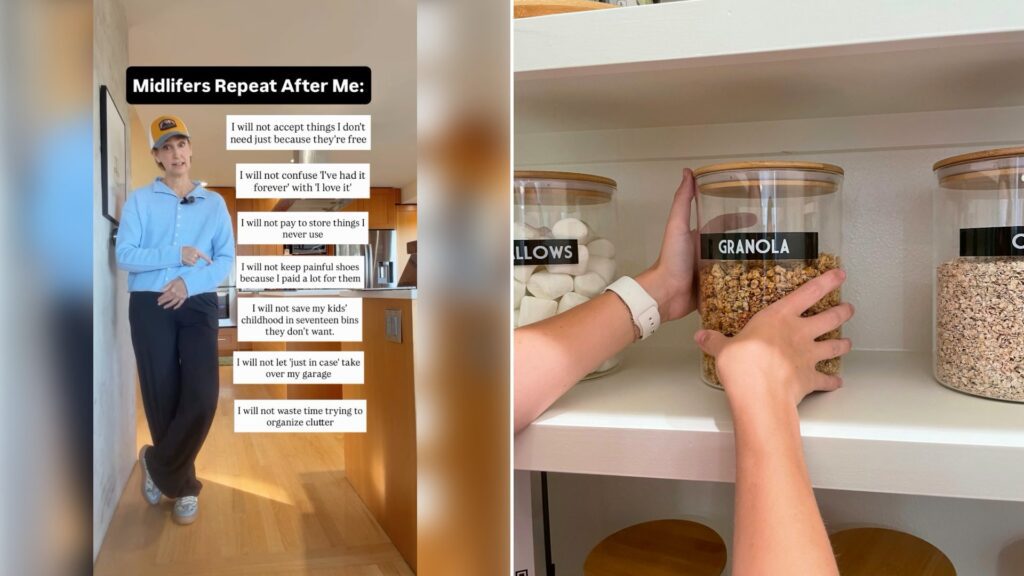
A video from the account method_seattle opens with a direct question aimed at a very specific audience: “Ready to crawl out from under your midlife clutter?” The caption that follows doesn’t soften the challenge, it just makes it manageable: “It doesn’t have to be hard, friends. In fact, comment EASY and I’ll send you a link to my Free 30 Day Decluttering Checklist.” The post, tagged #declutter, #emptynesters, #midlife, and #professionalorganizer, closes on a line clearly meant to be repeated back: “You Can Do Hard Things.” It pulled in 54,400 likes, more than 2,100 comments, and nearly 1,000 shares.
The account identifies itself as a professional organizer speaking specifically to midlife clients and empty nesters, a demographic with its own particular flavor of clutter problem. By midlife, most homes haven’t just accumulated things, they’ve accumulated decades of decisions never made: kids’ artwork nobody sorted, hand-me-downs nobody passed on, hobbies abandoned without ever clearing out the gear. The “it doesn’t have to be hard” framing is aimed directly at the paralysis that builds up around that kind of long-deferred clutter, where the size of the backlog itself becomes the reason nothing gets touched.
There’s a real psychological mechanism behind why letting go of long-held belongings is harder than it sounds, and it has a name: the endowment effect, a well-documented finding in behavioral research showing that people consistently value an item more highly simply because they own it, independent of its actual usefulness or resale value. A sweater worn twice a decade ago gets weighted differently once it’s “mine” than it would on a store shelf. Research out of the University of Iowa’s Tippie College of Business has specifically studied ways to counteract that bias during decluttering, finding that simply changing how a person frames the decision, thinking about what the item would cost to replace, or picturing handing it directly to someone who needs it, makes people meaingfully more willing to actually let go of it rather than keep it “just in case.”
Clinical psychologists who study clutter and procrastination, including DePaul University’s Joseph Ferrari, have also pointed out that chronic clutter tends to compound on itself: every unsorted decision adds a small amount of background stress, and that stress makes the next decision feel even heavier, which is exactly the loop a structured, day-by-day checklist is designed to interrupt. Instead of one overwhelming verdict on an entire house, a 30-day format turns the job into 30 small, separately decidable tasks, which matches almost exactly the research finding that breaking an aversive decision into smaller, more concrete choices measurably increases follow-through.
The “You Can Do Hard Things” framing lands differently for an empty nester than it would for someone in their twenties starting fresh in a first apartment. For this specific audience, letting go of clutter often means letting go of a chapter, the gear tied to the kids who’ve since moved out, the hobby equipment for a season of life that’s ended, the home office supplies for a job that’s changed. The video stops short of making that explicit, but the hashtags around it make the target unmistakable: this isn’t generic tidying advice, it’s permission, aimed at people who’ve been carrying a houseful of memory and obligation for a very long time, to finally set some of it down.
More from Decluttering Mom
- Former New Orleans Homeowner Says She Sold 99 Percent of Everything She Owned in 2007, Left With a Backpack and Has Lived in Studio Apartments for Almost 20 Years Since
- Homeowner Clearing the Hoarded Condo She Inherited From Her Late Dad Says She Was Punished as a Child for Throwing Things Away and Stopped Visiting to Keep Them Close
- Woman Who Does Free Cleans of Badly Cluttered Homes Says Cleaning Does Not Cure Depression and Asks Viewers to Swap How Could Someone Live Like This for What Might Have Happened