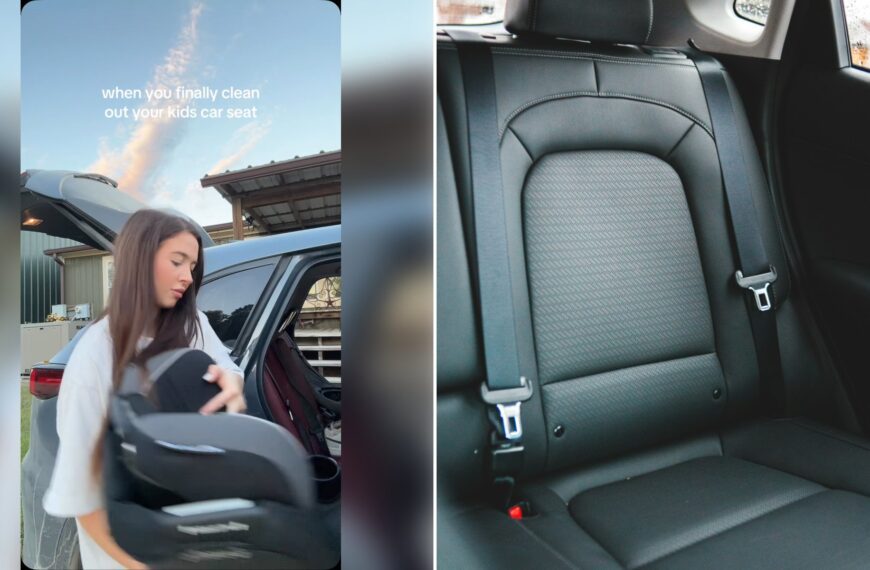
“As a parent and a psychologist,” she begins from the driver’s seat of her parked car, “I don’t tell my children they have to clean up all their toys.” She lets that hang for a second, then goes further: she does not tell them they have to clean up any of their toys, “for that matter.”
The 32 second Instagram reel, posted on September 27, 2026 by @raquelmartinphd, comes with a caption that sounds like a gentle parenting manifesto: “Some of you parents are so strict, don’t make your children clean up all of their toys.” The rest of the video makes it clear the joke is on anyone who stopped reading there.
“I just tell them they have to clean up the toys they wanna keep,” she says. Then she acts it out, pointing at imaginary toys on an imaginary floor: “You, you, you don’t have to pick up that car. You don’t have to pick up that truck.” She adds “that board game” to the list, and the rule comes into focus: “You just have to pick up the things you wanna keep.”
The other half of the rule follows. “And anything you leave laying around,” she says, “I’ll give to people,” pausing before she finishes the thought: “children who care about their things.”
She closes with a straight face that barely holds. “I’m not strict,” she says, then “I’m chill,” and finally the deadline: “Just leave the stuff that you don’t want here by the time you get back from school.”
One commenter raised the hard case. What happens, she asked, when the younger kids leave out toys that belong to an older sibling, who would be upset if those toys disappeared? That question is where a house rule like this one needs a little structure.
Making the Keep It or Lose It Rule Work at Home
Say the rule once, in plain words, the way she does in the video, and attach a time. “By the time you get back from school” works because it is specific and it gives the child a full window to act. Morning before school, or the half hour before dinner, are other natural checkpoints.
Use a holding bin before anything leaves the house. A labeled box in a closet or the garage gives you a cooling off period: toys go in at the deadline, and if no one asks for them within a set number of days, they go out. It also solves the sibling problem from the comments. If a toy in the bin belongs to someone who did not leave it out, it goes back to its owner, and the child who left it out is the one who answers for it.
Check what you are giving away. The U.S. Consumer Product Safety Commission’s Resellers Guide to Selling Safer Products says its rules reach charities and individuals at yard sales, not only stores, and that people who give away used products for free cannot donate products that do not meet the law. The CPSC states plainly that it is illegal to sell any recalled product, and on its online selling FAQ it points people to search for recalls at cpsc.gov/Recalls. A quick search by toy name before the bag goes to the donation drop takes a few minutes.
Sort the bin with younger children in mind. According to the same CPSC guide, products intended for children under 3 are banned if they have small parts, and the guide says to destroy toys with loose or missing magnetic pieces rather than pass them on. A toy car missing a wheel or a board game with a bag of loose magnets belongs in the trash, not the donation pile.
Then follow through. The rule in this video only works because the consequence is real. If the bin fills up and nothing ever leaves, children learn the deadline is a bluff. If one or two toys quietly go to the donation drop on schedule, the rule speaks for itself, and no one has to raise their voice, which is the point of her joke when she insists, “I’m chill.”
More from Decluttering Mom
- Mom of Three Counts Out Loud as She Pulls 100 Things From Her Playroom While Her Big Kids Are Out, Keeps Both Toy Shopping Carts for Her Baby and Decides the Couch Is Going
- 9 Old Toys Your Kids Left Behind That Could Be Worth Another Look
- Mom Who Thrifted Her Toddler’s Entire Christmas Says She Started in August With One Dollhouse Set and Shows the Play Kitchen, Dolls and Dress Up Shoes That Ended Up Under Her Tree