


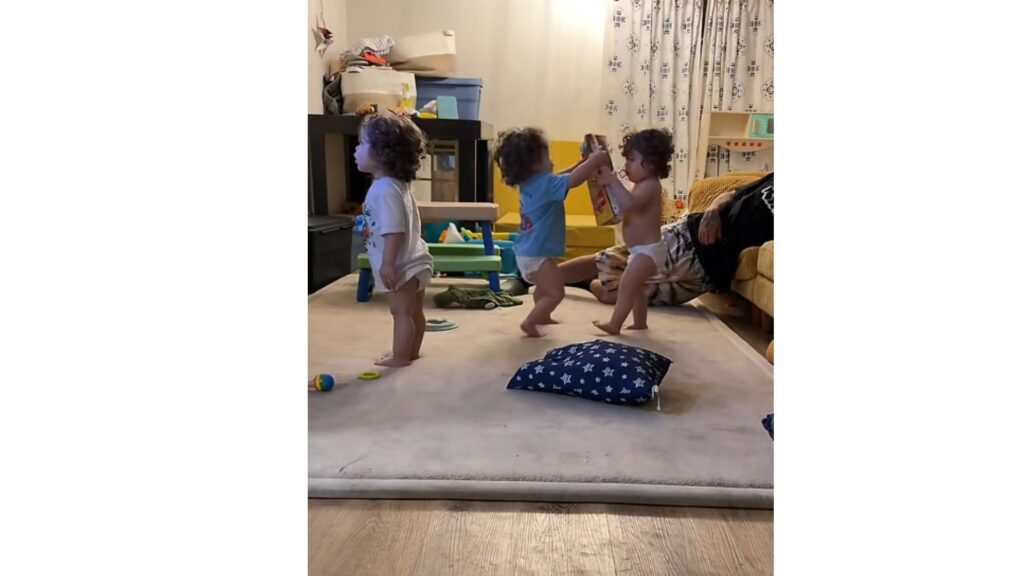
Not even two years old, and @tripletmamasadie’s triplets have already found something worth going to war over: an empty cereal box.
“One thing I didn’t expect to happen so early,” she narrates over the clip, “was seeing how often my triplets would fight over just absolutely random objects.” This particular skirmish starts small. Onyx, in the blue shirt, has the cereal box and is playing with it, mostly unbothered, until he drops it — and doesn’t seem to care. His shirtless brother picks it up instead, and for a moment, nobody’s fighting. Dad even gets in on it, playing with the box alongside the baby who claimed it.
Then it clicks. “It takes him a moment,” she narrates, “but then Onyx realizes, oh my gosh, my brother has my box! Now I’ve got to get it!” What follows is a full triplet production: screaming erupts, a third brother, Hendrix, looks around confused, seemingly wondering what the fight is even about, and Lennox drops to the floor “as if he was just assaulted” over a cardboard box he wasn’t even using thirty seconds earlier. Onyx, victorious, brings the box back to his mom “for safekeeping” — less because he wants to play with it and more because, apparently, if he can’t have it, no one can.
It’s a small, chaotic, thirty-second window into a household running at triple speed, and it’s exactly the kind of scene that makes multiples content resonate so widely — not because it’s dramatic, but because it’s recognizable to any parent who has ever watched two siblings fight over a toy neither of them wanted five minutes earlier.
Why Toddlers Fight Over Things They Don’t Even Want
Child development specialists have a name for exactly what happens in this clip: it’s not really about the cereal box, it’s about possession and attention. Toddlers, especially around age two, are still developing the concept of sharing and often experience another child’s interest in an object as the thing that makes it suddenly valuable — a phenomenon sometimes called the “reverse psychology of toddler toys.” Onyx didn’t want the box until his brother had it; the second it became contested, it became the most important object in the room.
Multiples add a layer most single-child households never experience: three kids at the exact same developmental stage, hitting the exact same possessive instincts, at the exact same time, with no older or younger sibling in the mix to break up the dynamic or model turn-taking. Parents of twins and triplets often describe this as the defining challenge of the toddler years — not sleep or feeding, but simply the sheer volume of simultaneous, identical conflicts that erupt over a single toy, a single seat, or, as here, a single empty box.
The advice most parenting experts give for this exact scenario is less about preventing the conflict — which is nearly impossible at this age — and more about staying calm through it. Narrating what’s happening out loud, the way @tripletmamasadie does in her video, actually mirrors a technique therapists recommend: naming the emotions and the sequence of events helps toddlers eventually learn to do the same for themselves. It also, not coincidentally, makes for a much funnier home video than most parents realize in the moment they’re living through it.
For a set of triplets who aren’t even two, moments like this are less a parenting failure and more a preview of the next several years — a reminder that with three toddlers in the house, patience isn’t a virtue so much as a survival skill, and a sense of humor is non-negotiable.
You can watch the full video and follow @tripletmamasadie on TikTok for more.