

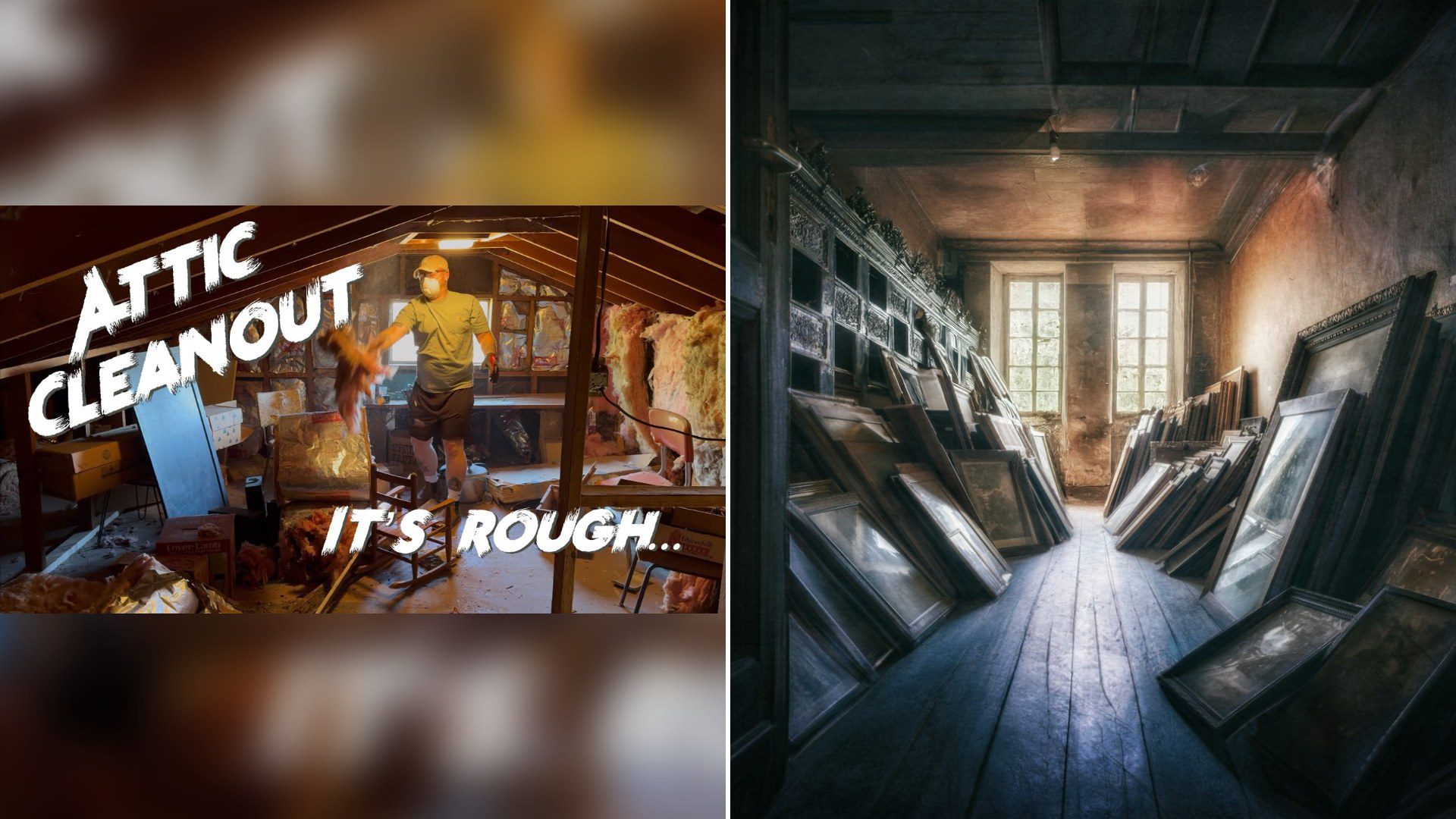
Old attics have a reputation for hiding treasure, but they are just as likely to hide a mess. The host of the channel @visitourgarden says that is exactly what she found when she finally tackled what she calls the creepiest space in her 112 year old farmhouse. She waited for the first cool day after a long stretch of roughly 100 degree heat, put on goggles and gloves and started hauling things out. Her verdict on the haul, in her words, was “So far, no treasure.”


Waiting Out the Heat
She says the weather had been brutal. It had been about 100 degrees, the attic was stuffy and miserable, and she avoided working up there. The day she started, she says, was about 25 degrees cooler than normal, the first cool day in a while. She dressed in cement stained clothes, shorts and boots, with goggles and gloves, and a helper hooked up a dump trailer and brought it to the back door so she could carry items down the stairs and load it.
She joked about the “lavish corridor” leading to what she called the not terrifying attic at all, and said it would be perfect for Halloween. Earlier that morning she had opened a window to air out the smell.
What Was Up There
Her first look around showed a lot of junk. One side held flattened insulation that she says was probably full of droppings and had to go, to be replaced with new insulation. Beyond that she listed a child’s chair, many other chairs, a desk, ceiling panels, particle board, some china, drywall, couch cushions and several beds on what she called the most terrifying side. She also found cold drink taps she could not identify and tiny pieces of real wood baseboard. She decided to keep none of it, and she would not reuse the drywall because she does not trust it.
As she cleared, more turned up. She found a nest, and instead of carrying every piece down the stairs one at a time, she decided to throw items down the staircase. There was an old, poor quality Christmas tree that she said had droppings in it, an antenna and cable she planned to check for power, and a label reading “Manufactured by Douglas Furniture of California.” She noted that it was stuffy and hard to wear a mask. The tightly rolled insulation also had to go, she says, because it was covered in droppings. At one point she remarked that a very large animal had lived up there, and she spotted some sticks and asked aloud whether one of them was a bone, without an answer.
The Cost and the Plans
One run to the dump costs twenty five dollars, she says. She stopped at a home improvement store on the way and wishes she had bought more masks, since the one she was wearing was disgusting by then. She said that once the space is remodeled it could hold holiday decorations for Christmas and Halloween.
Midway through, she took a moment to point out the bones of the old house. She showed the old frame and joists compared with the newer addition, the old roofline and a half wall. She tried to work out where the kitchen and carport sit below. Her plans include raising the kitchen ceiling and vaulting the ceiling in the bedroom and living room, and she says a hole has been cut in the living room to test the idea. She says previous owners insulated only portions of the house and none in the roof.
By the end of the day, friends had shown up and they visited for a couple of hours. She did not want to go back up. What remained was crawling through the far section, clearing the other side and sweeping. She offered a mattress with what she called a terrifying bed frame to anyone interested, calling it the scariest thing she had found on the property so far. She added that the attic was probably 100 degrees that day, and that on a hot day it could reach 115 to 120.
Why the Timing Matters
It is easy to laugh at the heat, but her instinct to wait is sound. Attics can reach dangerous temperatures in summer, and working in them on a hot afternoon invites heat illness. If you have an attic cleanout ahead, try these practical steps:
Start early on a cool day. Aim for the coolest hours, bring plenty of water and take breaks outside, even if it slows you down.
Wear real protection. Goggles and gloves are a start, but dust and droppings call for a properly fitted respirator rated N95 or better. A cloth mask does not filter fine particles well, and buying extra masks is cheap.
Do not sweep dry. Dry sweeping or vacuuming rodent droppings can send particles into the air. Health agencies suggest dampening the area with a disinfectant solution and wiping it up with paper towels instead.
Open a window and bring a light. She did both, and ventilation and good lighting make a dark space safer.
Check wiring before you grab it. She mentioned wondering whether an old cable was live. Treat any wire as live until an electrician tells you otherwise, and keep your feet on solid framing, not insulation or ceiling panels.
Plan your disposal. Know what your landfill or transfer station accepts, and expect fees. Insulation contaminated with droppings is usually bagged and thrown away, not donated.
Sort for salvage before the trailer fills. Real wood trim, solid furniture and brass hardware can have value even in a messy attic, while particle board and old drywall rarely do.
The Real Payoff
Her attic did not contain a trunk of letters or a stash of antiques, at least not in what she showed. Instead she gained a view of how her house was built and what is possible. Once the old insulation is gone and the space is clean, she can see the old framing, the roofline and the place where new ceilings might rise. For anyone with an old home, that may be the better prize. A cleared attic is storage you can use, a safer house and a clear look at the structure before you pay a contractor to guess. As for treasure, she says it did not turn up, but a farmhouse that is more than a hundred years old has plenty of corners left to explore.