

A five dollar vase should be the easiest purchase in the world. For @kate.thrifts.tn, it turned into a standoff at the register, a quiet detour to the back of the building and a confrontation in the parking lot. She shared the story on social media and asked a simple question: was she in the wrong?

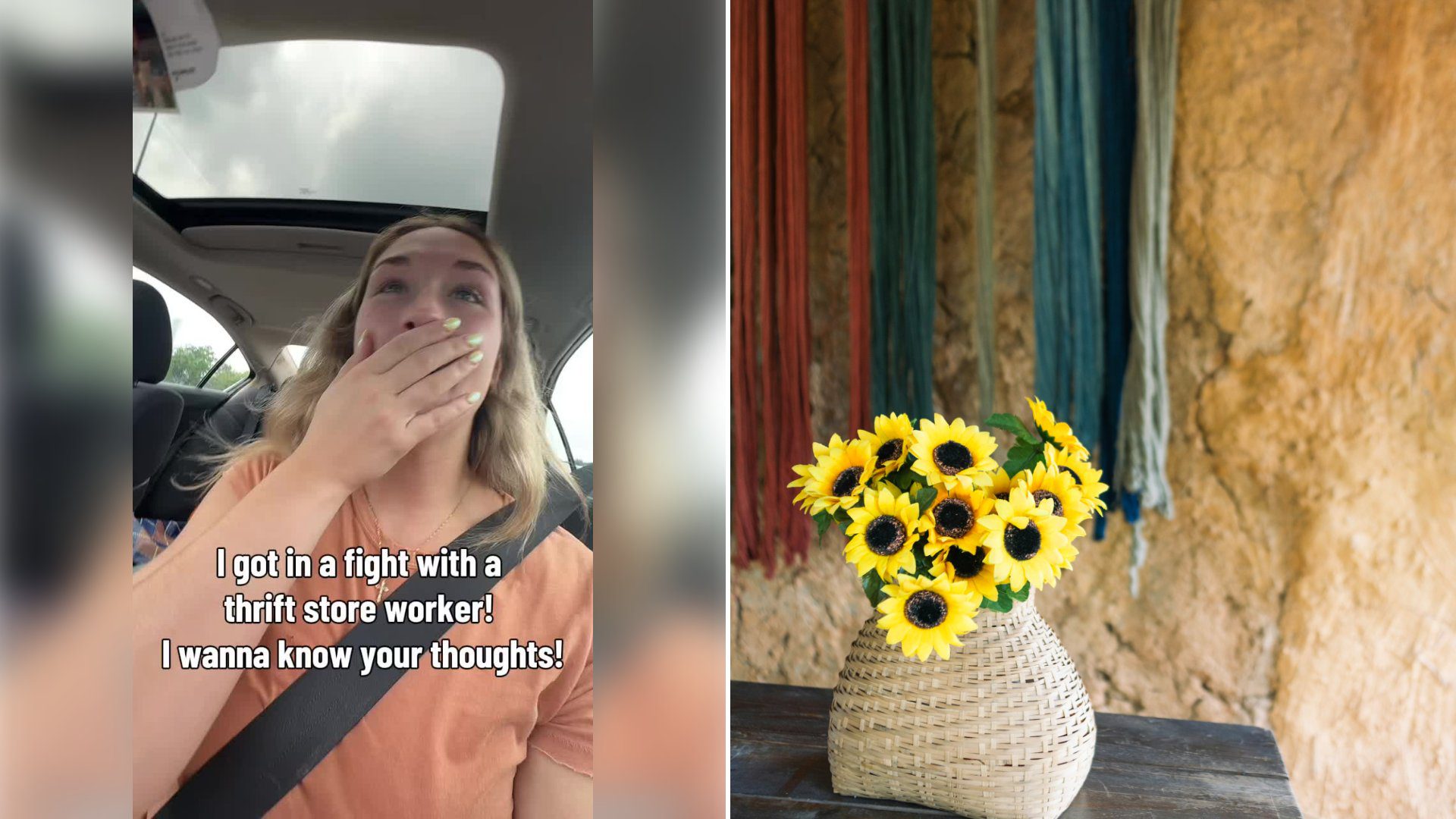
@kate.thrifts.tn
Buying the vase and finding the reeds
She says it started at a thrift store she loves and chose not to name. A wicker rattan vase was marked at a really good price, and she wanted it right away. Inside the vase sat a bunch of reeds, purple and gold pampas grass, which she describes as not her style. She only wanted the vase.
At the counter, she says, the worker did not say hello. She asked whether the store would sell the reeds on their own, or whether she could simply leave them behind as a donation. According to her, the answer was no, because there was nowhere in the store to put them.
That answer surprised her. She points out that the store is huge, so she offered an easy fix: wrap a rubber band around the stems and set the bundle on a shelf. She says the worker repeated that the store was not going to sell them. She then said she would donate them to a different thrift store instead, and she left with her vase.
The detour to the donation door
By her own account, the more she thought about it on the way out, the more ridiculous it seemed. So she walked around to the back donation door and handed the reeds over there. She says the woman accepting donations was super sweet and thanked her.
It is a small moment, but it is the heart of the story. In her telling, the reeds were in perfect condition, and the donation worker was glad to have them. Her phrase for it is the old saying that one person’s trash is another person’s treasure.
The parking lot confrontation
She says she was walking back to her car when the worker from the register ran out of the store. The worker, she says, told her she had been told the store would not sell those reeds and that she had gone behind her back to bring them to the donation center.
She says she answered, “Yes ma’am,” and added that she would not apologize for donating to a thrift store whose proceeds go to Make-A-Wish or some other charity. That detail is her own understanding, and she was careful to say she was not certain which charity it was, so it is worth treating as unconfirmed.
She says the worker then called her rude, disrespectful and malicious. She replied that the conversation was not worth her time and that she had only come in to buy a five dollar vase. She got in her car and drove away.
Her own second thoughts
What makes the story interesting is that she does not present herself as a winner. In her caption, she wonders whether it was rude of her and admits she feels a little bad now. She also offers a kinder guess about the other side: she thinks the worker may simply have been having a bad day.
At the same time, she says she will stand by her choice and calls it a hill she is willing to die on. It is a candid mix of confidence and doubt, which is part of what makes the story easy to relate to. This is one shopper’s account, and the worker’s side was not shared, so there is no way to know what was going on behind the counter.
Why stores sometimes refuse items
Without knowing anything about this particular store, it helps to understand why a thrift shop might turn down an item at the counter. Many stores have strict rules about what gets priced and put on the floor. Some items go through a sorting area first. Others are not accepted at all because of space, safety or staffing limits. Pricing and displaying a loose bundle of decorative stems can seem small, but a busy store may have a set process for everything that reaches the shelves.
Donation intake is also usually a separate operation from the register. The person at the front counter may not have any say over what the donation door accepts, and the reverse is true as well. That gap is probably why a single item could get two different answers in a single visit. Policies differ from one store to the next, so it is always worth asking what a location will take.
Tips for the next awkward thrift moment
If you ever find yourself in a similar spot, a few habits can keep things calm.
Ask early. If something comes bundled inside an item you want, such as flowers in a vase or books in a basket, ask at the register what the store prefers you do with the extras. A friendly question before you pay can head off confusion.
Keep it light. Staff members often handle long shifts, tight rules and busy lines. A pleasant tone costs nothing and often gets a better outcome than a debate at the counter.
Know the donation process. Most thrift stores list their accepted items and their drop off hours. If a store will not take something back, a different shop or a local charity may be glad to have it.
Do not take it personally. A short answer at the register is not always a judgment about you. Sometimes it is simply a rule, a long day or both.
Decor leftovers and where they can go
Dried pampas grass and similar decor can be a surprising hit with other shoppers. Home decorators, wedding crafters and teachers often look for dried stems at low prices. If you end up with decorative extras that do not suit your style, you have options beyond the trash can. You can offer them to a neighbor, post them to a local community group, pass them along to a classroom, or drop them at a donation center that accepts home decor.
There is also a quiet decluttering lesson here. She wanted the vase, not the reeds, and she chose to move the extras along to someone who might use them instead of keeping them out of habit. Letting go of things you do not love, in a way that helps another person, is one of the easiest and kindest ways to keep a home simple.
What do you think?
She asked for opinions, and a story like this can easily split people. Some will say she should have accepted the first answer and let it go. Others will say that donating a bundle of perfectly good reeds is exactly what a thrift store is for. Either way, the takeaway is gentle: ask questions early, stay polite, and remember that a five dollar vase is never worth a fight in the parking lot.