


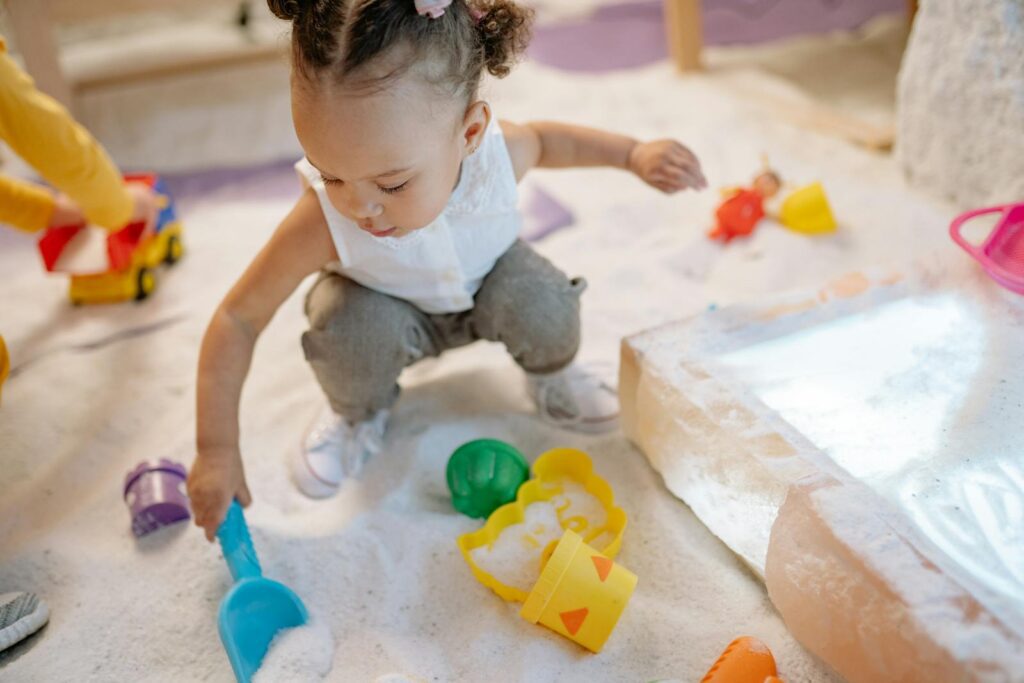
She had practiced the word dozens of times at home. Her mother would pretend to grab a toy, and the 4-year-old would plant her feet, stick out a palm, and shout “STOP!” It worked every time in the living room. Then, at a playground playdate, another child snatched her bucket and kept digging. The girl yelled “stop” exactly the way she had rehearsed. The other child did not even look up. Within seconds, she was sobbing in her mother’s arms, and the script that had felt so empowering at home lay in pieces on the sand.
Scenes like this one play out constantly among families with preschoolers. Parents invest real effort in teaching assertive language, only to watch it crumble the first time a peer refuses to cooperate. The frustration is understandable. But the breakdown is not a sign that the child failed or that the strategy was wrong. It is a sign that verbal boundary tools, on their own, are not enough for a 4-year-old. They need adult backup, emotional coaching, and expectations calibrated to what a small child’s brain can actually handle under pressure.
Why “use your words” hits a developmental wall


The advice to teach children phrases like “stop,” “no,” and “I don’t like that” is everywhere in parenting circles, and it is not bad advice. The problem is that it is incomplete. A preschooler who memorizes a script in a calm moment at home is drawing on a completely different set of brain resources than the one who has to deploy that script while flooded with frustration, surprise, or fear.
Research on executive function development helps explain why. The prefrontal cortex, the region responsible for impulse control, flexible thinking, and emotional regulation, is one of the slowest parts of the brain to mature. A framework from Harvard’s Center on the Developing Child describes executive function skills as emerging gradually throughout childhood, with the preschool years representing a period of rapid but uneven growth. A 4-year-old may be able to state a boundary during a calm role-play but lose access to that skill entirely when stress hormones spike during a real conflict.
This does not mean parents should stop teaching assertive language. It means they should expect the words to fail sometimes and have a plan for what happens next. The child also needs to know she can walk away, seek an adult, or simply leave the situation, not just rely on a single phrase to change another person’s behavior.
Why the tears come so fast
When the little girl’s “stop” was ignored, her tears were not manipulation or drama. They were her nervous system doing exactly what it is designed to do when a young child hits the wall of her coping capacity.
Psychologists who study emotional regulation in early childhood describe crying as a discharge response, the body’s way of releasing arousal it cannot process through higher-order thinking. According to guidance from Children’s Hospital of Philadelphia’s Executive Function (EXCEL) Clinic, young children who cry frequently or intensely are often struggling with underdeveloped self-regulation skills rather than being willfully difficult. The clinic advises parents to validate the child’s feelings while redirecting behavior toward a goal, rather than punishing or ignoring the tears themselves.
For the child in the playground scenario, the emotional math was straightforward: she did what the adults told her to do, it did not work, and she had no backup plan. The gap between “I followed the rules” and “nothing changed” was more than her 4-year-old brain could bridge without help. The tears were the only tool she had left.
What a “strong voice” actually looks like
Many parents respond to a child’s ignored “stop” by shouting at the other child or, just as often, by telling their own child to calm down. Neither response addresses the real need, which is for a confident adult to step in and physically help.
Janet Lansbury, a respected parenting educator and author of No Bad Kids: Toddler Discipline Without Shame, draws a clear distinction between yelling and using what she calls a “strong voice.” In her writing on children’s aggressive responses to limits, Lansbury urges parents to move toward the conflict rather than shout from across the room. That means stepping in physically, placing a calm hand between the children, and narrating what is happening: “I heard you say stop. He didn’t listen, so I’m going to help you move away.”
Lansbury also notes that children can sense when a parent is tentative about enforcing a boundary. If the adult hesitates or seems unsure, the child receives an unspoken message that the boundary is negotiable. For the mother in the “stop” story, the missing piece was not a better script for her daughter. It was her own readiness to act the moment the script was ignored.
Teaching boundaries without shutting down feelings
The instinct to tell a sobbing child “stop crying” runs deep, especially for adults who grew up hearing some version of “I’ll give you something to cry about.” But decades of research on emotional development have made clear that suppressing a child’s distress at the moment she is most overwhelmed does not teach resilience. It teaches her that her feelings are a problem.
The CHOP EXCEL Clinic’s guidance on frequent crying offers a more effective framework: validate the feeling, then redirect toward action. In practice, that might sound like: “You’re really upset that he didn’t stop. I’m right here. Let’s go to the swings.” The child’s attempt at assertiveness is affirmed, her tears are allowed to exist, and the adult takes responsibility for safety and next steps.
This approach threads a needle that many parents find difficult. It does not reward the crying by giving the child whatever she wanted in the conflict. But it also does not punish her for having a feeling she could not control. Over time, children who experience this kind of co-regulation build the internal wiring to manage bigger emotions on their own.
What parents can realistically expect at this age
It helps to know what is normal. Four-year-olds are in the middle of an enormous developmental leap. They are experimenting with social power, testing language, and learning where the edges of relationships are. A child who screams “I hate you!” after being told no, or who hits a sibling when frustrated, is not on a path to becoming a bully. She is running experiments, and according to educators at Chance School, these outbursts are “almost instinctual and part of normal growth and development.” Adults should think of them as tests: What can I say? What happens when I say it? Will you still love me?
A 4-year-old who cries when “stop” fails is running a version of the same test: Does the adult still protect me when my words don’t work? Is it safe to show how upset I am? The answer to both questions needs to be yes, delivered not just in words but in action.
A realistic plan for the next playground conflict
For parents who have been teaching “stop” and watching it fall apart, here is a framework grounded in what developmental science says preschoolers can actually do:
- Keep teaching the word, but add a second step. “If you say stop and they don’t listen, come find me. That’s your job. My job is to help.” This gives the child an action plan that does not depend on the other child’s cooperation.
- Stay close enough to intervene. Four-year-olds need adult proximity during peer play. This is not helicopter parenting. It is developmentally appropriate supervision.
- Step in with your body, not just your voice. Move toward the children. Get low. Place yourself between them if needed. Narrate calmly: “I see what happened. Let’s figure this out.”
- Validate before you redirect. “You said stop and he kept going. That’s really frustrating.” Then: “Let’s take a break over here.”
- Debrief later, briefly. On the car ride home or at bedtime: “Remember when you said stop and it didn’t work? You did the right thing. Sometimes people don’t listen, and that’s when grown-ups help. You can always come get me.”
None of this guarantees a tear-free playground visit. But it shifts the burden off a small child’s shoulders and onto the adult’s, which is where it belongs when the child is four.
More from Decluttering Mom: