


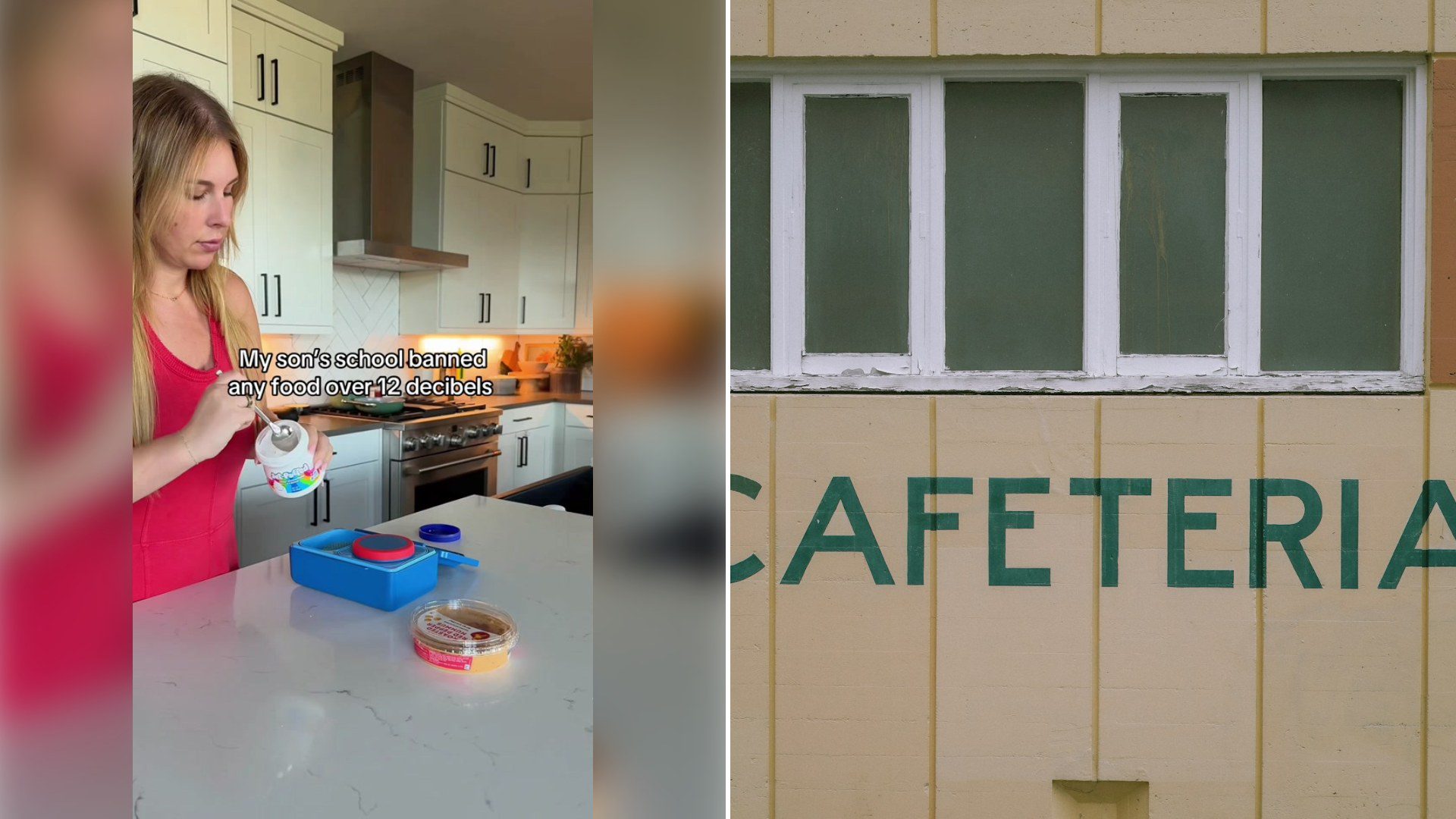
Packing a school lunch already comes with a list of rules, and one mom has imagined what happens when a school adds volume to that list. In a video filmed at her kitchen counter, the creator behind @goodbyetwenties stands over an open lunch box while text on the screen reads, “My son’s school banned any food over 12 decibels.”
She delivers the whole thing with a straight face, but the caption gives the game away. It reads “Silent lunch requirements?” and is tagged with the word satire, next to tags for elementary school and kids’ lunch. No school has sent her a sound meter. The video is a joke about how complicated lunch packing rules can feel, and it is built so carefully that it is worth walking through.
“My son’s school recently implemented a new policy that says that no food in student lunch boxes can be over 12 decibels,” she says at the start. Then comes the detail that sells it. “They even sent home a little device for us to practice with the foods that we’re planning on sending to make sure that it meets those requirements.”
The opening shots show her doing exactly that. She scoops a soft spread into a blue silicone cup. She holds a small black gadget beside her mouth while she eats a spoonful of something creamy, then holds it up again as she goes in for a bite of a red apple. After that she lifts a printed letter toward the camera, a full page of text with a table in the middle.
“There’s this letter that got sent to us, and I’m gonna read you part of it,” she says, sitting down with the page in one hand and the gadget in the other. “This is the device that they sent us to practice with.” A picture flashes on screen of an empty cafeteria beside a red and white sign that says “SILENT LUNCH.”
The letter, as she reads it, is written in the careful language of a real school notice. It describes the rule as “part of our ongoing effort to create a calm, focused, and respectful lunchtime environment.” The program has a name, which appears on screen as “Decibel Awareness Lunch Initiative,” and an acronym to go with it, DALI. Students, she says, are supposed to practice at home.
Then she gets to the list. “They gave this list of decibels of common foods,” she says, before running through what is out. There are “no apples, no chips, no popcorn,” she reads, and no crunchy crusted sandwiches, pretzels, granola bars or celery either. “Their official target is 12 decibels, which is whisper level.”
The letter even comes with homework. She points to “a chart here for us to go through and log some foods that fall within range,” then closes with the same deadpan she started with. “This is a new thing for our school,” she says. “I don’t know if anybody else has heard of this, but this is really interesting.”
The joke lands because every piece of it sounds like something that could arrive in a backpack. There is an official sounding initiative, an acronym, a list of banned foods, a target number and a log sheet for parents to fill out. The only thing that marks it as fiction is the tag in the caption, which is easy to miss when a video gets passed around without it.
That is the first useful thing to take from it. Before a surprising school rule gets forwarded to the class group chat, check the caption and the tags on the original post. Here the word satire is sitting right there. A rule that arrives with a gadget, a catchy acronym and a very precise number deserves a second look before anyone starts repacking lunches.
The second is what to do when a real letter comes home. Read the whole page instead of the first line, the way she does on camera. Look for the specifics, meaning what is not allowed, when it starts and what the school wants families to do at home. If something is unclear, a short message to the teacher or the front office settles it faster than guessing. Then keep the letter where the lunches get packed, so the list is in front of whoever is packing in the morning.
Third, the banned list in the video doubles as a snapshot of how a lot of lunch boxes look. Apples, chips, popcorn, pretzels, granola bars and celery are the easy grabs, which is why they make the joke work. If your own rotation is the same handful of things, the soft foods she tests on camera point to simple swaps, such as a spread or dip portioned into a small reusable cup or something creamy eaten with a spoon. None of it needs to pass a sound test. It just gives kids some variety and gives you more than one way to fill the box.
Her setup is worth copying too. She packs at a clear counter with the lunch box open, the containers out and the food portioned into a silicone cup that keeps a wet food from touching everything else. A small set of those cups, kept in one drawer with the lunch boxes, cuts down on the morning hunt for lids and bags.
The idea of a practice run at home is the one part of the fake policy that holds up. Letting a child try a new lunch food on a weekend, open the containers without help and eat it at the table shows you fast whether it will come home untouched. No device required.
She ends by wondering whether anybody else has heard of a rule like this. Going by her own caption, nobody has, and that is the point.
More from Decluttering Mom
- Mother of Nine Packs Breakfast for Lunch With Apple Shaped Waffles and Sausage in Heated Lunch Boxes, Then Adds Apple Juice, Applesauce, Apple Chips and an Apple Muffin
- Why She Packs Her Daughter’s Lunch This Specific Way, Explained
- Sunday Food Prep Does Not Have to Take All Day to Make School Lunches Easier All Week