


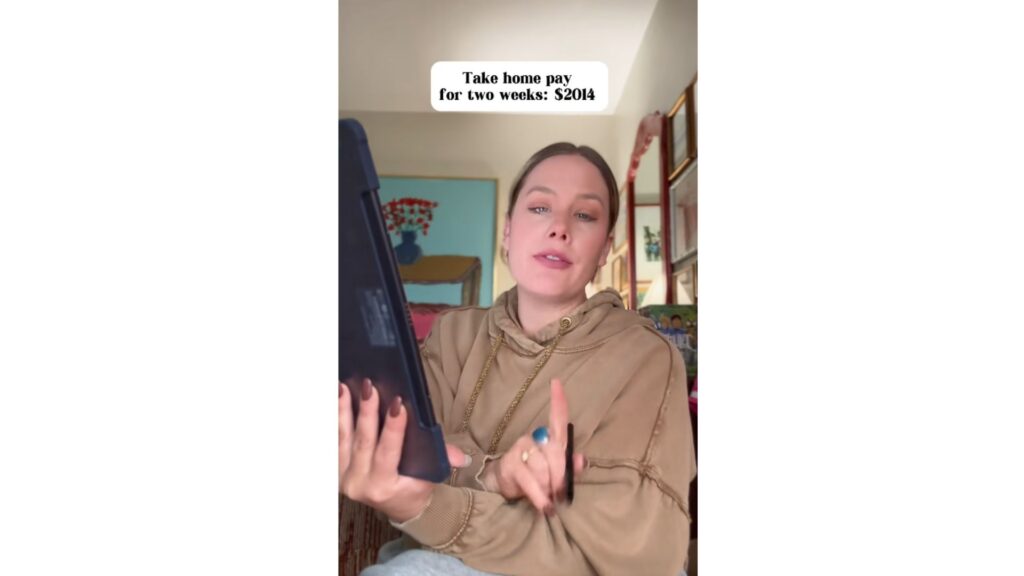
Lauren Williams teaches full time and is raising three children on her own, and in a video posted to TikTok as @lauren_in_louisville, she lays out exactly why her paycheck doesn’t stretch far enough. By her own breakdown, her monthly pay leaves her $2,150 short of covering her household’s expenses.
In her video, Williams walks through her monthly numbers category by category: take-home teacher pay on one side, and rent, childcare, groceries, utilities and other fixed costs of raising three kids alone on the other. When she adds it all up, she says the gap comes to $2,150 a month — money she has to make up somewhere else just to keep the household running.
It’s worth being precise about what Williams’s video actually shows: a self-reported budget breakdown from one teacher in one district, not a claim about teacher pay nationally. Salaries for teachers vary widely by state, district and years of experience, and take-home pay depends heavily on factors like health insurance premiums, retirement contributions and local tax rates that differ from one paycheck to the next. Williams’s $2,150 figure describes her own household’s gap between gross salary expectations and what actually lands in her account after those deductions, not a universal number every teacher would recognize.
That distinction matters because budget-breakdown videos like this one tend to spark exactly the kind of comparison that can blur self-reported numbers into broader claims. Williams’s video draws a distinction between her gross salary and her actual take-home pay, and she walks through specific expense categories rather than offering a single vague complaint about being underpaid — a level of detail that has made the video resonate with other single parents and educators trying to make similar math work.
Single parents working full-time jobs with a fixed salary face a particular version of this squeeze: unlike a two-income household, there’s no second paycheck to absorb a shortfall, and unlike hourly or commission-based work, there’s little room to simply work more hours to close the gap. Teaching in particular comes with a salary schedule set by a district or state, meaning a teacher in Williams’s position generally can’t negotiate a raise the way an employee in a different field might. That structural rigidity is part of what her video highlights: the shortfall isn’t from overspending, according to her breakdown, but from a fixed income that doesn’t match fixed costs.
Williams’s video also touches on the reality that many teachers already work second jobs, tutor on the side, or rely on family support to close gaps like the one she describes — context that frames her $2,150 figure not as an unusual crisis specific to her household, but as one concrete example of a pattern many educators recognize in their own finances. The specificity of her numbers is what separates the video from a general complaint: viewers can see exactly which categories are driving the shortfall rather than being asked to take a vague hardship claim at face value.
Because the figures in Williams’s video are self-reported, categories like rent or childcare costs reflect her own household’s specific circumstances — her city, her children’s ages, her particular living situation — rather than fixed benchmarks anyone else could expect to match exactly. A teacher with grown children, a paid-off home or a lower-cost region would likely see a very different gap, even on a comparable salary. That’s part of why Williams’s video works best as an illustration of the pressures many single-income teaching households face, rather than a precise formula for what any given teacher’s finances look like.
The Takeaway
Budget breakdowns like this one are useful precisely because they get specific — gross pay versus take-home pay, and a clear list of what’s actually consuming the paycheck, rather than a vague sense that money is tight. If you’re trying to understand your own gap between salary and actual costs, start by separating fixed expenses (rent, insurance, minimum debt payments) from flexible ones, since that’s usually where any real room to adjust exists. For single parents in particular, it’s worth researching whether local or district-level support programs, from subsidized childcare to teacher-specific assistance funds, apply to your situation, since many go underused simply because people don’t know they exist. And for anyone comparing their own numbers to someone else’s viral budget video, remember that categories like rent, childcare and insurance premiums vary enormously by location and life stage — a gap that looks alarming in one context can look completely different in another.