


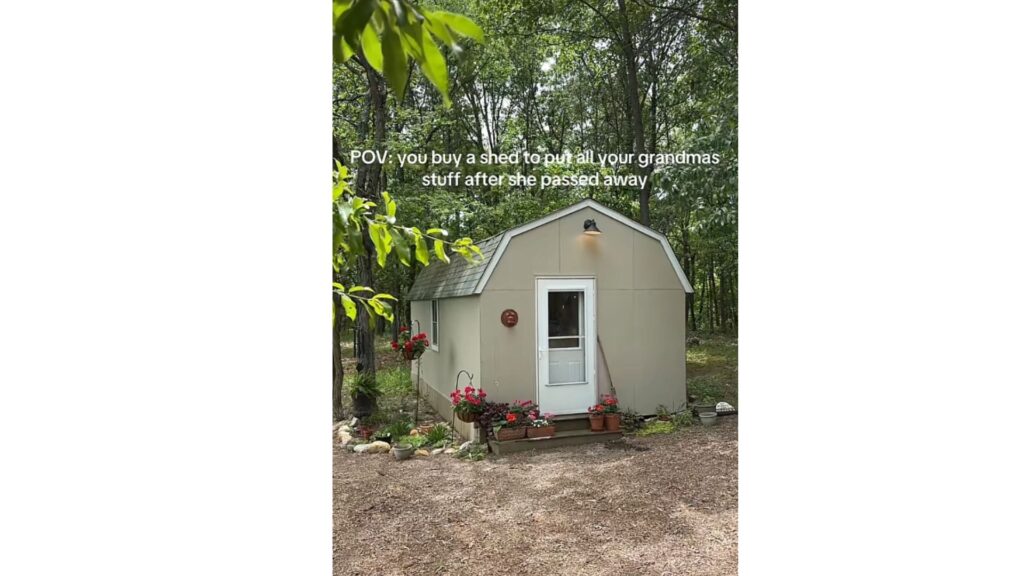
When Hudson Waters lost his grandmother, he didn’t just keep her memory in photographs and stories, he built her a space. Waters documented the creation of his backyard “nana cave,” a small structure dedicated to preserving their favorite memories together, on TikTok as @itshudsonwaters, where the video has reached 2.5 million views.
In the video, Waters walks through the transformation of a small backyard structure into a personalized memorial space, filled with details tied specifically to his relationship with his grandmother, the kind of items and touches that would mean little to an outsider but carry real weight for someone who shared that particular bond. He uses the term “nana cave” throughout, and this piece keeps that same terminology rather than substituting a more generic label, since it’s the family’s own name for the space and part of what makes the tribute feel personal rather than performative.
Grief projects like this one occupy a specific, meaningful corner of family content online: rather than a purely sentimental tribute confined to words or photos, Waters channeled his grief into something physical and lasting, a space he can return to. That impulse, to build something tangible in memory of someone gone, is one a lot of viewers recognize even if the specific form it takes, a backyard structure, ca dedicated room, a garden, looks different from one family to the next.
The scale of the response, 2.5 million views, suggests the video tapped into something many people carry with them: an unresolved instinct to do something concrete with grief rather than simply sit with it. Watching someone else act on that instinct, turning loss into a dedicated, lovingly built space, appears to have given a lot of viewers a kind of permission or inspiration to consider something similar for their own losses.
What comes through in the video isn’t sadness alone but a kind of ongoing relationship with a memory, kept alive through a physical space rather than left to fade. That framing, treating grief as something you can build around rather than simply endure, is likely a big part of why the project resonated as widely as it did.
The Takeaway
Grief doesn’t always need to be processed through words alone, sometimes building something physical, a dedicated space, a scrapbook, a small structure filled with meaningful details, gives a loss somewhere concrete to live rather than leaving it to surface unpredictably. If a project like Hudson’s resonates with you, it doesn’t need to be elaborate to matter; even a single shelf or corner filled with items tied to someone you’ve lost can serve the same purpose. What matters most is that the space reflects your own specific relationship with that person, not a generic idea of how memorial tributes are supposed to look.