


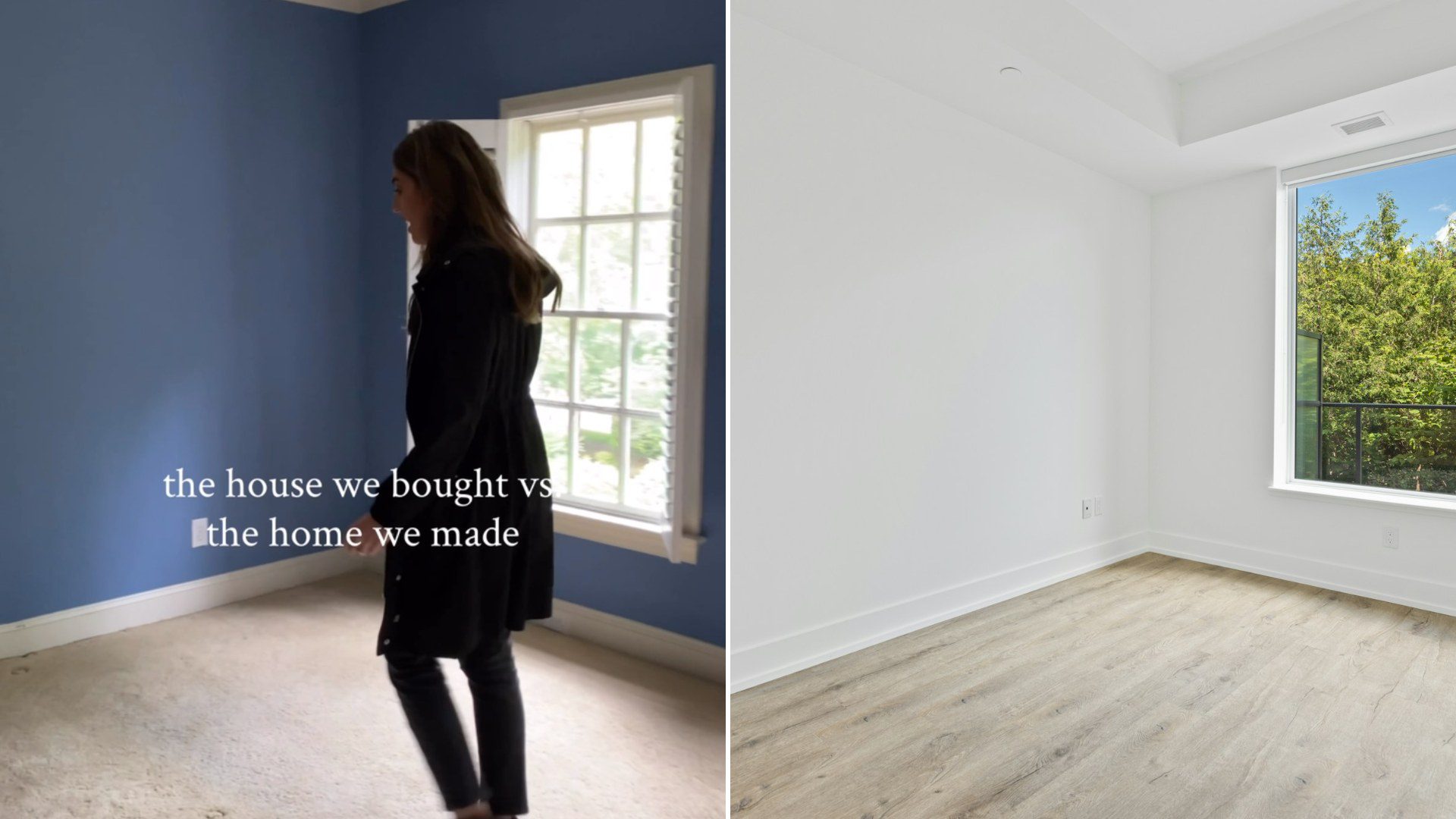
There’s something uniquely compelling about watching a house transform from a dated, overlooked property into a fully realized dream home, and creator @chrislovesjulia delivers exactly that in a reel tracing her house’s journey from the day she first walked through it to its final, renovated state. Her caption captures the emotional core of every renovation story: “We still remember walking through this house for the first time and seeing all the potential hiding,” a sentiment that speaks to the particular vision required to look past outdated finishes and awkward layouts and imagine what a space could eventually become.
Full home renovation content occupies a special place in the home improvement genre because it compresses what is often a years-long, physically and emotionally exhausting process into a few minutes, or even a few seconds, of satisfying visual transformation. For anyone who has lived through a renovation themselves, these videos carry an added layer of appreciation, a recognition of just how much dust, decision fatigue, and budget negotiation sits behind every carefully styled final shot, even when the final reel makes the whole thing look effortless.
The specific phrase “seeing all the potential hiding” touches on a skill that isn’t evenly distributed among homebuyers: the ability to look past surface-level flaws, dated wallpaper, awkward room flow, worn carpet, and recognize the underlying bones of a house that could become something special with the right vision and investment. Real estate markets reward this skill handsomely, since homes with obvious cosmetic issues but solid structural fundamentals often sell for considerably less than their move-in-ready counterparts, leaving real financial upside for buyers willing to do the work of seeing past the surface.
This kind of renovation journey also reflects a broader shift in how many homeowners approach buying a house in the current market. With housing inventory and affordability remaining persistent challenges in many areas, more buyers are choosing to purchase homes that need work rather than waiting indefinitely for a perfect, move-in-ready option within their budget. That shift has fueled enormous growth in renovation content specifically, as buyers increasingly look to creators like @chrislovesjulia not just for inspiration, but for genuine, practical guidance on tackling their own fixer-upper.
There’s also an emotional dimension to full-house transformation content that distinguishes it from smaller, single-room makeovers. A whole-house renovation typically represents years of a family’s life, holidays spent amid construction dust, children growing up through multiple phases of an evolving home, major financial decisions and compromises made along the way. Capturing that full arc, from the first walkthrough to the finished product, tells a more complete story than any single before-and-after room reveal could, which is part of why these longer-format renovation journeys tend to build such devoted, invested audiences.
For viewers currently sitting in their own dated, unrenovated homes, content like this offers something genuinely valuable beyond entertainment: proof that the vision required to transform a space isn’t some rare, innate gift, but a skill that develops through research, patience, and a willingness to live through temporary chaos in service of a long-term goal. Watching someone else’s completed transformation can reframe a homeowner’s own overwhelming to-do list from an insurmountable burden into a series of achievable, sequential projects.
It’s also worth acknowledging how much renovation content has shaped consumer expectations and design trends more broadly. Popular renovation creators and shows have driven measurable shifts in what buyers look for and prioritize, open floor plans, specific cabinet colors, particular flooring choices, often based directly on trends popularized by exactly this kind of before-and-after content. That influence runs in both directions: creators respond to what audiences find compelling, and audiences, in turn, absorb new ideas about what their own homes could become.
There’s also a financial literacy angle worth noting for families following along with renovation journeys like this one. Watching a project unfold, even in a condensed highlight reel, offers glimpses into the real decision-making involved: which upgrades deliver the most visual impact for the investment, which structural issues can’t be skipped even though they’re invisible in the final product, and how a family prioritizes a limited renovation budget across competing needs. That kind of transparency, even when implicit rather than explicitly spelled out, provides real value to anyone planning their own future renovation.
Ultimately, what makes this kind of content so enduringly popular isn’t just the glossy final reveal, it’s the honesty embedded in that opening line about walking through a house and seeing potential hiding beneath the surface. It’s a reminder that every beautifully renovated home started out looking like somebody else’s problem, and that the gap between those two states is bridged not by magic, but by vision, patience, and a willingness to do the work.