

A cardboard box taped shut on July 1st, 1992, has finally been opened, and what came out of it is a small slice of American shopping history. Thrift and estate sale host @red.car.crew returned to a house the crew refers to as Pearl’s, picked up a catalog-order box that had never been opened in all those years, and cut it open on camera.

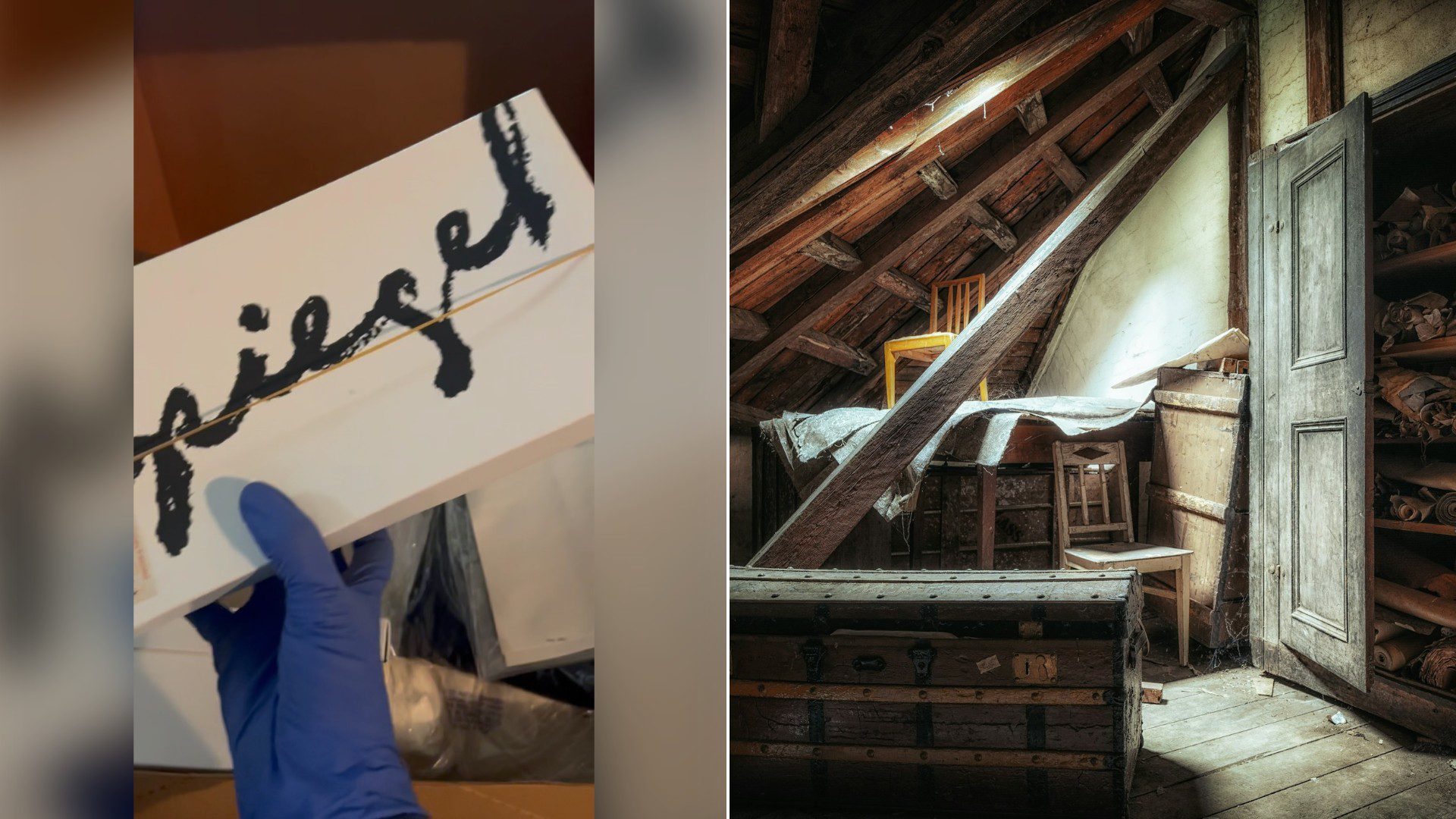
“You see that date? July 1st, 1992,” the host says as the box comes into view. It is a Spiegel box, the second from that company the crew has opened, and it had never been touched since it arrived at the house. The host jokes that on that very day in 1992 she was at a summer camp in Sharon, Connecticut, calling her parents collect every day from a payphone attached to the back of a tree.
Inside, the first layer was a stack of new old stock Levi’s 505 jeans, still in the condition they left the warehouse. The host points out the size, 34 by 30, and says she counted about 12 units in the one box. The crew found four pairs of new old stock Levi’s from 1992 in that first reveal alone, and she says 34 by 30 is a “normal person size” that the average shopper wears.
How The Catalog Habit Worked
The host explains that the house tells a clear story. From what she can gather, Pearl’s catalog ordering began somewhere around 1988. The crew found close to 3,000 catalogs in the house, which she stresses is no exaggeration.
The routine was always the same, according to the host. A catalog would arrive in the mail, and the pages would get folded over for items that caught Pearl’s eye. She would then write notes all over the front of the catalog about who each item would be bought for. The order would be placed, the box would arrive, and then the box would stay closed. “That’s the part that gets me,” the host says. Pearl would simply put each new box in a corner and never open it.
The host says the buying intensified somewhere around 2004 and 2005. She estimates the house holds between a thousand and possibly two thousand unopened boxes, and they are not all from Spiegel. They come from all over, including L.L.Bean and J.C. Penney, which she describes as a store that was in there “forever.”
Reading The Paperwork On The Box
One of the most fun parts of the opening is the packing paperwork. The host holds up the sheet and walks viewers through it. On the left is the description of the item. Next to it is the SKU number from Spiegel, then the color, the size, the number of units, and the actual price Pearl paid.
That last column is where the price tag jumps out. The host reads the total as $112 and remarks that it was a lot of money for 1992. For a box of 12 pairs of jeans the per-pair cost is modest, but the host’s point is that the amount of money tied up in a house full of boxes like this one adds up fast.
Because every order came with its own paperwork, each unopened box doubles as a dated receipt of a purchase, showing what was sold, in what size, and at what price, in a particular year.
A Time Capsule, Not Just An Estate
The host does not treat the project as just another cleanout. “This isn’t just an estate. It’s a time capsule,” she says, calling it a record of life, a particular moment in retail history and a woman’s relationship with the things she collected. In her words, every box has a story, and the crew is only beginning to uncover them.
She also says the project has been heavy on her personally. “It’s definitely taken an emotional toll,” she says. She describes the house as charming and the inventory as extraordinary, and says the curiosity around the project is going to be enormous.
Yes, There Will Be An Estate Sale
For anyone wondering if they can shop the collection, the answer from the host is a firm yes. There is going to be an estate sale. How she will manage it is still taking shape, and she says she has thought a lot about how to do it.
Her crew’s events are getting busier and busier, and she says she is grateful for that and never wants to take the support for granted. But this house is different, and she says she does not want chaos. What she wants is for everyone to have a nice, pleasurable “Pearl experience.” Timing and details are still to come.
What Vintage Shoppers Can Take From It
New old stock is a phrase worth knowing if you shop estate sales and resale sites. It means an item that was made years ago but never sold to a customer or worn. Items in that condition, from jeans to sweaters, often draw more interest from collectors than worn pieces from the same era, because the fabric, tags and packaging are all original.
- Check the original paperwork. Packing slips, order forms and price tags help document the year, size and price of a piece.
- Look at the size. Common sizes like a 34 by 30 are easier to resell than very small or very large cuts, which is the host’s own observation.
- Keep items sealed until you are ready to sell or photograph them, since opened packaging can change how a buyer sees the condition.
- Pick the right moment. Large estate inventories take time to sort and price, so expect the sale to be planned carefully.
Catalog shopping was once the main way many Americans bought clothes and household goods, and a catalog house like Spiegel was a household name for decades. Opening a box from 1992 gives shoppers a real look at what a pair of jeans cost, what a size 34 by 30 meant, and what a family was spending on catalog orders before online shopping took over.
For now, the host’s message to her followers is simple: she is back at Pearl’s house, there are more boxes waiting, and she plans to open them with her audience as the work goes on.
More Stories You May Like
- Mom Of Two Who Got Rid Of Half Of Her Family’s Belongings Says Most People Wear Just 20% Of Their Clothes 80% Of The Time
- Someone Over 60 Who Lives Alone Took Twelve Things Out Of Their Home After Their Knees And Back Paid For Every Fluffed Pillow And Dusted Shelf
- Garage Sale Run From A Driveway Had About 25 Cars Waiting Before The Nine AM Opening And Was Still Packed Late In The Afternoon