


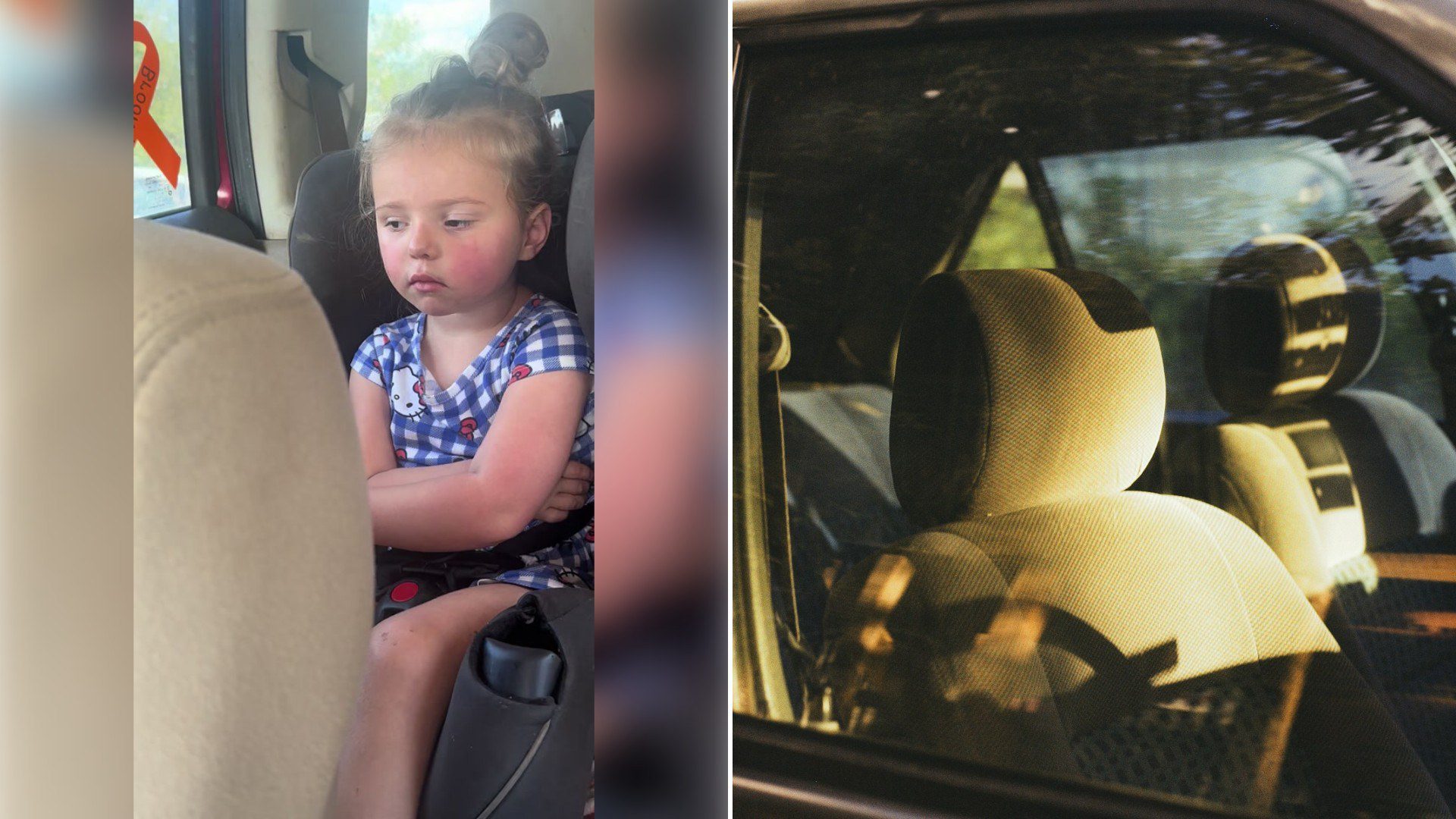
A creator posting under the handle ayer1721_b.a.t_designs captured her toddler daughter sitting in her car seat, arms fully crossed, delivering a look of pure defiance while flatly refusing to comply with a clear, firm instruction to buckle in properly.
@ayer1721_b.a.t_designs The side eye queen 🫣🫣🤣#sideeye #toddler #sassy #iflookscouldkill #mycarboncopy
The caption plays up the attitude on display, and it’s easy to see why — the expression alone tells the whole story without needing much explanation. It’s a real, candid standoff rather than a scripted bit, the kind of moment that happens dozens of times a week in households with a toddler who has recently discovered the power of a firm “no.”
This stage of toddlerhood, where a kid tests boundaries with increasingly theatrical body language, is developmentally normal and, for most parents, exhausting in the moment and pretty funny in hindsight. The crossed arms and side-eye aren’t really about the car seat itself so much as a broader push for some sense of control.
Parents navigating a similar standoff might not get a resolution as quick as they’d like, but there’s some comfort in knowing the theatrics, however convincing in the moment, are a normal part of this particular developmental stage rather than a sign of anything going wrong.
There’s a particular skill involved in delivering a side-eye with this much conviction, and toddlers seem to arrive at it almost overnight. One week a kid’s facial expressions are mostly limited to happy, sad, and confused; the next, they’ve apparently absorbed an entire vocabulary of disdain from somewhere and are deploying it with the timing of a seasoned performer. Nobody teaches a toddler how to give a withering look — it just seems to arrive, fully formed, right around the same time they discover the word “no” has real power.
Car seats specifically tend to become a flashpoint for this kind of standoff, and it’s not hard to see why. Unlike most disagreements with a toddler, this one has genuine, non-negotiable stakes attached — an unbuckled strap isn’t just a parenting inconvenience, it’s a real safety issue, which means the parent can’t simply let the moment pass or pick a different battle. That mismatch, a toddler treating it as one more small skirmish to win and a parent treating it as the one thing that absolutely cannot be negotiated away, is exactly what makes the standoff so tense and, later, so funny to watch back.
The crossed arms are doing a lot of communicative work here, too. It’s a gesture toddlers didn’t invent so much as absorbed from watching the adults around them, repurposed at a scale that makes it read as almost comically serious on a small child rather than intimidating the way it might on an adult. There’s something inherently funny about a person who can’t yet tie her own shoes adopting the exact posture of someone refusing to sign a contract.
What’s really happening underneath the theatrics is a toddler testing the edges of her own autonomy, which is a completely normal and even healthy part of this developmental window. A kid who is just old enough to have opinions about her own body — how she sits, what she wears, whether her straps feel right — but not yet old enough to fully understand why some rules genuinely aren’t up for negotiation is going to push against exactly those non-negotiable rules the hardest, precisely because they’re the ones where she has the least actual leverage.
Parents who’ve been through this exact standoff know there’s rarely a clever trick that makes it disappear entirely. Sometimes it’s a countdown, sometimes a favorite song, sometimes simply buckling the straps anyway while the toddler registers her objection through pure body language rather than actual resistance. The defiance is real in the moment, but it’s also usually more performative than it looks — a toddler who has fully made up her mind to refuse doesn’t typically stop at crossed arms and a look; she escalates. A side-eye alone, dramatic as it is, is often the toddler equivalent of a formal objection entered into the record rather than an actual attempt to prevent the buckling from happening.
There’s also something worth appreciating about how quickly these moments tend to pass, even when they feel endless while they’re happening. A toddler delivering the performance of her life over car seat straps at 8:15 in the morning is frequently laughing about something entirely unrelated by 8:17, having moved on completely from a disagreement that, thirty seconds earlier, seemed to carry the full weight of her dignity. That short emotional half-life is one of the more merciful features of toddlerhood, even if it doesn’t always feel that way to the parent still recovering from the standoff.
Clips like this one resonate because the expression is so universally recognizable, transcending the specific prop involved. Swap the car seat for a coat, a seatbelt, a pair of shoes, a hairbrush, and the exact same crossed-arms, side-eye combination shows up in households everywhere, on toddlers who have never met each other and share nothing except an age bracket and a newly discovered appetite for pushing back. It’s less a story about one particular defiant toddler than a shared, almost universal snapshot of what this exact age looks like at its most theatrically stubborn.
By the time this kind of clip gets watched back later — by the parent, by other parents scrolling past, by the kid herself years down the road — the tension of the actual moment has usually faded into pure comedy. What’s left is just a small, perfectly captured piece of evidence that toddlers, for all their limited vocabulary and motor skills, are fully capable of communicating exactly how they feel about something without saying a single word.