


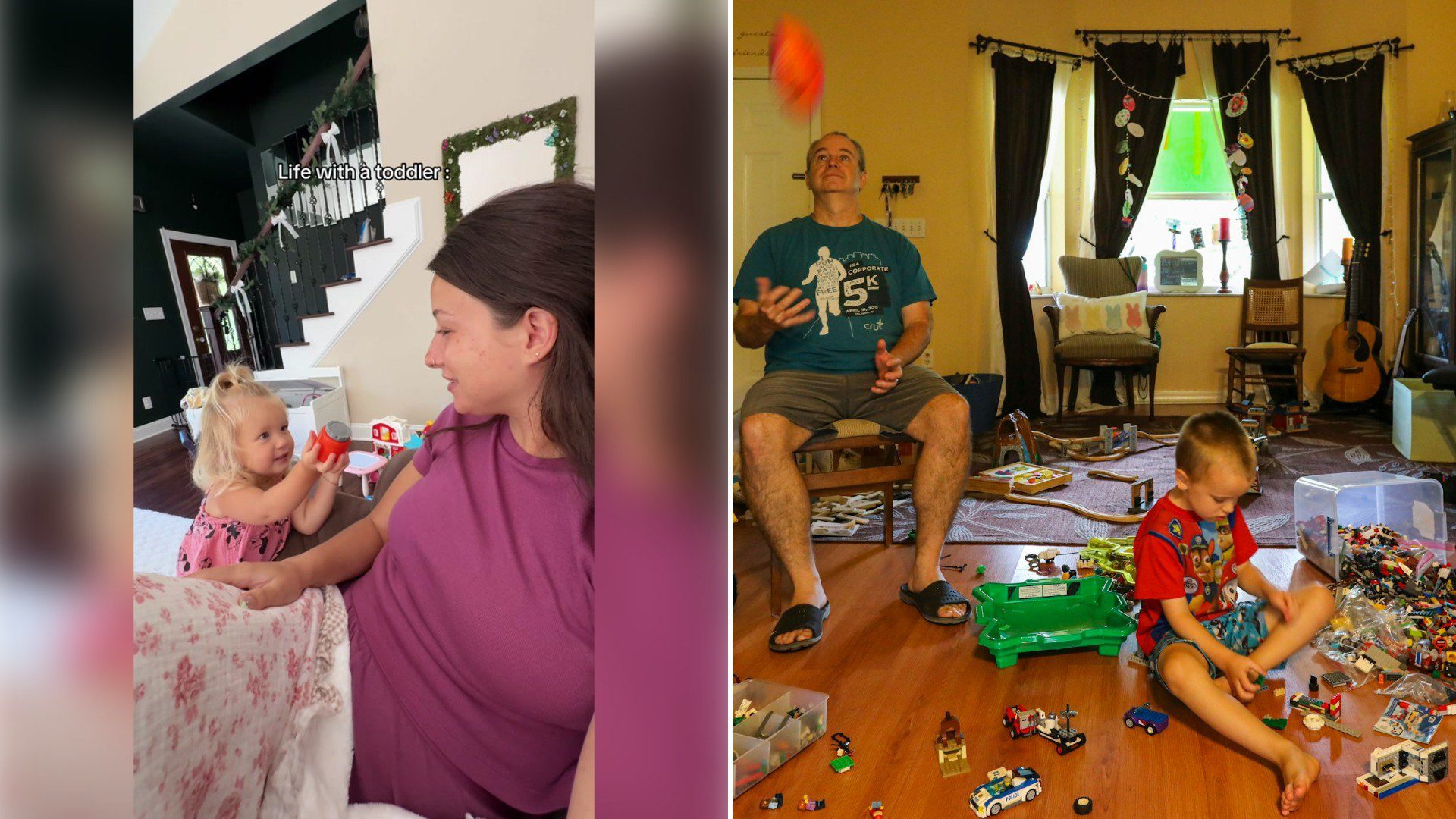
A creator posting under the handle macyanndennis caught a completely real, unscripted back-and-forth with her toddler daughter, who spends over thirty straight seconds holding up a toy tomato-paste can insisting it needs to be opened, while mom repeats “it doesn’t open” more than a dozen times before both of them finally dissolve into laughter.
@macyanndennis #toddlersoftiktok #toddlermom #momlife #momsoftiktok #toddler
Neither party budges for most of the exchange — the toddler is fully convinced the can should open, and mom’s calm, repeated correction doesn’t register as an answer so much as background noise to be worked around. It’s toddler logic at its purest: full conviction, zero interest in the actual explanation.
That kind of loop is instantly familiar to anyone who’s argued with a toddler over something objectively simple. The exchange isn’t really a disagreement so much as two completely different operating systems talking past each other, one running on facts, the other running on pure determination.
The laughter at the end is what makes the clip land — a stalemate that could easily have turned into frustration instead resolves in shared giggles, a small reminder that most toddler standoffs are more absurd than infuriating once you step back and actually listen to them play out.
What makes the exchange so watchable is how specific and physical the standoff actually is. This isn’t a toddler arguing in the abstract about whether cans can open — it’s a kid holding up one particular toy can, over and over, as though repetition alone might change the outcome, while an adult who already knows exactly how the toy works calmly repeats the same four words back. Thirty seconds sounds short on paper, but anyone who has lived through a toddler standoff knows it can feel like a genuine negotiation when you’re inside it.
Toddlers at this age are just beginning to test the idea that insisting on something hard enough might actually change reality, and a toy that looks like it should open — a lid-shaped top, a seam, a shape that reads as “container” to a small brain still cataloguing how objects work — is exactly the kind of object that invites this sort of confident, mistaken certainty. The can isn’t designed to open, but nothing about its appearance tells a two- or three-year-old that, and so the toddler’s conclusion isn’t irrational so much as based on incomplete information delivered with total confidence.
Mom’s side of the exchange is its own quiet comedy. Repeating the same flat correction more than a dozen times without escalating into frustration or over-explaining is its own kind of parenting skill, even if it doesn’t feel like one in the moment. There’s no drawn-out lecture about how toys are manufactured, no attempt to physically demonstrate the can’s sealed seams in detail — just the same short, true sentence, delivered again and again, trusting that eventually the message will either land or the whole thing will resolve itself through sheer repetition fatigue.
That refusal to escalate is worth noticing, because the easy alternative — getting visibly annoyed, raising a voice, trying to end the debate through sheer volume — would have turned a funny, harmless moment into a tense one almost instantly. Toddlers are remarkably good at sensing when an adult’s patience is fraying, and that shift in tone tends to turn a silly disagreement into a real meltdown far faster than the original disagreement ever could on its own.
There’s also something very true-to-life about how neither side actually wins the argument in any conventional sense. The can never opens. The toddler is never persuaded that it doesn’t open. Nobody changes their mind about anything. And yet the whole thing resolves anyway, not through logic prevailing but through both parties simply running out of steam and landing, unexpectedly, on the same shared joke instead. That’s a much more realistic ending than a tidy one where the toddler suddenly accepts the correct answer and moves on satisfied.
Plenty of parents will recognize this exact shape of conversation from completely different objects — a remote control that supposedly needs new batteries it doesn’t need, a door a toddler insists is locked when it simply sticks, a shoe declared broken because it’s on the wrong foot. The specific prop changes, but the pattern is nearly universal: a toddler forms a conclusion, states it with total certainty, and then treats any correction as an obstacle to repeat past rather than information to actually absorb.
It’s also a small, useful window into how toddlers process being told they’re wrong. At this age, being corrected doesn’t reliably update the belief the way it would for an older kid or an adult — it often just gets absorbed as background noise while the original conviction stays fully intact. That’s not defiance so much as a genuinely different relationship with certainty, one where repetition of a claim can feel, to a toddler, like it carries its own kind of proof.
The moment the laughter breaks through is really the heart of the clip, because it shows how quickly a standoff like this can flip from mildly exasperating to genuinely delightful once someone — usually the adult — decides to stop treating it like a problem that needs solving and starts treating it like the absurd little scene it actually is. Once mom laughs, the toddler picks up on that shift immediately, and the whole disagreement dissolves into something closer to a shared bit than an actual dispute.
Clips like this tend to resonate widely because they capture something that’s hard to describe accurately after the fact but instantly recognizable in the moment: the specific fatigue-turned-fondness of repeating the same simple sentence to a small person who simply isn’t going to be talked out of their position today. It’s not really about the can at all — it’s about the very particular comedy of loving someone whose logic runs on a completely different track than yours, and choosing to laugh about it rather than fight it.