


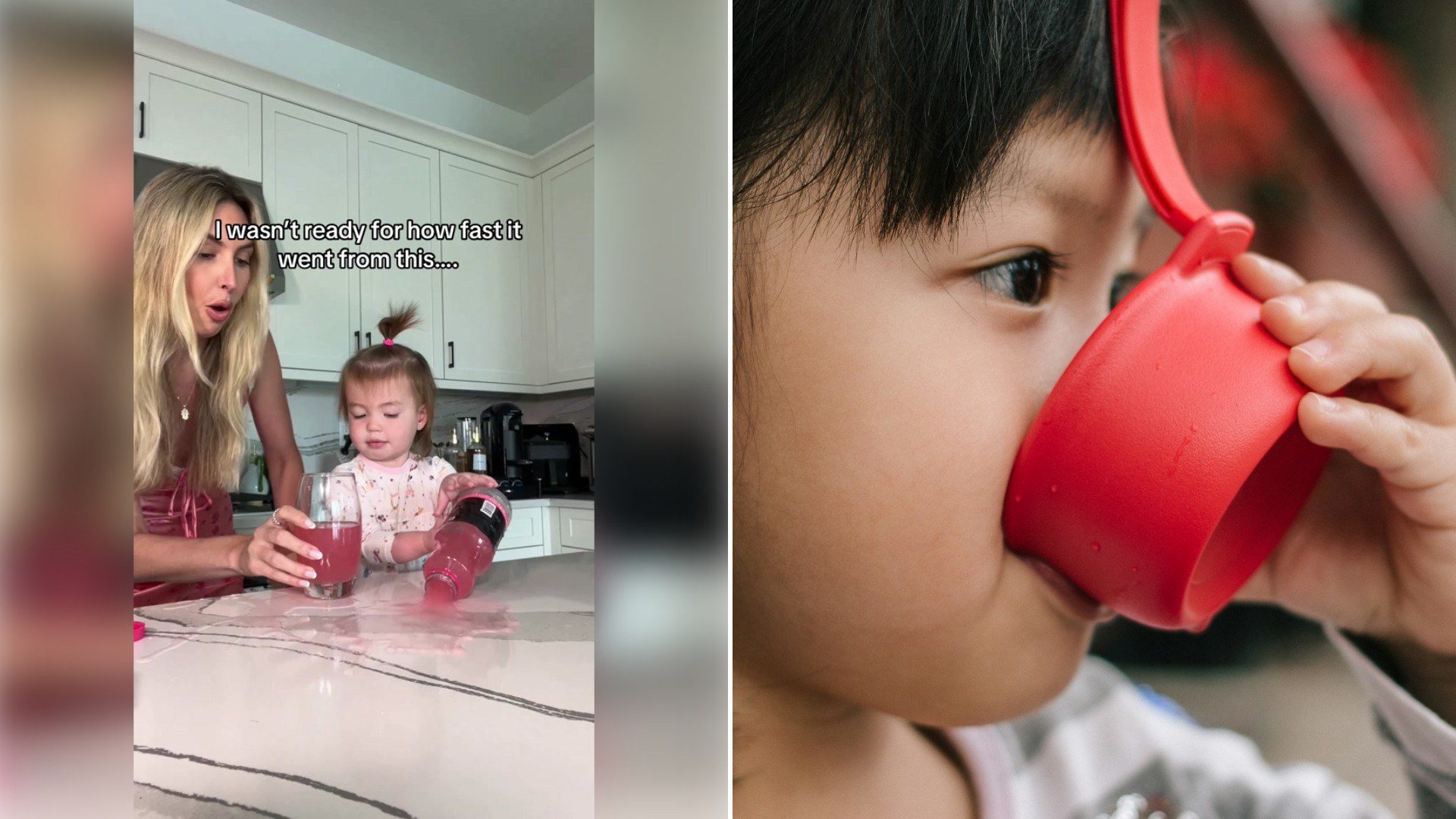
A creator posting under the handle melissametrano put together a real montage spanning real developmental time: her toddler daughter repeatedly spilling drinks all over the kitchen counter trying to pour them herself, cut against the same girl, visibly older, pouring a drink cleanly and confidently.
@melissametrano Time is a thief 🥹
There’s no dialogue — just the footage doing the work, along with a simple caption, “time is a thief,” that captures the bittersweet feeling of watching a small, messy skill quietly become a mastered one while you were busy doing everything else parenting requires.
It’s a specific kind of nostalgia that sneaks up on parents: not the big milestones everyone circles on a calendar, but the small, ordinary skills — pouring a drink, tying a shoe, buttoning a coat — that go from chaotic to effortless so gradually you don’t notice the exact moment it happened until you’re looking at old footage.
What makes this one resonate widely is how universally recognizable the specific skill is. Almost every parent has some version of the spilled-juice era, and almost every parent eventually gets blindsided by how matter-of-fact their kid becomes at the exact same task, with zero fanfare, seemingly overnight.
There’s something particularly effective about a before-and-after structured as a single, unbroken cut rather than a slow, gradual reveal. Watching the same child spill a drink and then, in the very next frame, pour one flawlessly compresses what was actually months or years of quiet, unremarkable practice into a jarring couple of seconds. That compression is exactly what makes “time is a thief” land as the perfect caption — it’s not really about time stealing anything, so much as time moving at a pace too slow to notice in real time and too fast to process once you finally stop and look back at it.
Pouring a drink without spilling is such a small, mundane task that it rarely gets celebrated the way crawling, walking, or talking does. Nobody throws a party for the day a kid finally masters pouring milk into a cup without half of it ending up on the counter, yet that skill represents just as much real developmental progress — fine motor control, hand-eye coordination, the patience to go slowly rather than dumping the whole container at once. It’s a milestone that happens in the background of ordinary life, without ever getting its own designated moment of recognition.
Parents who’ve lived through the spilled-juice era know it’s rarely a single dramatic incident so much as a long, repetitive stretch of small messes, day after day, that eventually stops happening without any specific turning point to mark. There’s no single Tuesday when a kid suddenly gets good at pouring; there’s just a slow accumulation of tries, most of them messy, until one day a parent realizes the paper towels haven’t come out in weeks and the skill has simply, quietly arrived.
What makes footage like this especially poignant is the specific role parents play during that whole invisible process. All those spilled drinks required someone to clean them up, to hand over another cup and encourage another attempt, to resist the urge to just pour it themselves and get it over with faster. The eventual mastery on display is as much a testament to that patient, repetitive supervision as it is to the kid’s own growing coordination — a partnership that rarely gets acknowledged because it looks, in the moment, like nothing more than mopping up another mess.
There’s also a specific kind of grief embedded in watching old footage of a kid’s earlier, clumsier self, even when the current version of that skill is something to be proud of. The spilling toddler in the old clip isn’t just less skilled; she’s also younger, smaller, a version of the child who no longer exists in quite the same way. Celebrating the growth and missing the earlier stage simultaneously is a strange, uniquely parental kind of emotional multitasking, and it’s exactly what a caption like “time is a thief” is trying to capture in three words.
For parents currently deep in their own spilled-drink era, with a counter that seems to need wiping down every hour, there’s a real comfort in seeing proof that the mess is temporary, however permanent it feels in the moment. Every parent staring down a puddle of spilled juice for the third time in a day has, somewhere in the back of their mind, the knowledge that this particular phase has an expiration date — footage like this is simply a concrete, visual reminder of that fact, rather than an abstract reassurance.
By the end of the clip, nothing dramatic has really happened — a kid poured a drink, cleanly, the way she’s presumably done a hundred times since without anyone filming it. But set next to the earlier footage, that ordinary moment becomes something much bigger: visible proof of exactly how much ground gets covered during the years that feel, at the time, like they’re mostly just about cleaning up spilled juice.
There’s also something worth noting about why a parent would think to film the spilling in the first place, long before knowing it would ever be compared against a more polished future version. Most parents don’t film mundane failures with any archival intent — they film them because they’re funny, or frustrating, or simply because a phone happened to be nearby when the mess occurred. It’s only much later, once the skill has quietly matured, that the old footage reveals its real value: an accidental record of a phase that would otherwise have been completely forgotten, preserved only because someone happened to hit record during an ordinary, spilled-juice kind of afternoon.