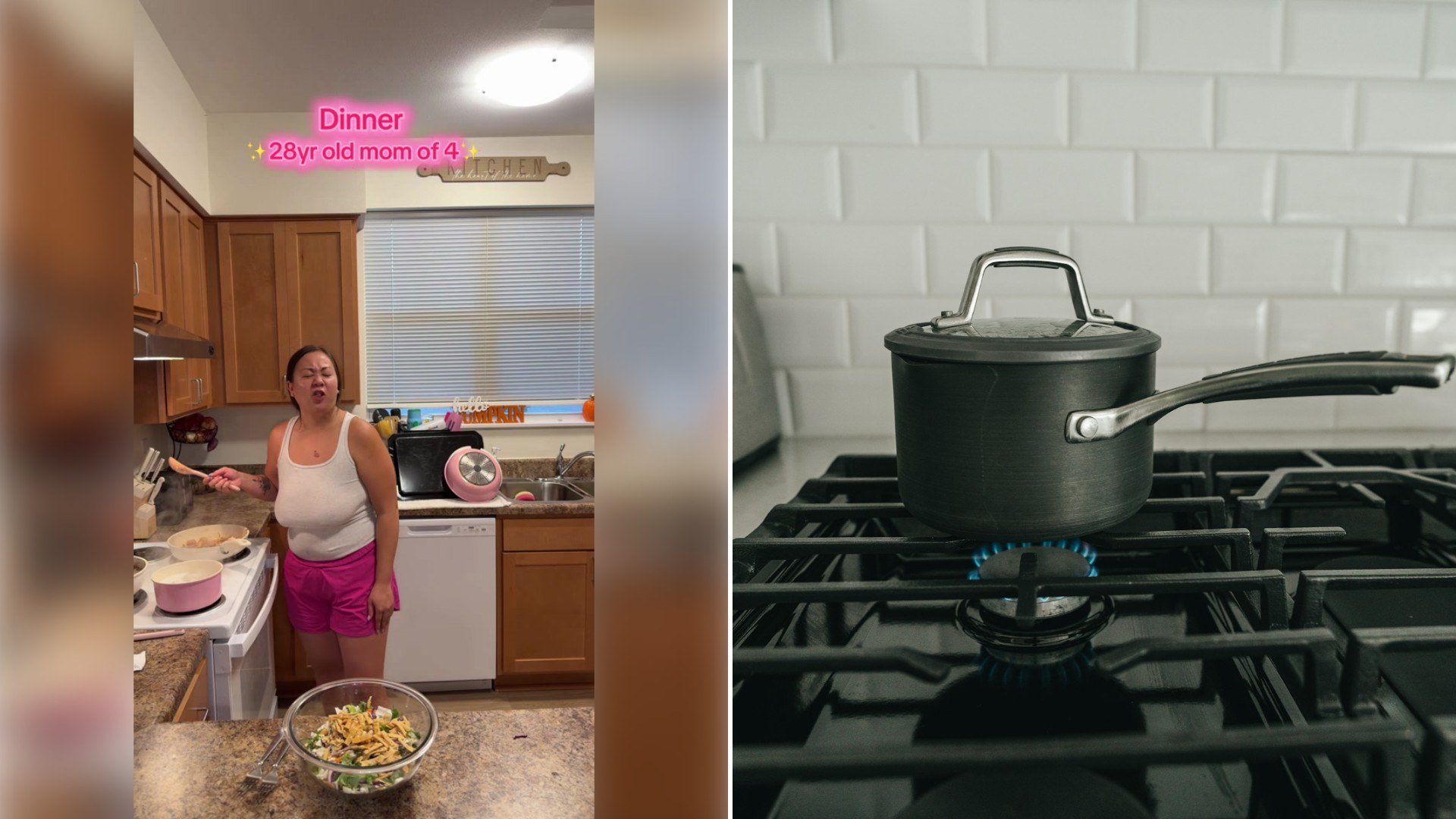
A creator posting under the handle lillianphan, a 28-year-old mother of four, filmed herself cooking a quick family dinner while narrating the chaos happening in real time around her, including stopping mid-cook to tell her kids to quit kicking the floor.
@lillianphan Listen idc what yall got to say 😂 save it #lillianphan #realisticmomlife #fypシ #dinner #fyp
It’s an unfiltered, single-take look at a genuinely hectic weeknight rather than a curated recipe video — no cutaways to a calm, finished plate, just the actual noise level and constant interruptions that come with cooking for a house full of kids at the end of a long day.
Dinner prep with young kids underfoot rarely resembles the quiet, methodical cooking content that dominates so much of social media, and this video leans fully into that gap rather than smoothing it over. The narration itself becomes part of the chaos, a running commentary delivered while actually managing it.
For parents in a similarly loud household at dinnertime, the appeal here isn’t a recipe tip so much as validation — proof that getting food on the table while parenting in real time rarely looks calm, and that it doesn’t need to in order to count as a win.
There’s a particular skill involved in narrating your own chaos while it’s actively happening, rather than reflecting on it afterward once things have calmed down. Most parenting content that touches on dinnertime chaos does so in hindsight, safely distant from the actual noise. This one drops the viewer directly into the middle of it — the floor-kicking mid-sentence correction, the yelling in the background, the dinner somehow still getting made despite all of it — which is a much harder thing to pull off convincingly, and a much more accurate representation of what a real weeknight with four kids actually sounds like.
Cooking for a house full of young kids is its own particular kind of multitasking, one that rarely gets the credit it deserves because it doesn’t look impressive from the outside. It’s not just following a recipe; it’s following a recipe while simultaneously monitoring four separate kids for safety, volume, and general behavior, redirecting at least one of them mid-step without losing track of what’s on the stove, and doing all of it without the meal actually burning. That combination of tasks, run in parallel rather than sequence, is a genuinely demanding cognitive load that a polished recipe video never has to account for.
The floor-kicking detail specifically is such a small, ordinary thing to have to address mid-cook, and that’s exactly what makes it land. It’s not a dramatic incident — nobody’s hurt, nothing’s broken — just one more minor correction folded seamlessly into an already full plate of tasks, the kind of interruption that barely registers as its own event to a parent managing four kids, even though it would be a genuinely disruptive distraction in almost any other context.
What’s notable about her tone throughout is the lack of real frustration in the delivery. The caption’s blunt “idc what y’all got to say” energy suggests she’s not performing calm for an audience, nor is she performing exasperation for sympathy — she’s simply narrating her actual reality, matter-of-factly, the way someone describes weather rather than a crisis. That flat, unbothered delivery does more to convey how normal this level of chaos has become for her than any amount of visible stress ever could.
Content like this tends to draw a specific kind of gratitude from other parents managing a full house at dinnertime, precisely because it refuses to sand down the noise for the sake of presentation. So much dinner content online implies, even unintentionally, that a calm kitchen and a well-behaved audience of kids waiting patiently at the table is the standard outcome. A video like this one pushes back on that quietly, just by showing what actually happens most nights in a house with several young kids all wanting attention at the exact same moment food needs finishing.
There’s also something worth noting about scale here specifically. Managing dinner chaos with one or two kids is its own challenge; doing it with four adds a kind of multiplying effect, where the odds that at least one kid is misbehaving, yelling, or otherwise needing intervention at any given moment climb steeply with each additional child in the mix. A 28-year-old mother of four navigating this nightly, and still finding the humor to film and caption it rather than simply surviving it in silence, says something about the specific resilience this stage tends to require.
By the time dinner actually lands on the table, none of the chaos captured along the way has really been resolved — the kids presumably keep yelling, the floor-kicking presumably resumes eventually, and tomorrow night likely looks almost identical. But the meal gets made anyway, which is really the entire point being made here: dinner doesn’t require a quiet kitchen to count as a success, just a parent willing to cook through the noise instead of waiting for it to stop.
It’s also worth pointing out how much this kind of unfiltered narration functions as a kind of quiet community-building, even if that’s not the explicit intent. Watching someone else describe the exact same nightly chaos, in the exact same blunt, unapologetic tone, tends to make a parent’s own loud, imperfect dinner routine feel less like a personal failing and more like the shared baseline it actually is. Nobody watching this video walks away thinking her house is unusually chaotic; most walk away recognizing their own kitchen in it.
There’s a reason this kind of content keeps circulating widely even without any dramatic hook or trending audio driving it. The appeal isn’t novelty — it’s recognition, delivered in real time, from someone clearly speaking from lived experience rather than performing a persona. A dinner made under exactly these conditions, night after night, eventually stops feeling like chaos worth documenting and starts feeling like simply how dinner happens in a full house — which is, in the end, the most honest kind of cooking content there is.