


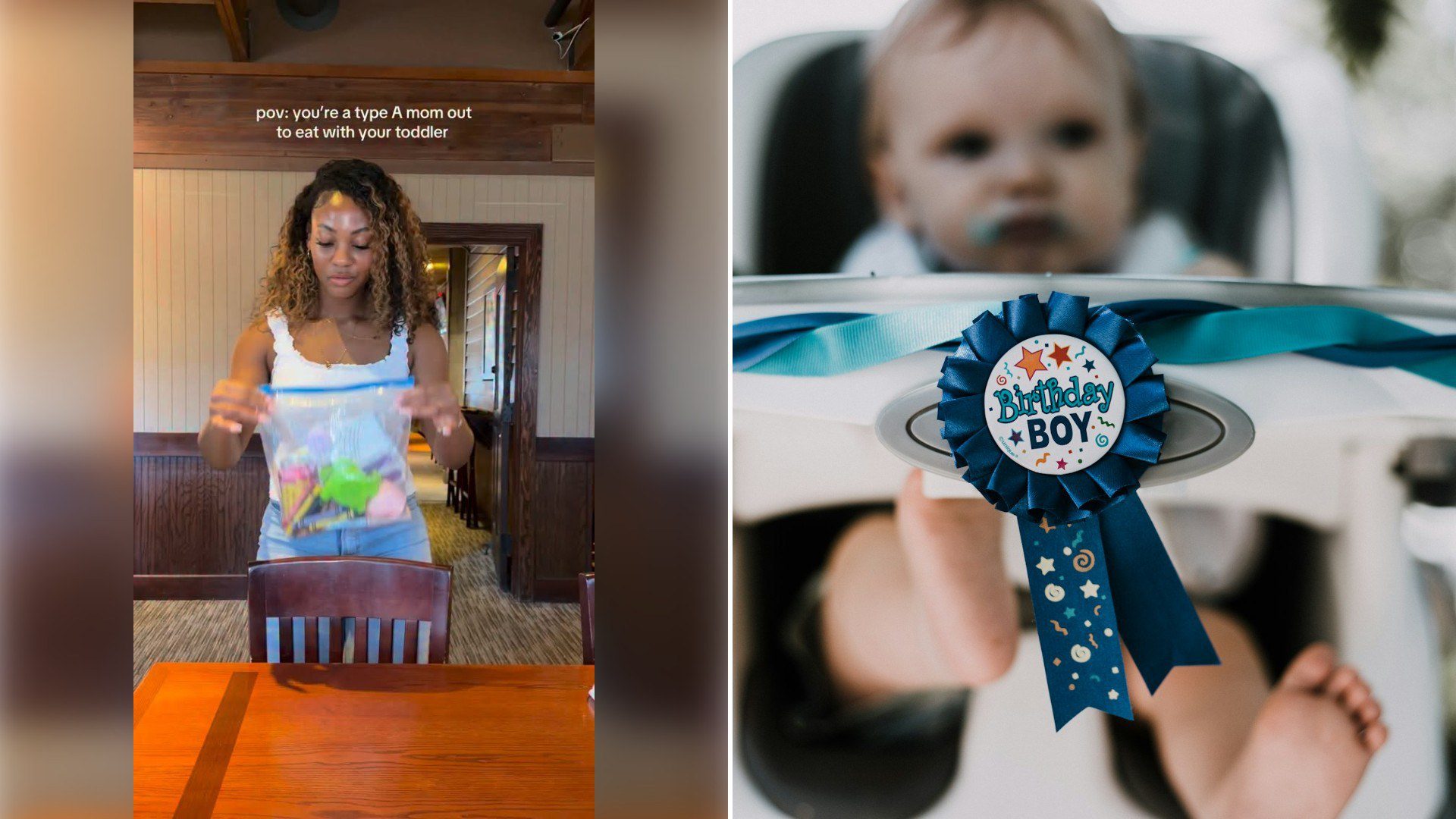
A creator posting under the handle xokiamatthews pulled out a full ziploc bag of small tools and gadgets at a restaurant table and walked through exactly what each one does to make eating out with a toddler manageable, from spill catchers to small distraction tools, using every item at the actual table with her child rather than just listing them off.
What separates this from a typical product roundup is that every item gets demonstrated in real conditions — an actual toddler, an actual restaurant, an actual meal in progress — rather than laid out neatly on a counter at home. It’s the kind of “survival kit” content that reads as genuinely tested rather than aspirational.
Eating out with a toddler is one of those parenting tasks that looks simple on paper and rarely is in practice, between spills, restlessness, and the general unpredictability of asking a small child to sit still through an entire meal. A compact, purpose-built bag of go-to tools — kept ready rather than assembled last-minute — takes a meaningful amount of stress out of what would otherwise be a gamble every time.
Her caption invites followers to comment for shoppable links to some of the items shown, so a few pieces of the kit may be affiliate-linked — worth keeping in mind for anyone hoping to recreate the exact setup rather than substitute with whatever’s already on hand.
There’s a particular kind of dread that comes with the words “should we just eat out tonight” once a toddler is in the picture. What used to be a simple, spontaneous decision becomes a small logistics operation: is the restaurant loud enough to mask a meltdown but not so loud it overstimulates, does it have a high chair, will the food actually arrive before patience runs out. A kit like this one is really an answer to that whole category of anxiety, condensed into a single bag that travels from the diaper bag to the car to the table without much extra thought required each time.
What makes a “Type A” approach to this particular challenge resonate so widely is that it turns an unpredictable situation into something at least partially controllable. Parents can’t control whether a toddler decides to have a great night or a rough one, but they can control whether there’s a spill-catching placemat on hand, a small toy that hasn’t been seen in a week, or a snack that buys five extra minutes before the food arrives. Preparation doesn’t guarantee a smooth dinner, but it meaningfully raises the odds.
It’s also a reminder of how much invisible planning goes into what looks, from the outside, like a totally ordinary family dinner out. Other diners see a toddler happily occupied at a table and assume it just worked out that way; they don’t see the bag of pre-selected tools that made that calm fifteen minutes possible, or the dozen other dinners that went sideways before this particular system got refined into its current, reliable form.
There’s a reason this kind of content performs so well with other parents specifically: it’s aspirational without being unattainable. Nobody watching expects to replicate the exact contents of someone else’s bag down to the last item, but seeing the general category of solution — spill control, distraction, snack backup — gives other parents a framework to build their own version suited to their own kid’s particular quirks and preferences.
It’s also worth noting how much this kind of prep tends to evolve with a kid’s age. What works as a distraction tool for a fourteen-month-old looks nothing like what keeps a three-year-old occupied at the table, and parents who’ve been doing this a while usually cycle their kit’s contents every few months as interests and needs shift. The bag itself becomes a kind of running record of whatever phase a toddler happens to be in at any given time.
By the end of the video, the takeaway isn’t really about any single gadget so much as the underlying philosophy: a little upfront preparation turns a potentially stressful outing into something closer to routine, and that shift, more than any individual item in the bag, is what actually makes restaurant dinners with a toddler sustainable long-term.
There’s also a financial logic worth acknowledging here, even if it isn’t the headline of the video. A single kit assembled once and refreshed occasionally is a fraction of the cost of the alternative — ordering food to go every time because a sit-down meal feels too risky, or skipping restaurants altogether for a few years out of sheer avoidance. A modest investment in a handful of small, reusable tools can end up paying for itself many times over simply by making more family outings possible in the first place.
It’s worth pointing out, too, that content like this doubles as quiet reassurance for parents who feel like they’re the only ones struggling with restaurant outings. Seeing someone else treat the challenge seriously enough to build an entire dedicated kit for it validates a feeling a lot of parents have been sitting with privately: that eating out with a small child really is harder than it looks, and that needing help isn’t a sign of doing it wrong.
For parents on the fence about whether a kit like this is worth assembling, the simplest version of the advice holds up regardless of which specific products end up inside the bag: pick two or three reliable go-tos, keep them stocked and ready, and let a little boring preparation absorb some of the unpredictability that toddlers bring to every single outing, restaurant or otherwise.