


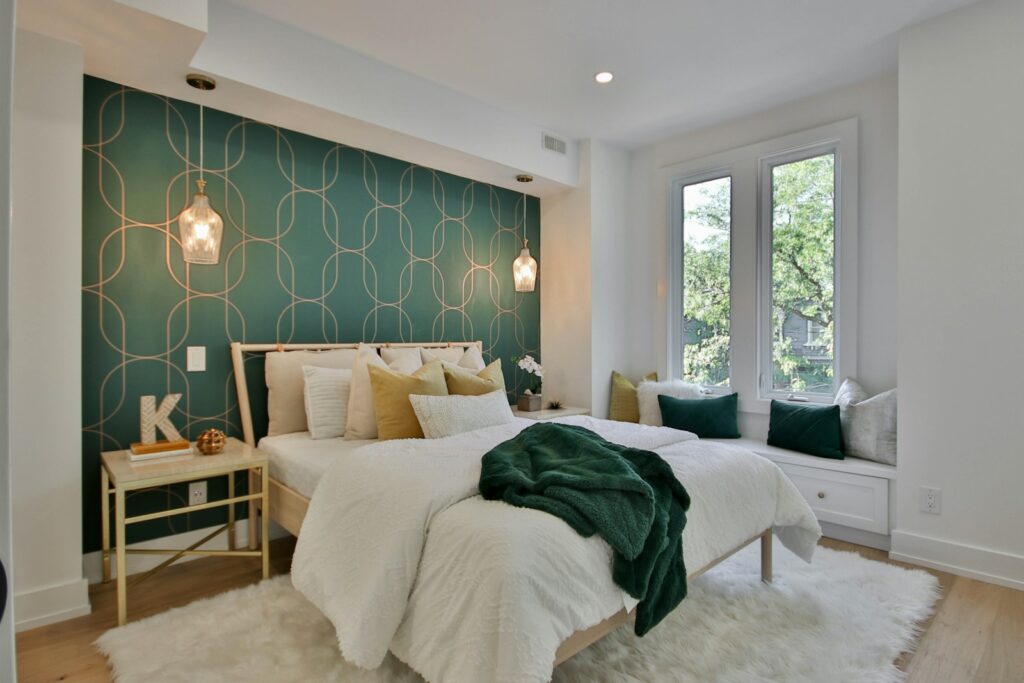
Architectural paint volume in the United States is on track to shrink by 0.3% in 2026, even as the total dollars spent on it inch up slightly, according to forecasting firm ChemQuest’s data reported by PCI Magazine. Wallpaper is moving the opposite direction. The global wallpaper market is projected to grow from roughly $2.0 billion in 2025 to $2.9 billion by 2030, a steady climb of about 5% a year, per Grand View Research. Search interest tells the same story at the consumer level: Houzz’s 2026 trend data shows searches for linen wallpaper up 104% and seagrass wallpaper up 94% year over year. Put those trend lines side by side and you get something the wallcoverings industry hasn’t been able to say in more than ten years — paint’s growth curve is flat to negative while wallpaper’s keeps climbing. It’s not that paint has stopped being the default. It’s that the gap between the two has closed faster than almost anyone in the renovation industry expected.

The Numbers Behind the Shift
Paint still moves far more total dollars than wallpaper does nationally, so this isn’t a story about wallpaper overtaking paint’s overall market size. It’s a story about direction. ChemQuest’s 2026 forecast, covered by PCI Magazine, puts architectural coatings volume down 0.3% for the year, with executives at major manufacturers telling the trade press that the category has now logged “consecutive years of market decline,” according to reporting in Coatings World. Wallpaper, meanwhile, hasn’t had a down year in this stretch. Grand View Research’s July 2026 report has the category compounding at roughly 5% annually through 2033, with the U.S. alone accounting for more than 80% of the North American market. That’s the “first time in over a decade” framing: paint contracting while wallpaper expands, at the same time, in the same renovation cycle.
Peel-And-Stick Changed the Math
You can trace most of this swing to a single product category: removable, peel-and-stick wallpaper. It didn’t exist in any meaningful volume a decade ago, and it solved the two biggest reasons people avoided wallpaper in the first place — the mess of wet paste and the commitment of a surface you couldn’t easily undo. Grand View Research’s analysis specifically calls out the “growing popularity of peel-and-stick wallpapers, supported by the DIY home improvement trend,” as a driver expanding the category’s market penetration beyond traditional pasted product. That matters because it changes who’s buying. Renters, first-time homeowners, and anyone renovating a space they don’t plan to stay in forever can now treat wallpaper the way they’d treat a can of paint: low-stakes, reversible, and something you can swap out in an afternoon rather than a weekend.
What’s Actually Driving the Swap
Part of it is fatigue with a decade of all-white, all-gray walls that made paint feel interchangeable from one house to the next. Part of it is affordability math working against paint specifically. ChemQuest’s forecast notes that DIY paint purchasing has been trending downward as buyers grow more price-conscious, and industry executives quoted in Coatings World point to housing affordability pressure and tighter renovation budgets pushing people toward smaller, cheaper projects rather than whole-room repaints. An accent wall of peel-and-stick wallpaper can cost less than a gallon of premium paint plus primer, and it does more visual work per square foot. There’s also a texture argument. Houzz’s 2026 search data shows the fastest-growing wallpaper searches skewing toward natural, tactile materials like linen and seagrass, not glossy prints — the same instinct pulling people toward limewash and Venetian plaster finishes in paint, just executed with wallpaper instead because it’s faster to apply and easier to remove.
What It Means If You’re Renovating
If you’re planning a refresh this fall, the practical takeaway isn’t “throw out your paint cans.” Paint remains the cheapest, fastest way to change a room, and it’s still the right call for most full-room jobs and rentals with restrictive lease terms. What’s changed is the calculus for accent walls, powder rooms, closets, and other smaller, high-impact spaces, where the gap between paint’s cost-per-visual-impact and wallpaper’s has narrowed to the point that wallpaper often wins. Measure the wall before you shop — peel-and-stick rolls are typically sold by the square foot, and buying slightly more than your measurement to account for pattern matching will save you a second order. If you’re renting or expect to move within a few years, that reversibility is the real selling point, not just the pattern.
None of this means paint is going away — it’s still the backbone of nearly every renovation budget in the country. But the industry data lines up in a way it hasn’t in years: one category is shrinking in volume while the other compounds year after year, and that shift is showing up on actual walls, not just in trend reports.