


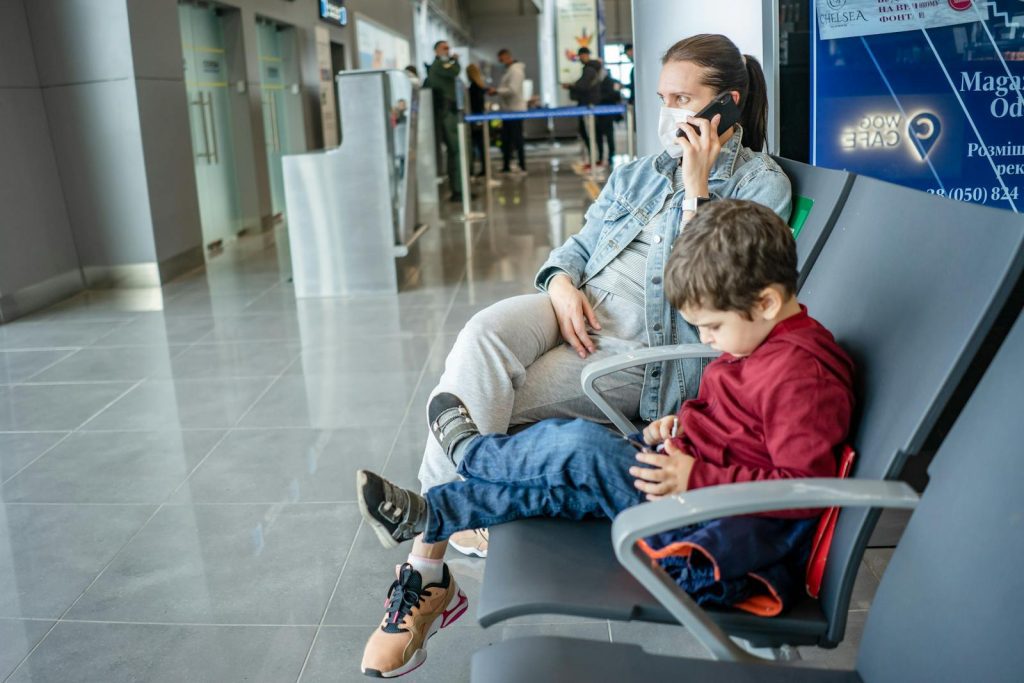
A winter escape to the Caribbean has turned into a grinding ordeal for one family, who say they have been stuck for days and are now roughly $10,000 over what they planned to spend. Their story, echoed by other Americans scattered across island airports, captures how a fast-moving geopolitical crisis can suddenly swallow ordinary travelers’ savings and sense of control.
Instead of counting down the hours to a return flight, they are counting receipts, watching credit card balances climb, and wondering when they will finally sleep in their own beds again. The only certainty, they say, is that “we’re still not home.”
The family that blew past its budget, and the chain reaction behind it

The stranded family at the center of this saga had done what many careful travelers do: they set a budget, booked round-trip tickets, and expected a predictable journey back from the Caribbean. That plan collapsed when their homebound flight was canceled and rebookings kept slipping away, leaving them marooned in Barbados and paying out of pocket for extra nights, meals, and last‑minute transport as they tried to navigate a maze of disrupted routes and limited seats, according to detailed first‑person reporting from Barbados. What began as an inconvenience quickly hardened into a financial shock.
By their own account, the family ultimately spent “$10,000 more than we budgeted for” and stressed that “we spent $10,000 m, $10,000” just to keep moving and stay housed while they waited for a viable way home, a figure laid out in the narrative By David Morris. Their experience unfolded as U.S. military operations involving Venezuela prompted sudden airspace closures and cascading cancellations across the region, leaving tourists and families in limbo far beyond their original travel dates.
From Barbados to St. Kitts and Puerto Rico, a region of stranded travelers
The Barbados family’s ordeal is part of a much wider pattern that has swept across the Caribbean since U.S. strikes in Venezuela led to airspace restrictions and flight suspensions. In St. Kitts, a Michigan family that had already taxied to the airport for a Saturday departure discovered that “air travel throughout the region” had been thrown into disarray, forcing them to scramble for lodging and food as their costs mounted and their return date vanished into uncertainty, according to local coverage of their attempt to leave Kitts on Saturday. For them, as for the Barbados travelers, the financial strain is no longer hypothetical but a daily calculation.
Another Michigan group described a similar sense of abandonment, saying airlines were not stepping in to cover basic needs as the days dragged on. “The airline, nobody is accommodating us for the hotel, nobody is paying for anything. It’s all coming out of our pocket,” Derrick Chriss said, explaining that his family’s flight had been repeatedly affected by the U.S. operation in Venezuela and the resulting closures, a complaint captured in interviews with Derrick Chriss. Their frustration mirrors the Barbados family’s sense that they are bearing the full cost of a crisis they did not create.
Officials and reporters have documented how quickly the disruption spread, with Passengers in the Caribbean suddenly grounded after airspace was closed around Venezuela, and with airlines warning that limited aircraft and crew made rapid recovery difficult. In Puerto Rico, two Arizona friends summed up the surreal mix of boredom and anxiety as they waited with “Two girls, four bags, just luggage. One has a janky wheel,” a wry description from Meza that underscored how even small inconveniences become magnified when there is no clear way home, as they explained while seeking help through a fundraiser linked by Two girls, four bags.
Human stories behind a geopolitical flashpoint
For families like the one stuck in Barbados, the geopolitical backdrop can feel abstract compared with the concrete reality of canceled boarding passes and swelling hotel bills. Yet their predicament is directly tied to U.S. military decisions and the response from Venezuela, which led to airspace closures that rippled across commercial routes. Coverage of American tourists stranded after the operation has highlighted how quickly a foreign policy move can strand vacationers, with By Mary Markos detailing how major carriers like JetBlue and Delta had to reroute or cancel flights as the situation evolved and as operations were Updated at 6:36 pm, according to NBC Universal. The result is a patchwork of delays that no single airline or traveler can easily solve.
Local broadcasters have also put names and faces to the disruption. In one segment, anchor Jan introduced the story by saying, “I’m Robin Marsh,” before turning to a report on a Deer Creek family whose Caribbean trip collided with the U.S. strikes, a moment captured in a clip featuring Robin Marsh. Reporter Jan then noted that “Misha Knight tells us that her family they’re trying to head home from the Caribbean when that attack happened,” underscoring how quickly a routine journey became a high‑stakes scramble for safety and a seat home, as described in the segment centered on Misha Knight. Together with the Barbados account that begins, “Although we ended up stranded in the Caribbean,” these stories show how a single week of turbulence has left families repeating the same refrain: the trip is over, the money is gone, and they are still not home.
Supporting sources: Untitled, Untitled, A Deer Creek family stranded after U.S. strikes in Venezuela …, A Deer Creek family stranded after U.S. strikes in Venezuela …, My Family Has Been Stuck in the Caribbean for Days, American tourists stranded across the Caribbean after …, Michigan family stranded in Caribbean as Venezuela conflict …, Caribbean travel disrupted by U.S. operation – NBC Boston, Michigan family stuck in Caribbean over U.S. operation in Venezuela, Arizona friends stranded in Puerto Rico after strikes in Venezuela ….
More from Decluttering Mom: