


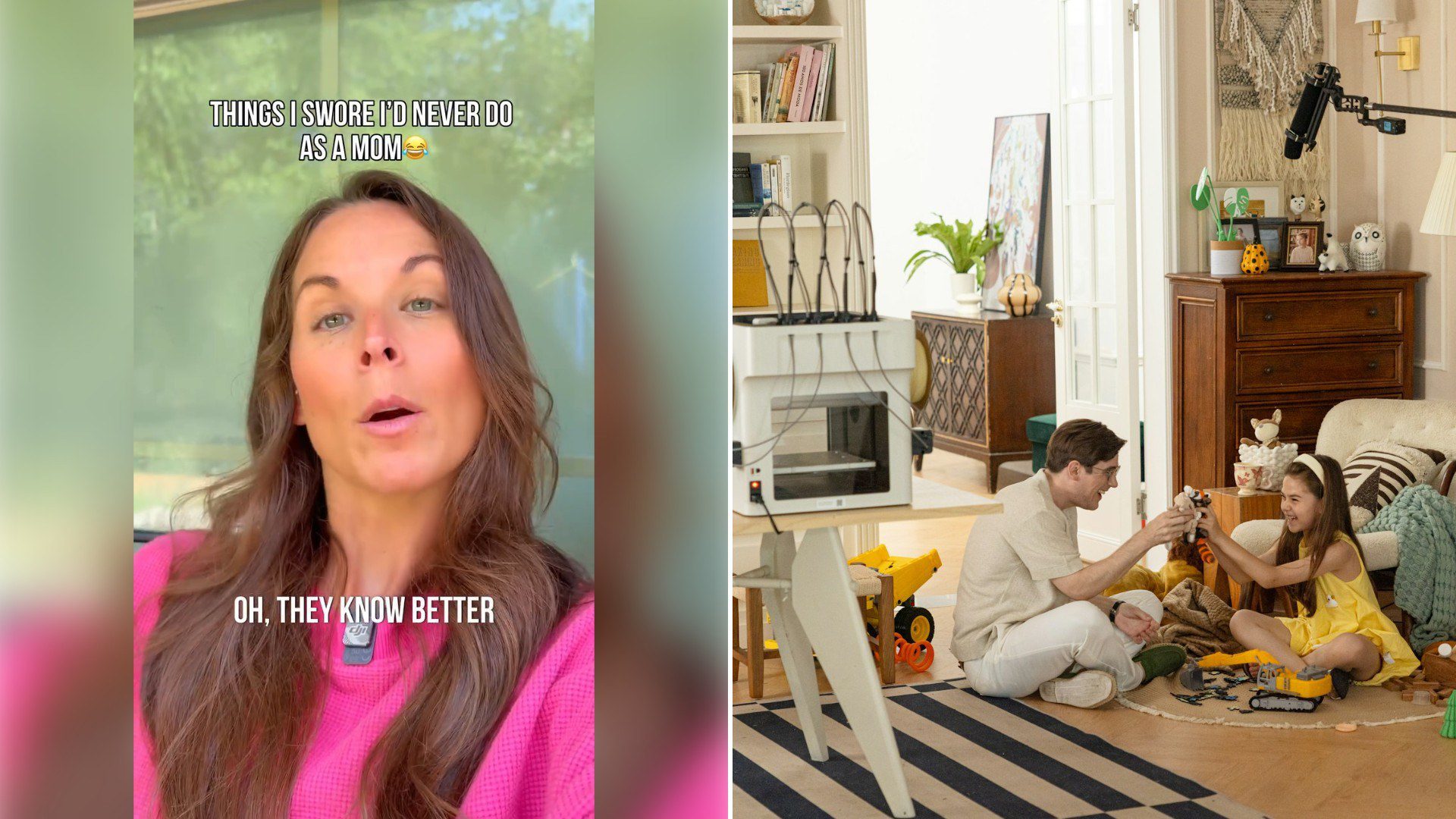
Every new parent eventually confronts the gap between the parent they imagined they’d be and the parent they actually turn out to be, and a creator posting under the handle ezsnb recently turned that exact gap into a viral moment of comedy. Her video runs through a series of ironic, relatable comparisons between the confident parenting declarations she made before having kids and the far messier reality she now lives every single day.
The setup is simple but devastatingly effective: a rundown of the specific things she swore, with total conviction, she would never do as a mom, immediately followed by the honest, often comical admission that she now does exactly those things on a regular basis. Her caption sums up the whole premise perfectly, admitting with a laugh that she was a phenomenal parent before she actually had children — tagged with #comedy, #parentinghumor, #momhumor, and #funny.
The response reflected just how widely shared that experience turns out to be. The video drew approximately 4 million views from an account with about 691,000 followers, a notable jump even for a creator with an already substantial platform, suggesting the specific format of “before kids vs. after kids” tapped into something especially resonant this time around.
The “things I swore I’d never do” genre has become a reliable staple of parenting content precisely because almost every parent has a version of the same story. Before having kids, it’s easy to hold firm, confident opinions about screen time limits, bedtime rules, or how calmly you’ll handle a public meltdown. Those opinions tend to dissolve almost immediately on contact with an actual, exhausted, strong-willed toddler, and the resulting gap between theory and practice is where so much of parenting humor lives.
What makes that gap funny rather than shameful is the shared recognition that pre-parenthood confidence was never really a fair benchmark to begin with. Nobody parenting from the outside — without sleep deprivation, without the constant negotiation of a real child’s needs, without the accumulated fatigue of an actual daily grind — has any real basis for the rules they confidently set in advance. The humor comes from finally understanding, from the inside, just how naive those earlier certainties really were.
For parents feeling a private pang of guilt over their own broken “never” rules, videos like this one offer a genuinely useful kind of reassurance: breaking a pre-parenthood promise to yourself isn’t a personal failure, it’s simply what happens when theory meets the much more complicated reality of raising an actual human being. The parents who adapt their rules in response to what their specific child actually needs are, in most cases, doing a better job than the ones rigidly clinging to opinions formed before they had any real information.
Ultimately, what makes @ezsnb’s video so widely shared isn’t the specific examples she lists — it’s the universal relief of watching someone else publicly admit the gap between expectation and reality, and finding it funny rather than something to hide.
Developmental psychologists have long noted that most pre-parenthood expectations are formed without any direct exposure to the actual, lived reality of caregiving, which is part of why they tend to collapse so quickly and so completely once a real child enters the picture. It isn’t a failure of willpower so much as a simple gap in information that no amount of reading or observing from the outside can fully close.
This kind of self-deprecating, “before vs. after” content has also become an important corrective to a longer tradition of parenting advice delivered with total, unwavering confidence. By publicly laughing at her own earlier certainty, this creator implicitly pushes back on the idea that good parenting means sticking rigidly to a plan formed in advance, offering instead a more honest, flexible model built around responding to an actual child rather than an imagined one.
For expecting or new parents feeling anxious about their own pre-baby promises already slipping, the healthiest reframe is simply this: flexibility in the face of new information isn’t a broken promise, it’s evidence of actually paying attention to the specific child in front of you rather than a hypothetical one.
It’s also worth noting that this kind of humor tends to age particularly well within a family, becoming a recurring inside joke that parents return to years later, long after the specific broken rule has been forgotten in every other context. Looking back on an old “things I swore I’d never do” list with a decade of hindsight often produces even more laughter than the original realization did, since so much more of the list usually turns out to be broken by the time a kid reaches school age.
There’s also a useful reminder here for anyone still expecting a baby: taking pre-parenthood parenting opinions less seriously, including your own, tends to make the actual transition into parenthood considerably smoother, since arriving with fewer fixed expectations leaves more room to simply respond to the child who actually shows up, rather than the one imagined in advance.
In the meantime, the running list keeps growing for most parents, one gently broken promise at a time, and that, more than anything, is the real punchline behind the whole genre.