


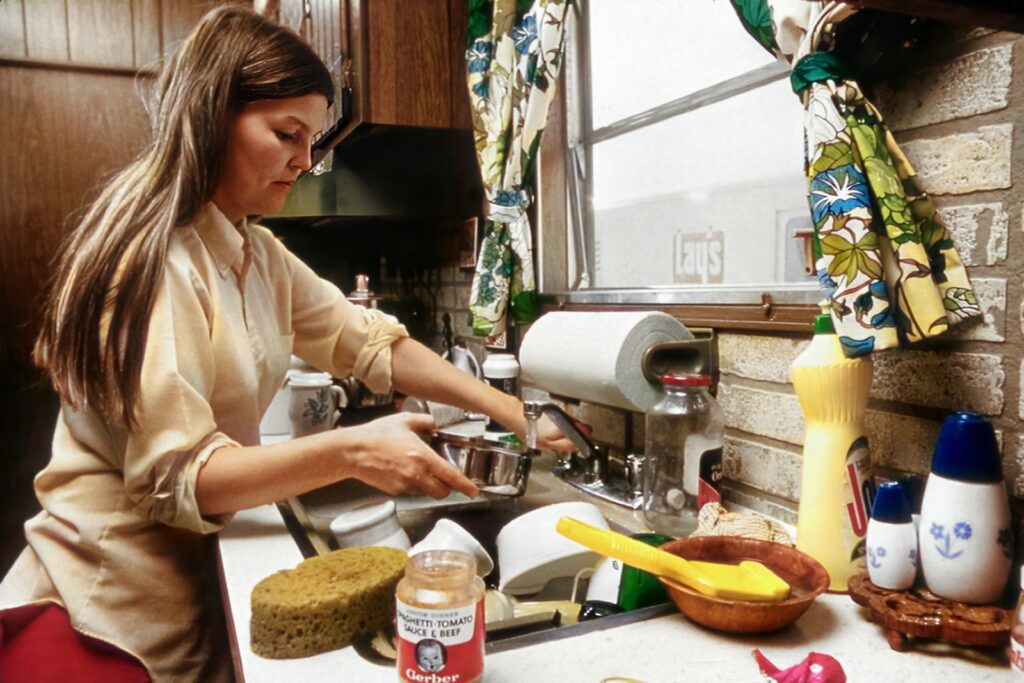
Women spent an average of 0.81 hours a day on housework in 2025, compared with 0.30 hours for men, nearly three times as much, according to the newest American Time Use Survey data, released by the U.S. Bureau of Labor Statistics on June 25, 2026. The one category where men logged more time than women: lawn and garden care, where men averaged 0.26 hours a day versus 0.13 for women, roughly double.


Cleaning, Laundry and Food Still Fall to Women
The full ATUS report breaks “household activities” into several sub-categories, and the pattern holds across nearly all of them. Interior cleaning and laundry, what BLS classifies simply as “housework,” is where the gap is widest: 0.81 hours a day for women against 0.30 for men, a ratio of roughly 2.7 to 1. Food preparation and cleanup shows a similar split, with women spending 0.91 hours a day compared with men’s 0.51 hours.
Zoom out to the broader “household activities” category, which folds cleaning, cooking, laundry and home organization together, and 87% of women reported doing at least some of it on an average day, versus 75% of men, according to BLS’s own Economics Daily summary of the release. Among people who did any household activity that day, women put in 2.8 hours to men’s 2.1 hours.
The Outdoor Exception
Lawn and garden care is the clearest reversal in the data. Men spend nearly twice as long outside tending grass, plants and landscaping as women do, 0.26 hours a day versus 0.13. It’s a small slice of the overall time-use pie, but it lines up with prior years of ATUS data, which has repeatedly found outdoor and maintenance-type chores sorting along the same lines even as the indoor gap narrows only slowly from year to year.
Caregiving follows a related pattern, according to the same BLS release. Time spent caring for household members runs higher for women too, a gap that compounds with the housework split rather than offsetting it, since caregiving and cleaning both tend to happen inside the home during overlapping stretches of the day.
A Gap That Has Proven Durable
None of this is new. BLS’s time-use surveys have tracked a similar divide for two decades, with modest narrowing driven mostly by women logging somewhat less housework rather than men picking up meaningfully more of it. The 2025 numbers don’t show a dramatic shift in either direction. Men’s and women’s housework hours sit close to where they’ve landed in recent survey years, and the “nearly three times” ratio for housework specifically has held up even as remote work, dual-income households and shifting family structures have all changed the shape of American life since ATUS began in 2003.
What the data does make clear is where the imbalance concentrates. It isn’t spread evenly across every kind of home labor. It’s sharpest in the recurring, indoor, often-invisible tasks like scrubbing, folding and washing dishes, and it flips only when the work moves outside to the mower and the flower beds.
The Rest of the Day Skews the Same Way
Housework isn’t the only place the day splits along gender lines, just the sharpest split inside the home. The same BLS data shows men logging more time on work and work-related activities, 8.3 hours a day versus 7.6 for women, and more leisure and sports time too, 5.8 hours versus 5.0. Women, meanwhile, spend more time caring for household members: 2.5 hours a day among women who did any caregiving that day, compared with 1.9 hours for men. Women are also more likely to report doing any caregiving at all, 25% on an average day versus 19% for men.
Put together, the numbers describe something more specific than “women clean more.” The unpaid, recurring work of running a household, cleaning, cooking and caring for the people in it, clusters on one side of the ledger, while paid work and leisure time cluster more on the other, even though the size of each individual gap is modest hour by hour.
What This Means for Your Household
If you split chores with a partner and it feels lopsided, the government’s own numbers back that up rather than argue with it. The imbalance isn’t concentrated in one unusual task. It shows up across cleaning, laundry and food prep alike, while yard work is the lone category where men consistently do more. Couples negotiating who does what have an actual benchmark to work from now, rather than a guess: on average, indoor labor still defaults to women by a factor of nearly three, and outdoor labor defaults to men by a factor of two.