What makes this decision so loaded is that it touches everything at once: infant safety guidelines, a toddler’s emotional adjustment to a sibling, breastfeeding logistics, and the adults’ own need for sleep and connection. The families navigating it deserve more than vague reassurance. They need to know what the evidence actually says and where the flexibility lives.
What the safety guidelines distinguish, and why it matters
The American Academy of Pediatrics updated its safe sleep policy statement in 2022, and the core recommendation has not changed: infants should sleep on a firm, flat surface, on their back, in the caregivers’ room but not in the caregivers’ bed, for at least the first six months. The AAP draws a clear line between room-sharing, which is associated with a reduced risk of sleep-related infant death, and bed-sharing, which the organization recommends against because of suffocation and overlay risks.
That distinction matters more when a toddler is in the picture. A sleeping two-year-old is unpredictable. They roll, kick, fling arms, and drag blankets. Even parents who managed bed-sharing safely with one child may not appreciate how much an older sibling’s movement changes the risk profile for a newborn on the same surface. The AAP specifically warns against placing infants on shared sleep surfaces with other children.
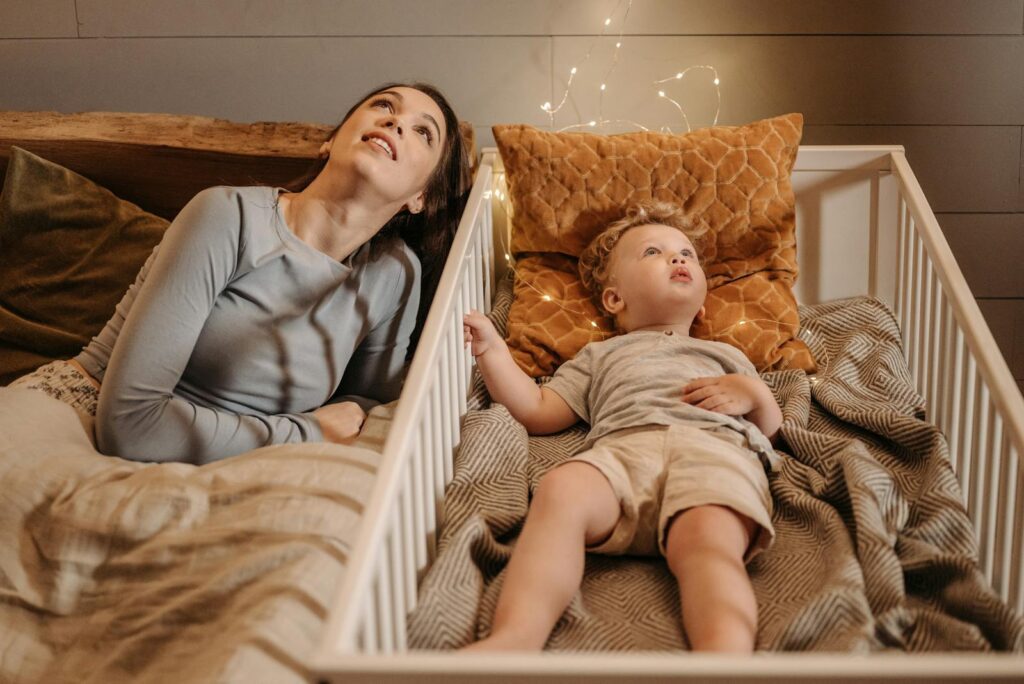
None of this means a family has to abandon closeness. Room-sharing is not just permitted; it is encouraged. The question is how to arrange the room so the infant has a protected sleep space and the toddler still feels included.
Bedside sleepers, floor beds, and the options in between
For families who want the newborn within arm’s reach for nighttime nursing, a bedside bassinet or sleeper that sits flush against the adult mattress is one practical solution. These products create a separate infant sleep surface while keeping the baby close enough for feeding and soothing without fully sharing the bed. When choosing one, parents should look for models that meet the Consumer Product Safety Commission’s bassinet standards and ensure there are no gaps between the sleeper and the adult mattress where an infant could become trapped.
The toddler’s arrangement requires a different kind of thinking. A floor mattress or low toddler bed in the same room gives the child proximity to the parents without placing them on the adult sleep surface alongside a newborn. Some families set up the toddler’s bed at the foot of the parents’ bed or along a nearby wall. Others move the toddler to a sibling room or their own room, depending on the home’s layout and the child’s readiness.
Attachment-focused sleep consultants often recommend a gradual approach rather than an abrupt change. The idea is to introduce the toddler’s new sleep space weeks or even months before the baby arrives, so the child does not associate losing the family bed with the sibling’s arrival. That separation of events can make a significant difference in how the toddler interprets the change.
Helping the toddler adjust without feeling replaced
A toddler who has slept next to a parent since infancy has built a deep association between physical contact and safety at night. Asking that child to sleep differently, right as a new baby appears, is asking a lot. Research from Penn State’s Thrive program on bed-sharing among toddlers and preschoolers notes that young children who co-sleep often depend on a caregiver’s presence to fall asleep and may struggle with transitions that feel sudden.
Gradual methods tend to work better than cold-turkey moves. One well-known approach is the “chair method,” where a parent sits beside the toddler’s new bed at lights-out and, over the course of a week or two, moves the chair progressively farther from the bed until the child can settle with the parent outside the room. It is slow, and some nights will be harder than others, but it preserves the child’s sense of being accompanied rather than abandoned.
Equally important is the daytime narrative. Toddlers understand more than they can articulate, and framing the new sleeping arrangement as a sign of growing up, rather than a demotion, gives them something to feel proud of. Letting the child pick out new bedding, reading books about becoming a big sibling, and maintaining a consistent bedtime routine with songs or stories all reinforce the message that closeness has not disappeared; it just looks different now.
The part no one talks about: the parents
Most of the conversation around co-sleeping transitions focuses on the children, but the adults in the bed matter too. A 2024 study published in Sleep and Breathing found that bed-sharing parents reported more nighttime awakenings and lower sleep quality compared to parents whose children slept independently. When a newborn’s feeding schedule is layered on top of a toddler’s night wakings, the cumulative sleep loss can strain mental health, work performance, and the couple’s relationship.
Partners who disagree about the sleeping arrangement often are not really arguing about furniture. They are negotiating values: how much sacrifice is reasonable, whose comfort gets prioritized, and what kind of parenting identity they are building together. Acknowledging that both perspectives carry legitimate weight, the desire for closeness and the need for sustainable rest, is usually more productive than trying to win the argument.
There is no single correct configuration. Some families thrive with everyone in one room for the first year; others function better with the toddler in a separate space from the start. The best arrangement is the one that keeps the infant on a safe sleep surface, gives the toddler enough security to adjust, and leaves the adults with enough rest to parent well during the day. That target may shift week to week, and adjusting the plan is not failure. It is just parenting after dark.
More from Decluttering Mom: