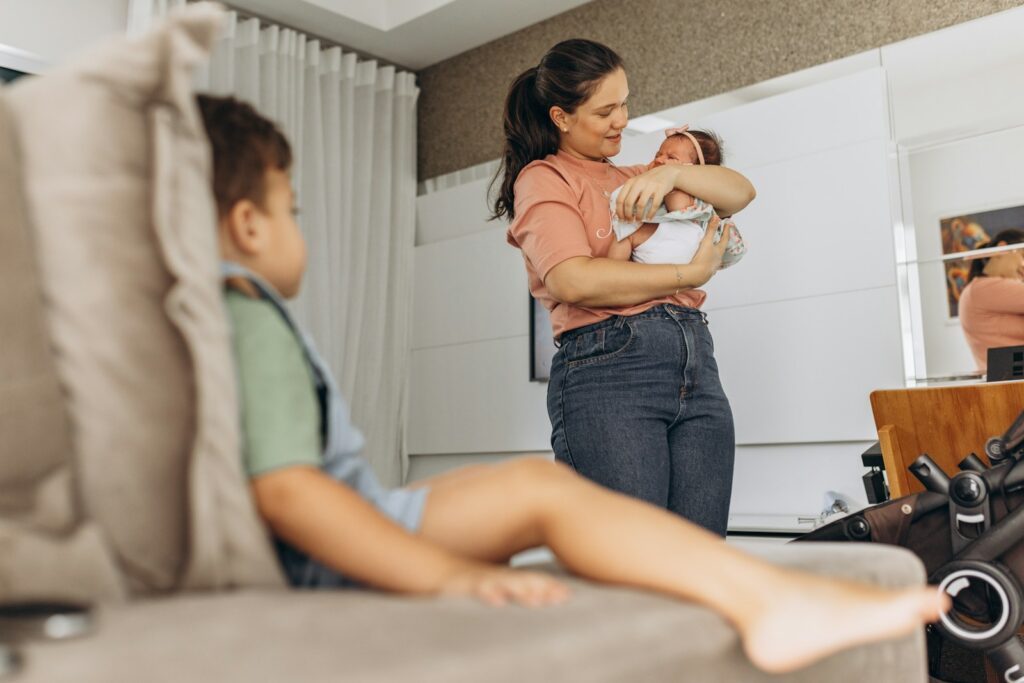
The alarm goes off at 5:47 a.m., and before her feet hit the floor, the baby is crying and the toddler is calling from his crib. She has slept in fragments, maybe four hours total, and the morning ahead involves nursing, two diaper changes, a daycare bag that needs repacking, and a commute that starts in 90 minutes. She loves these children completely. She also feels a low, steady dread she cannot name.
That combination of fierce devotion and daily overwhelm is not a contradiction. For parents raising two children under the age of two, it is one of the most common emotional realities of early parenthood, and one that rarely gets talked about honestly.

What the research says about parenting two under two
The jump from one child to two young children is not twice as hard. Research suggests it is a qualitatively different experience. A 2018 study published in Pediatrics found that mothers’ sleep satisfaction does not fully recover until six years after the birth of a first child, with the sharpest declines in the first three months postpartum. For a mother who has a second baby before the first turns two, that recovery window never opens.
Chronic sleep deprivation at this level is not just tiring. According to the Centers for Disease Control and Prevention, insufficient sleep is linked to impaired cognitive function, difficulty regulating emotions, and increased risk of depression. For a parent already managing the constant mental switching between two children at different developmental stages, the effects compound quickly. Decision-making slows. Patience thins. Small setbacks, a spilled bottle, a missing shoe, feel catastrophic.
Survival mode is a real psychological state, not a buzzword
Clinicians use the term “survival mode” to describe a stress response in which the brain narrows its focus to immediate threats and tasks, shutting down long-range planning, creativity, and the capacity for pleasure. Dr. Becky Kennedy, a clinical psychologist and author of Good Inside, has described this pattern in parents who are so depleted that they stop registering their own needs entirely. They skip meals. They ignore persistent anxiety. They tell themselves things will ease up “when the kids are older,” even as each week feels harder than the last.
Amy Morin, LCSW, a psychotherapist and host of the Mentally Stronger podcast, has outlined how survival mode becomes self-reinforcing: when a parent stops asking “What do I need?” and only asks “What has to get done?”, the emotional deficit grows until even small demands feel unbearable. For a mother of two under two, that might look like dreading mornings not because anything specific is wrong, but because the entire day has become a high-stakes obstacle course with no rest stops.
The line between exhaustion and something clinical
Not every overwhelmed parent has a diagnosable condition, but the overlap between normal new-parent exhaustion and postpartum depression or anxiety is significant enough that experts urge vigilance. The American College of Obstetricians and Gynecologists recommends that clinicians screen for perinatal mood disorders at least once during the postpartum period, using validated tools like the Edinburgh Postnatal Depression Scale. Yet many mothers of second children fall through the cracks because their postpartum visits are over and their symptoms look, from the outside, like ordinary tiredness.
Warning signs that exhaustion has crossed into something more serious include persistent feelings of hopelessness, inability to feel pleasure even during good moments with the children, intrusive thoughts, and withdrawal from a partner or friends. If mornings consistently feel not just hard but hollow, that is worth bringing to a healthcare provider, not just powering through.
Why this is not just a personal problem
The United States remains one of the few high-income countries with no federal paid family leave. According to the Bipartisan Policy Center, as of early 2026, only 13 states and the District of Columbia have enacted paid family and medical leave programs. For parents outside those states, returning to work weeks after a second birth is often a financial necessity, not a choice.
Childcare costs add another layer. The U.S. Department of Labor reports that the average family spends more than $10,000 per year on childcare per child, a figure that can exceed the cost of in-state college tuition. For a household with two children under two, both likely in infant or toddler care (the most expensive age brackets), the financial pressure alone can make mornings feel like a countdown to a job that barely covers the cost of being away from home.
This structural reality matters because it reframes the morning dread many parents feel. It is not a failure of gratitude or resilience. It is a predictable response to a system that expects parents to perform at full capacity on broken sleep, with minimal institutional support, while shouldering costs that would strain any household budget.
Small, practical shifts that can make mornings less punishing
When a parent is already running on empty, sweeping lifestyle overhauls are not realistic. What can help are targeted, low-effort changes that reduce the number of decisions and tasks crammed into the first hour of the day.
- Prep the night before. Laying out children’s clothes, packing daycare bags, and setting up bottles or breakfast items the evening prior removes several friction points from the morning. The goal is not perfection; it is fewer things to think about at 6 a.m.
- Stagger wake-ups if possible. If a partner or another adult is in the home, alternating who handles the first wake-up, even two or three mornings a week, can give each parent at least a few days with a less frantic start.
- Lower the bar on “ready.” A toddler who eats breakfast at daycare instead of at home, or who wears yesterday’s pants, is fine. Letting go of small standards that do not actually matter frees up mental bandwidth for the things that do.
- Build in one non-negotiable for yourself. Five minutes of coffee before the children are up, a short walk to the car alone, a podcast during the commute. It does not fix the structural problem, but it signals to your own brain that you still exist as a person, not just a function.
These are not solutions to the deeper issue. They are triage. But for a parent in survival mode, triage is what keeps the day from unraveling before it starts.
What partners and support networks need to understand
When a mother says mornings are unbearable, the most unhelpful response is advice about gratitude or time management. What she is usually communicating is that she has hit a wall, that the ratio of demands to resources is unsustainable, and that she needs someone to absorb some of the load, not optimize her schedule.
Partners can start by auditing the invisible labor: Who tracks the pediatrician appointments? Who notices when the diapers are running low? Who mentally holds the daycare pickup time, the nap schedule, the allergy list? Research published in the American Sociological Review has documented that mothers in heterosexual couples disproportionately carry this cognitive labor, even when both parents work full time. Redistributing that invisible work is often more meaningful than any single morning hack.
For friends and extended family, practical help beats encouragement. Dropping off a meal, taking the toddler for an hour on a Saturday, or simply saying “You are doing something genuinely hard, and it makes sense that you are struggling” can cut through the isolation that makes survival mode worse.
Loving your children and struggling with your days can coexist
The cultural script around early parenthood still leans heavily on the idea that love should be enough, that if you adore your children, the hard parts should feel meaningful rather than crushing. That script does not hold up against the reality of two children under two, chronic sleep loss, limited support, and a society that has not built the infrastructure parents need.
A mother who dreads her alarm is not failing her children. She is absorbing the cost of a situation that was never designed to be manageable alone. Naming that honestly is not pessimism. It is the first step toward asking for what she actually needs, whether that is clinical support, a more equitable division of labor at home, or simply the permission to say that this stage is brutal and she is doing it anyway.
More from Decluttering Mom: