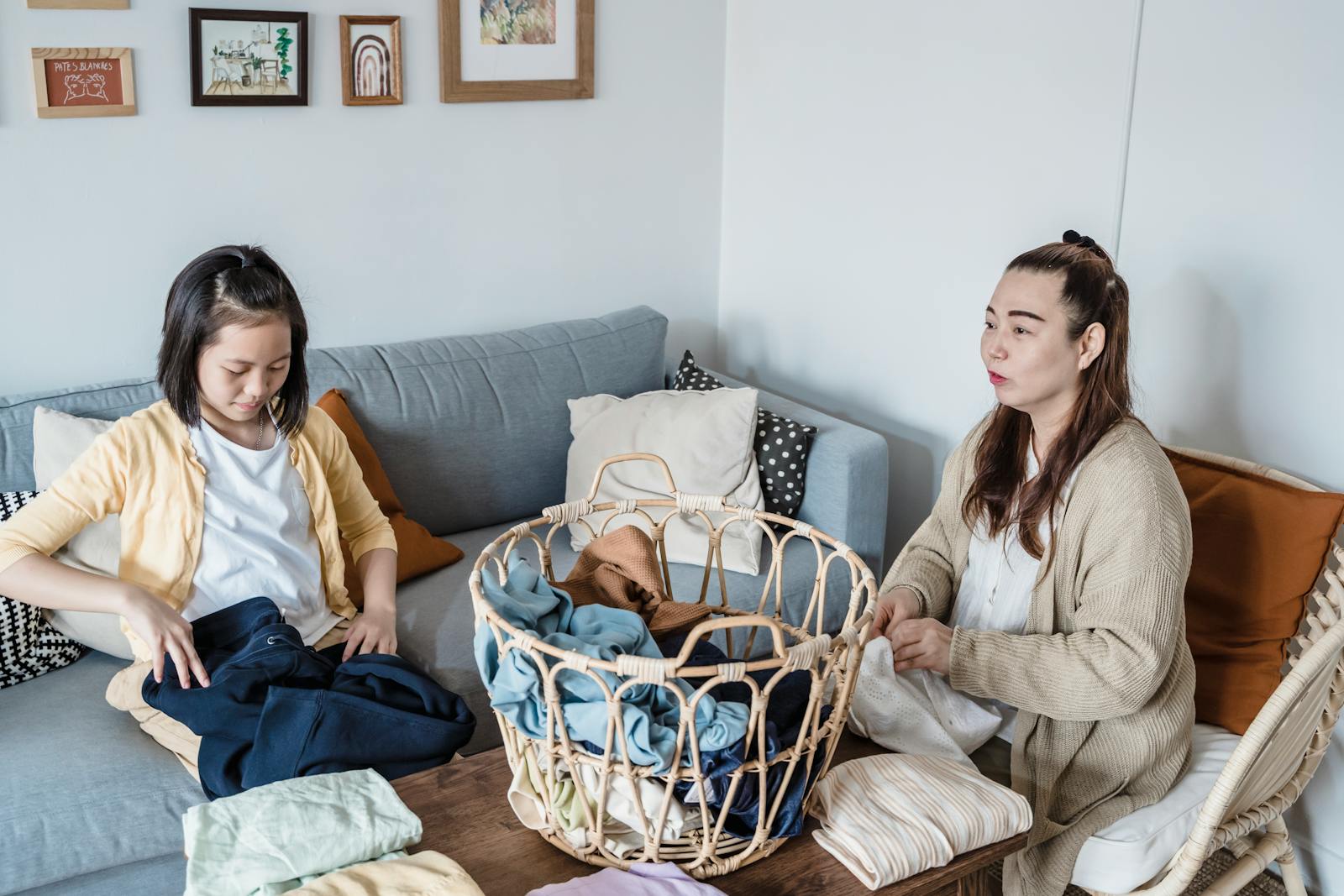
She had four kids, three sports, and one washing machine. While her daughter’s soccer team kicked off across town on a Saturday afternoon, she sat on the living-room floor sorting uniforms and matching socks. By the time the last load hit the dryer, the game was over. Her phone buzzed with a video from her husband: their daughter scoring from the corner of the box, the crowd noise tinny through the speaker. She watched it twice and cried, not because she didn’t care about the game, but because she had chosen a laundry basket over the sideline and still wasn’t sure it was the right call.
Scenes like this play out in households across the country every weekend during youth sports season. According to the Aspen Institute’s 2024 State of Play report, roughly 70% of children in the United States participate in some form of organized or team sport by age 12. For families with multiple children, that can mean overlapping practice schedules, tournaments in different zip codes, and a logistics burden that falls disproportionately on mothers. A 2023 Pew Research Center survey found that among two-parent households, mothers are still far more likely than fathers to say they handle the majority of scheduling and day-to-day household management, even when both parents work.
The missed game becomes a symbol of something larger: the collision between the logistics of keeping a family running and the moments that make the running feel worthwhile.
The hidden cost of keeping it all running

From the outside, a weekend packed with youth sports looks like a wholesome blur of cleats and orange slices. Inside the minivan, it feels closer to air-traffic control. A parent with four kids in activities is tracking practice times, field locations, snack-bar duties, and carpool commitments while monitoring the family calendar and the gas gauge. When a mother stays home to tackle laundry instead of sitting in the bleachers, it is not because she cares less about the game. It is because someone has to make sure there are clean jerseys for the next one.
That tradeoff carries a real emotional cost. Research published in the journal Sex Roles in 2020 found that mothers experience higher levels of guilt than fathers when they perceive themselves as falling short of caregiving ideals, even when the reason for the perceived shortfall is another caregiving task. The guilt, in other words, is not rational. It fires whether a mother is at work, at the grocery store, or folding towels in the next room.
Registered nurse Mary Ann Hassing, who has counseled parents returning to work, has described a version of this pattern. In an interview with Cleveland Magazine, she noted that many mothers talk about missing milestones and describe themselves as “emotional, overwhelmed, and anxious.” The mother crying over a soccer video on her phone is living the same tension. Her office that afternoon just happened to be the laundry room.
Guilt, expectations, and the pressure to be everywhere
The sting of a single missed game does not exist in isolation. It lands on top of a pile of expectations that modern parents, and mothers in particular, absorb from every direction. Social media feeds are curated highlight reels of parents cheering at every recital and tournament, which can make one absence feel like a character flaw rather than a normal outcome of a crowded calendar.
Psychologist Suniya Luthar, whose research at Arizona State University has focused on resilience among mothers, has argued that the cultural expectation for mothers to be physically present at every child-related event has intensified over the past two decades, even as family schedules have grown more complex. In a 2017 study published in Developmental Psychology, Luthar and colleagues found that mothers across income levels reported high levels of loneliness and emptiness tied to the feeling that they were perpetually falling short of what their families needed.
When a mother with four kids in sports chooses laundry over a sideline, she is often measuring herself against an invisible standard that assumes unlimited time, energy, and the ability to be in multiple places at once. Fathers face scheduling pressure too, but research consistently shows that mothers bear a heavier share of both the logistical labor and the guilt that comes with it.
What kids actually notice
One question parents in this position rarely stop to ask is whether their children experience the absence the same way they do. Developmental research suggests the answer is more forgiving than most mothers expect. A 2019 study in the Journal of Family Psychology found that children’s sense of parental support is shaped more by the overall quality of the relationship, including warmth, consistency, and responsiveness, than by attendance at any single event. A child whose parent watches the goal video with her that evening, asks about the play, and celebrates the moment together may feel just as seen as one whose parent was on the sideline.
That does not erase the parent’s sadness at missing the live moment. But it does suggest that the guilt may be doing more damage to the mother than the absence is doing to the child.
Finding small wins in a season of overload
For families deep in the youth-sports years, the answer is rarely as simple as “just skip the laundry” or “never miss a game.” The schedule is real, and so are the uniforms that need washing before Monday practice. What can shift is the story parents tell themselves about what showing up actually means.
Some families start by naming the tradeoffs out loud. When a missed soccer game is framed as a household decision rather than a private failure, it loses some of its power to trigger shame. Others build carpool networks or lean on extended family so that no single adult is expected to cover four fields in one afternoon.
Even small reframes help. Watching the game video later with the child who scored, pausing to point out a smart pass or a confident run, can turn a secondhand clip into a shared ritual. Luthar’s research supports the idea that what children remember is not perfect attendance but consistent emotional engagement: the parent who asks good questions, who notices effort, who makes time to listen after the cleats come off.
None of this erases the reality that youth sports culture in the United States asks a great deal of families, often more than the schedule or the budget can comfortably absorb. As of early 2026, travel-team commitments, year-round seasons, and rising registration fees continue to push household logistics to the limit. Parents who feel stretched thin are not failing. They are responding to a system that was not designed with a four-kid family and one washing machine in mind.
The mother who cried on the living-room floor was not doing anything wrong. She was doing two things at once, both of them for her kids, and the math just didn’t work out that afternoon.
More from Decluttering Mom: