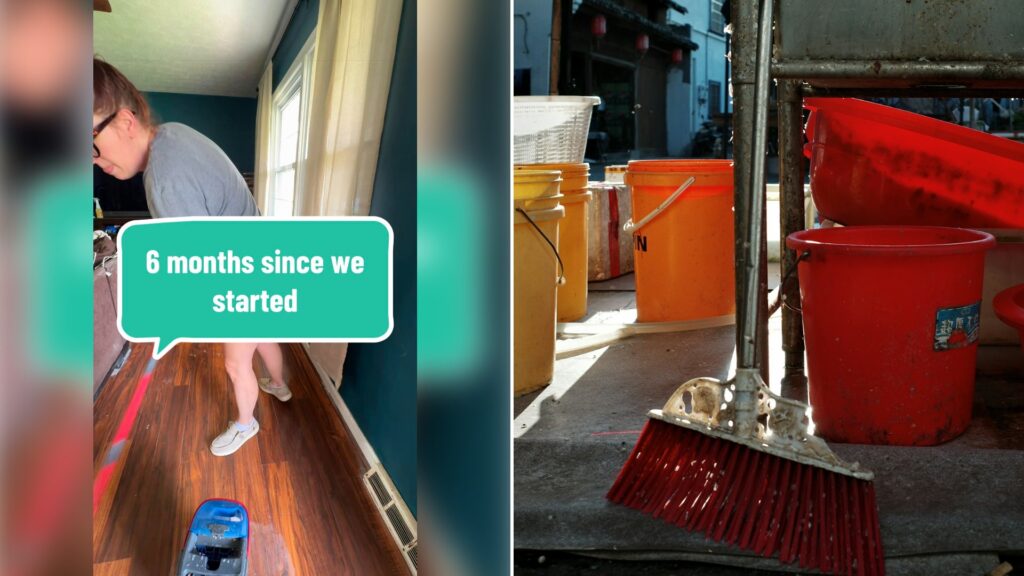
There’s no slow build-up in this video, no montage before the point gets made. The creator looks directly into the camera and states her position plainly, that keeping a clean home is foundational to mental clarity and can genuinely change a person’s life. It’s a bold, almost confrontational claim to open with, and it’s delivered with total conviction rather than hedged with qualifiers.

Creator @phoebelemcke walks through her reasoning for why a clean space matters so much more than most people give it credit for, framing a tidy home not as a vanity project but as a kind of foundation that everything else in a day gets built on top of. The directness of her delivery is part of why the video has sparked so much debate; it leaves little room for a lukewarm reaction, people either agree strongly or push back just as hard.
@phoebelemcke
The underlying claim isn’t just a personal opinion dressed up as fact; there is a meaningful body of research connecting a person’s physical environment to their mental state. Environmental psychology studies have repeatedly found associations between a cluttered or disorganized living space and elevated self-reported stress and difficulty concentrating, particularly for the people primarily responsible for maintaining that space. Researchers studying attention have also pointed to visual clutter as a competitor for limited cognitive resources; every object out of place is something the brain registers and has to filter out, even subconsciously, which can leave less mental bandwidth available for focused tasks.
That said, the relationship between a clean home and mental clarity is not perfectly one-directional, and that nuance is likely part of what fuels the pushback this kind of video tends to get. Mental health professionals often note that the causation can run both ways: a cluttered home can contribute to stress and low mood, but a depleted mental state, from depression, anxiety, ADHD, or simple exhaustion, can also make it much harder to keep a home clean in the first place. That means a blanket claim that cleaning fixes mental health risks oversimplifying a more complicated two-way relationship, even if the core idea that environment affects mental state holds up.
Where the claim holds up most strongly is in the idea of a clean space lowering the baseline level of friction in a day. Clinicians who study habit and routine frequently describe a tidy, predictable environment as reducing the number of small decisions and search tasks a person has to perform, finding keys, locating a document, clearing a surface before starting a task, each of which draws on limited attention and willpower. Removing that friction doesn’t guarantee mental clarity on its own, but it does remove one layer of resistance between a person and whatever they’re trying to focus on next.
What keeps this video circulating despite, or maybe because of, the debate it stirs up is that it forces a real conversation rather than offering an easy, universally agreeable statement. Some viewers see their own experience validated immediately, recognizing the fog that lifts after a deep clean. Others push back, pointing out that telling someone struggling mentally to simply clean their house ignores why the mess accumulated in the first place.
Either way, the conversation the video sparked says as much about how differently people experience their own homes as it does about cleaning itself, and that tension is exactly why a single bold claim delivered straight to camera managed to travel as far as it did.
More from Decluttering Mom
- Professional Cleaner Shows How He Vacuums a Whole House Room by Room and Explains Why the Order Matters for a Faster and More Thorough Cleaning Job
- Husband Says Clearing the Kitchen Counters Changed His Wife’s Mood and Explains Why a Cluttered Kitchen Can Weigh So Heavily on the Whole Household
- Mom Says One Squeegee Habit After Every Shower Keeps Mold From Coming Back and Shows How Little Time It Takes To Protect Your Bathroom Glass and Grout