A dad found out just how determined his toddler can be when snacks are on the line. He lay down on the floor, clutched her lollipop and pretended to be fast asleep. She had other plans.
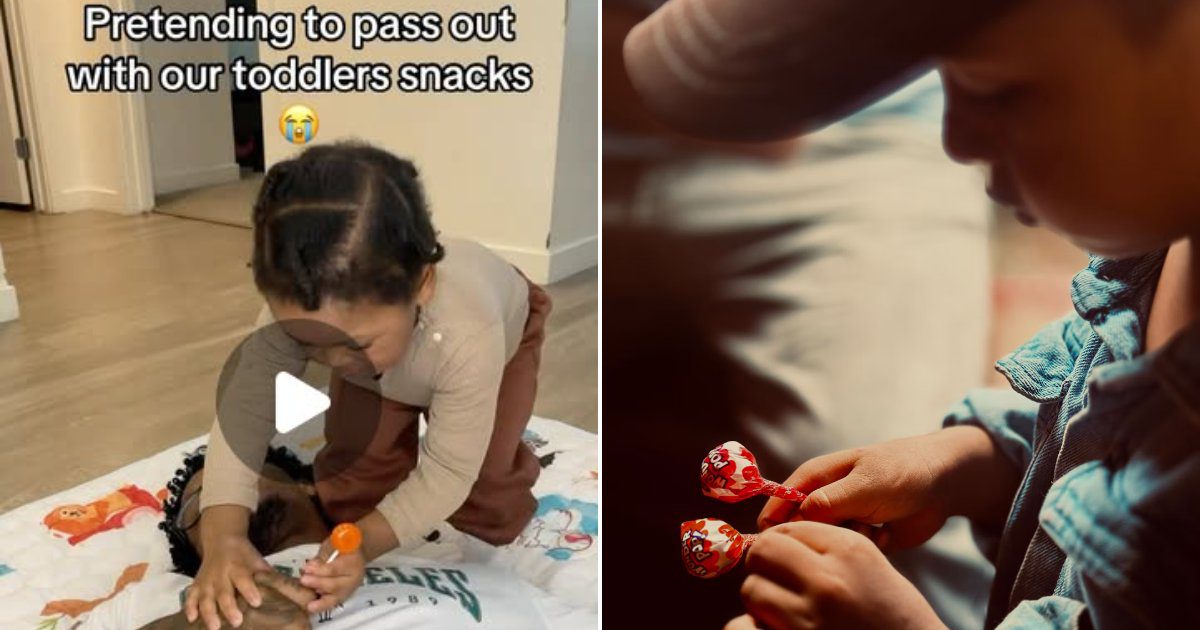
The post from @avi.and.dq is captioned, “Pretending to pass out with our toddlers snacks.”
View this post on Instagram
The setup
Dad is flat on his back on a children’s play mat, an orange lollipop gripped in his closed fist on his chest. His eyes are shut. A toddler wanders in from the next room, in a beige top and brown pants, and walks straight toward him.
The tug of war
She starts by trying to pry the lollipop out of his hand, making complaining sounds and saying “mine.” When that does not work, she gives “uh-oh” a try, then pats his face and chest and calls out “Dada” as if to wake him. Still nothing. Then she gets serious, pulling at his fingers one by one and tugging on the stick, repeating “mine” and “give it.”
After about half a minute, she wins. The lollipop comes free, dad’s eyes pop open and he sits up laughing, impressed at how strong she is. She spins around and runs off with the candy, shouting “no!” over her shoulder.
Why toddlers are such stubborn negotiators
At around two years old, children discover that they have wants of their own and the power to act on them. Words like “mine” appear early because ownership is one of the first big ideas they grasp. Playing along with a game like this one lets a child practice persistence in a safe, silly setting.
A few quick notes if you try something similar at home:
- Keep sticks and hard candy supervised, since lollipops can be a choking hazard for very young children.
- Make sure the game ends with the child getting what they were working for.
- Stop right away if your child becomes upset instead of amused.
The “mine” stage, explained
Toddlers learn the word “mine” early because they are figuring out that they are separate people with their own wishes. It can sound bossy, but it is a normal and even healthy step. Possessiveness often peaks around the toddler years, and it fades as children develop patience and learn to take turns.
Parents can guide this stage without squashing it. Give children plenty of items that are truly theirs, and teach a few simple phrases, like “my turn” and “your turn.” Praise sharing when you see it, and avoid forcing it every time, since toddlers are still learning what it means.
Candy and small children: what to know
Hard candy is considered a choking risk for children under 4, because a piece can easily block a small airway. That includes lollipops, which can also break apart or be bitten off. Even when a treat is held by an adult, young children should always sit down to eat and be watched closely. Small, round, hard or sticky foods are the biggest concerns for toddlers.
If you give your toddler a sweet treat, choose a moment when you can sit nearby, keep the portion small, and offer water afterward. Brushing teeth later helps protect small smiles from sugar.
Common questions parents ask
Why does my toddler get so upset over a snack? Little ones have big feelings and few ways to express them. A snack can matter a lot when a child is tired, hungry or just learning to assert herself. Staying calm and naming the feeling, such as “You really want that,” often helps.
Is it okay to play teasing games with toddlers? Light, silly games can be fun when a child is clearly enjoying them. Watch her face and body language, and stop if she seems upset. The goal is laughter that both of you share.
What should I do about tantrums over food? Offer a choice between two acceptable options, keep your tone steady and hold the boundary kindly. Tantrums are common at this age and usually pass quickly.
Try this at home: toddler-friendly snack ideas
- Soft fruit cut into small pieces, such as banana or ripe pear.
- Yogurt with a toddler-safe spoon.
- Small cubes of soft cheese.
- Well-cooked vegetable pieces cut to a safe size.
- Toast strips with a thin spread.
Remember that every toddler is different. Some are fierce negotiators, some are gentle, and many are both in the same afternoon. Pay attention to your child’s cues, and adjust your approach as she grows.
Playful moments like this one are part of what makes parenting memorable. With a little attention to safety, they can stay fun for everyone.
Credit for the original post goes to @avi.and.dq on Instagram.