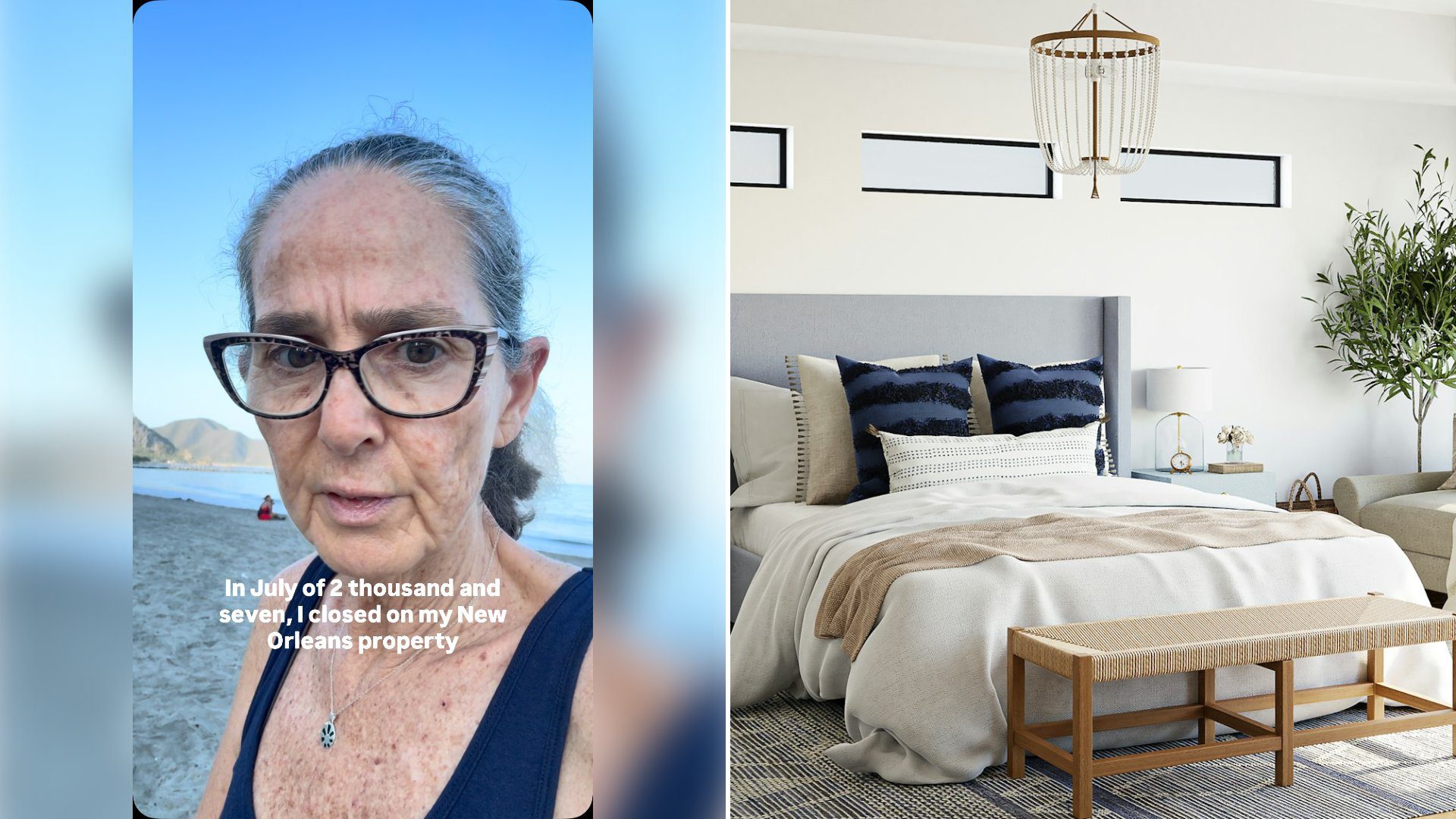
“In July of 2007, I closed on my New Orleans property,” says the woman who posts as @iamjodibrown, walking a beach with a row of white high rises behind her. What came next takes her a few seconds to tell. She packed up, sold “99% of everything I owned,” kept “a small five by five foot storage unit” and “left the country with a backpack.”
She says she left with “a promise to myself” to “try and find somewhere else to live,” and she is blunt about her state of mind: “I was an angry American.” She describes being furious about what she “witnessed happen to US citizens in New Orleans” after Hurricane Katrina, and says, “I wanted to take the money that I had and try and get settled” in another country.
The move abroad is not the subject of the reel, which runs just under three minutes, and she passes over it quickly. “A lot of things don’t work out the way I hope,” she says, “but here’s what I took away from that whole experience.”
What she took away came through a car window. She says she lived in New Orleans for two more years after the storm, and “as I drove through New Orleans” in those years, all she saw on the side of the street, in a cruder word than this one, was junk: things people buy and do not need, “things that we consume that don’t do anything but weigh us down.” Her caption describes the same drives as “looking at people’s possessions piled on curbs and scattered across yards.”
“I learned that the things that matter most to me are people, places, and experiences,” she says. The caption prints those three words in capitals. The things people work so hard to pay for, she says in rougher language than this, stop counting “when it’s all over and said and done” and your belongings are out in the yard, “wet and damaged.” Her next line: “What really starts to matter is the people in your life.”
Then she turns to the viewer. “I’m going to put an offer out to all of you now,” she says, “as things are starting to change in our later years and we’re surrounded by all of our stuff.” The offer is an assignment: “I want you to take a peek at everything you have surrounding you and make a decision about what you need and what you don’t need.” Her caption prints the question in capitals: “WHAT DO I ACTUALLY NEED?”
Her argument is about options more than tidiness. “You’re surrounded by a bunch of things that are weighing you down,” she says, “and keeping you from being able to make more fluid choices.” The caption puts it this way: “Some of the stuff surrounding you may be doing more than taking up space. It may be limiting your options.”
Her own record is the evidence she offers. “I’ve lived in studio apartments since 2007, almost 20 years,” she says. “I have never gotten into acquisition mode again.” The payoff, in her words: “It keeps me limber and it keeps me able to adjust and move” and to “accommodate environments quickly, because I’m not trying to liquidate everything I have.”
Her recommendation is addressed to viewers “who are concerned about the coming” months and years, people she describes as “staring down the barrel of our aging life.” For them, she says, “it’s time to just make a list of the things that you need” and get rid of what is not on it. For anyone short on cash she adds a second step. “You need a little bit of money? Start selling some stuff on Facebook Marketplace,” she says. “Start looking at selling some stuff on Etsy or the other platforms.”
Her audience is women looking at their later years, and the caption is tagged for women over 60, but the method works in a house full of kids too. Write the need list first, away from the stuff. Her instruction is to list what you need, not to sort what you have. A list made at the kitchen table, before a single cabinet is opened, keeps each object from arguing its own case.
Apply the two exclusions from her caption while you write it: “Not at what you like. Not at what you paid for.” If the only reasons for keeping something are that you are fond of it or that it cost a lot, by her rule it does not go on the list.
Set a hard size for what stays off the list but stays in your life. She did not sell everything. She sold 99 percent and kept what fit in a storage unit five feet by five feet. A household version is one closet shelf or one lidded bin per person for keepsakes, chosen before the sorting starts.
Sell before you donate if the money would help. She names Facebook Marketplace and Etsy, and her caption says the proceeds “can help fund whatever comes next.” Photograph and list the items the same week you pull them, so they leave the house instead of moving to the garage.