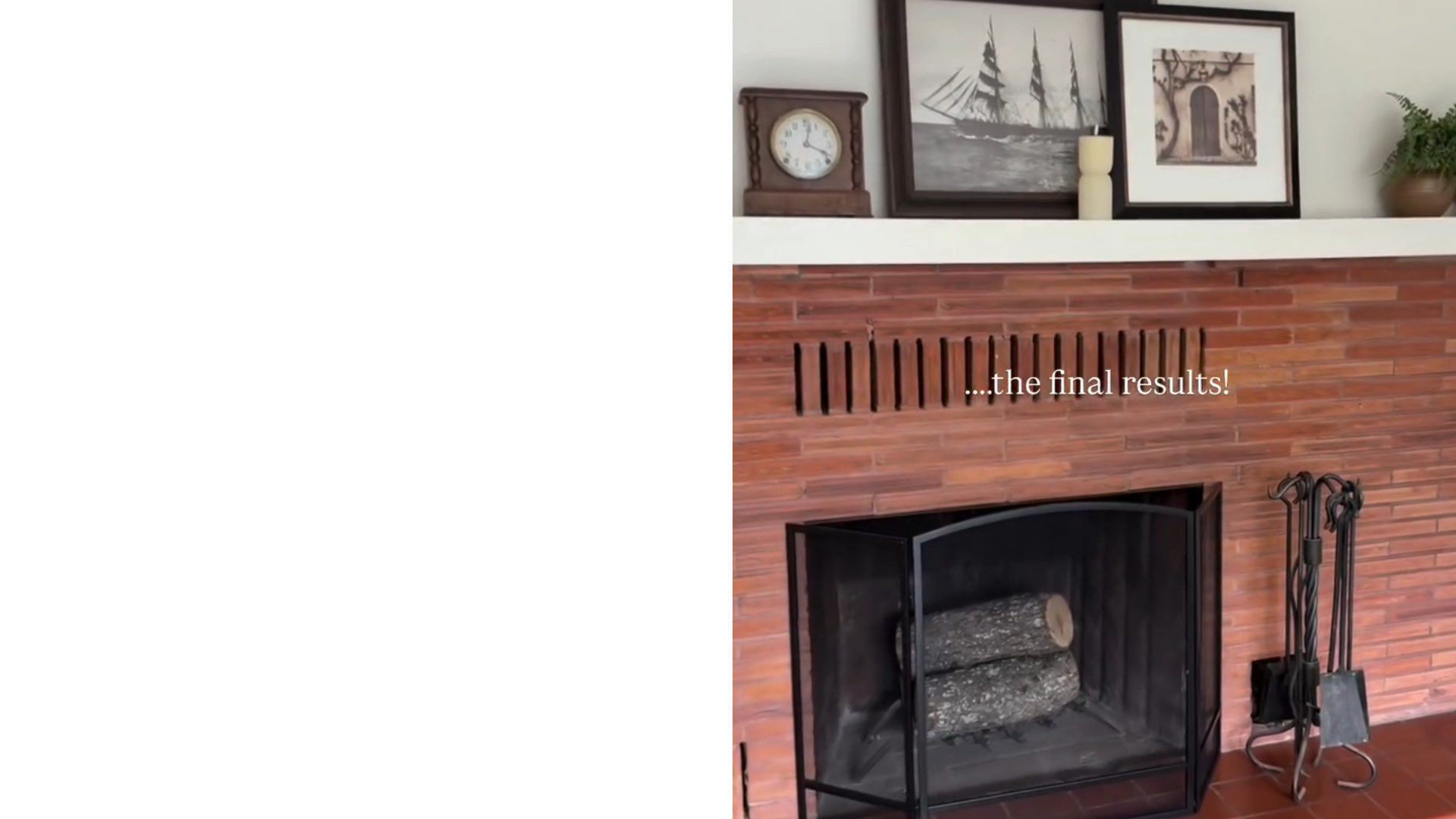
A house-flipper documenting her latest project on Instagram opened up a plain drywall wall expecting nothing behind it and hit brick instead: a fully intact fireplace dating to 1958, still standing in one piece under decades of cover-up. The reel has pulled in roughly 2 million views, a figure her own account puts at 239.4 times her typical post, and it’s easy to see why. Watching a hammer punch through drywall to reveal an untouched piece of the original house hits differently than another cabinet reface.
What the Reel Actually Shows
The footage follows a demolition moment mid-flip: a section of flat, featureless wall comes down in chunks, and instead of studs and insulation, a brick firebox and mantle surface emerge, dust and all. Based on the build date she cites, the fireplace predates whatever remodel buried it, meaning at some point a previous owner chose to wall over a working hearth rather than remove it. That decision, unremarkable at the time, is exactly what makes the reveal land decades later.
Why 1950s Fireplaces Keep Turning Up Behind Drywall
This isn’t an isolated find. Renovators document versions of it often enough that it functions as its own genre online. Atomic Ranch, which covers mid-century home renovations, featured a similar case in a 1970s Palm Springs project where a contractor tore a wall of mirrored cladding off a fireplace and found intact concrete brick underneath. The pattern tracks with a broader decline in how fireplaces were built and treated over time. The National Association of Home Builders found fireplaces were installed in just 41% of new single-family homes by 2018, down from 57% in 2001, and according to HomeLight’s own reporting on that data, fireplace counts nationally fell from an estimated 17.5 million in 2014 to around 13 million by 2016. As tastes shifted toward gas inserts, open floor plans and central heating, plenty of owners opted to cover an old masonry fireplace rather than deal with removing it.
That covering-up habit is exactly what makes a moment like this one land so hard for viewers. A wall that looks like nothing is, in a real share of older homes, hiding a structural and decorative feature that a previous owner covered rather than removed.
What the Discovery Actually Does for the Flip
The financial case for an original fireplace is more modest than the viral reaction suggests. A certified general real estate appraiser cited in HomeLight’s reporting estimated a fireplace might add somewhere between $500 and $1,000 to a home’s value, if it moves the number at all, and NAHB data shows only 16% of homebuyers consider a fireplace an essential feature. So the reveal isn’t a windfall by the numbers. What it does buy a flipper is a genuine focal point and a story for the listing, something original and structural in a market full of homes that all got the same beige update. For a flip specifically, restoring rather than re-covering a found feature like this can be the difference between a living room that looks staged and one that looks like it belongs to the house.
There’s also a practical upside buried in the discovery itself: an intact 1958 firebox means the structure survived whatever renovation covered it without being gutted or damaged, which is not guaranteed. Plenty of covered fireplaces get discovered with cracked liners or missing hardware, turning a fun reveal into an expensive inspection.
If You Think a Wall in Your Own House Might Be Hiding Something
Homes built in the late 1950s and early 1960s are the likeliest candidates, since that’s roughly the window when brick and stone fireplaces were standard in new construction before builders shifted toward simpler, cheaper heating setups. A few signs are worth checking before you assume a wall is just a wall: an odd bump-out or extra-thick section of drywall, a chimney visible on the roofline or exterior that doesn’t line up with any fireplace inside, or a rectangular seam in the drywall texture that doesn’t match the rest of the room. None of those guarantee a hidden hearth, but they’re the same tells renovators say led them to the discovery in the first place.
If you do find one, a professional inspection matters more than the demolition footage suggests. A firebox that’s been sealed for decades can have a deteriorated flue liner or blocked chimney, and running a fire in an unverified original fireplace before that gets checked is a genuine hazard. The reveal is the fun part. Making sure the thing you uncovered is safe to actually use is the part that doesn’t make it into the reel.
The Bigger Renovation Lesson
What keeps this kind of reveal resurfacing on renovation accounts has less to do with dollar value than with a reminder worth sitting with: plenty of “updated” older homes are just older homes with a layer stapled over them. Before you drywall over, panel over or tile over anything original in a house built before central air was standard, it’s worth checking what you’d actually be burying.