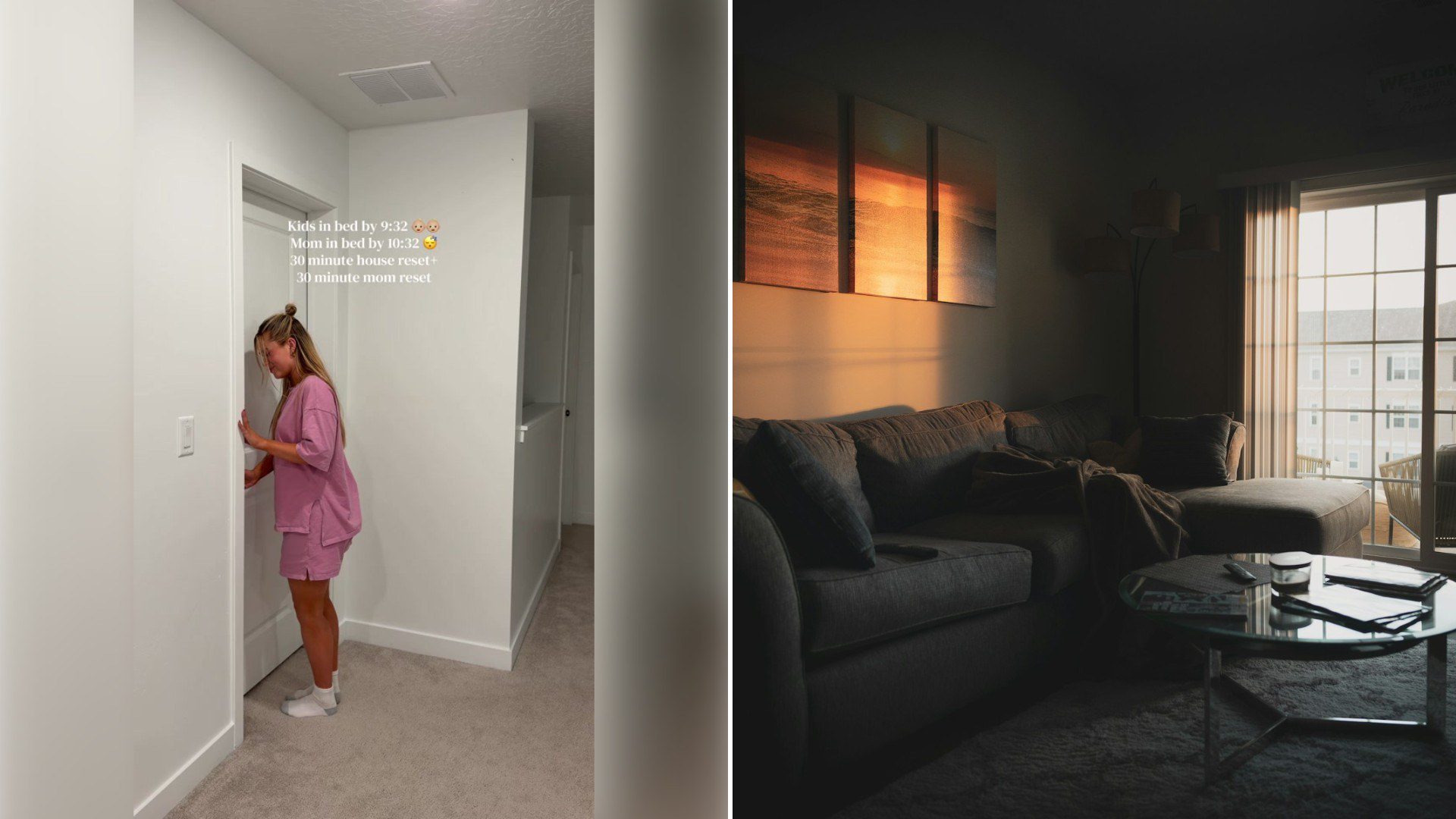
A creator posting under the handle kylensuttner documented her actual nighttime routine once the kids are finally asleep: a fast-paced reset of the house, followed immediately by a separate wind-down routine for herself before bed. Her caption gets specific about the real timing — kids down by 9:32, mom in bed by 10:32.
@kylensuttner Seperate rooms tonight!! Let’s see how this goes 👀👏🏼 Putting the house to bed & mom to bed in one hour!! 🤍🤍#nighttimereset #housereset #momreset #momoftwo #momofboys
There’s no exaggeration for effect here, just a genuine after-hours routine plenty of exhausted parents will recognize immediately. The house reset comes first — straightening, cleaning, resetting surfaces — because doing it while the house is quiet is far more efficient than trying to tidy around active kids earlier in the day.
What stands out is the deliberate second half: a full thirty minutes reserved just for herself afterward, rather than collapsing straight into bed the moment the house is in order. That kind of intentional, protected wind-down time is easy to skip when exhaustion sets in, even though it’s often the difference between feeling recovered by morning and starting the next day already behind.
For parents running a similarly tight evening schedule, the specific, timestamped structure here is worth borrowing even loosely — a defined cutoff for house tasks, followed by a separate block that’s actually protected for winding down, rather than letting one bleed endlessly into the other.
There’s something quietly radical about a parent claiming a dedicated half hour for herself at the end of the day, purely for her own recovery, rather than treating the moment the kids fall asleep as simply the start of chores or the start of unconscious scrolling until exhaustion wins. Naming it explicitly as a separate block — not “whatever’s left after everything else” but an actual planned portion of the evening — signals a level of intentionality that a lot of parents aspire to but rarely manage to protect consistently once real life gets in the way.
The house reset happening first, rather than being squeezed in whenever energy allows, reflects a practical understanding of how limited a parent’s bandwidth actually is by the end of the day. Doing the physical tidying while there’s still enough energy to move efficiently through it, then switching gears entirely into something restorative once the more demanding task is finished, tends to work a lot better than trying to do both at once, or leaving the tidying for whenever there’s leftover energy that may simply never materialize.
Putting an actual number on both halves of the routine — thirty minutes for the house, thirty minutes for herself — does something subtle but important: it turns a vague intention into something concrete enough to actually follow through on. “I’ll relax a little before bed” is easy to abandon the moment something else demands attention; “I have thirty protected minutes starting at ten” is a lot harder to quietly skip, simply because it has a defined shape rather than being an open-ended, easily postponed idea.
Plenty of parents recognize the specific trap this kind of structure is designed to avoid: finishing the house reset, sitting down “just for a minute,” and then discovering an hour has evaporated into mindless scrolling, leaving no actual recovery time and a much later bedtime than intended. A defined wind-down routine, with its own shape and its own endpoint, tends to resist that kind of time slippage far better than an open-ended “relax whenever” approach ever does.
There’s also something worth noting about the specific choice to document this particular routine rather than a more conventionally impressive one. A thirty-minute house reset followed by a thirty-minute wind-down isn’t a dramatic morning routine or an elaborate self-care ritual; it’s a modest, sustainable rhythm built for an ordinary Tuesday night, which is exactly why it resonates. Most parents aren’t looking for an aspirational hour-long ritual involving candles and a five-step skincare routine — they’re looking for something they might actually be able to replicate on a night when they’re already running on fumes.
For parents whose evenings currently dissolve the moment the kids go down — no real structure, no protected time, just whatever happens to fill the hours until exhaustion forces bed — borrowing even a loose version of this two-part structure could make a meaningful difference. It doesn’t require the exact same tasks or the exact same timestamps; it just requires drawing a clear enough line between “house maintenance” and “personal recovery” that the second one doesn’t keep getting quietly absorbed by the first, or skipped altogether once the house is finally back in order.
By the time this particular night wraps up, the house is reset and she’s in bed roughly an hour after the kids went down, with both halves of the evening actually accomplished rather than one perpetually crowding out the other. That kind of consistency, repeated night after night, tends to matter more over time than any single evening’s specific tasks — it’s the difference between an exhausted parent limping through each night and one who’s built a rhythm sturdy enough to actually hold up under the accumulated fatigue of raising young kids.
There’s also a ripple effect worth considering here, one that extends beyond the individual parent’s own recovery. A parent who consistently protects even a small window of personal time tends to show up better the next day — steadier, less frayed, with a bit more patience in reserve for whatever the morning throws at them. That downstream benefit rarely gets mentioned explicitly in these kinds of routine videos, but it’s arguably the strongest argument for treating a wind-down block as non-negotiable rather than the first thing to get sacrificed on a harder night.