A mom who posts on Instagram as like_funny_fam built a 35-second reel around two labels and one swap. The first label, “Don’t do this to your kids,” sits on the screen as she leans over a shaggy gray living room rug in a pink sleeveless top and denim shorts and lowers a baby in a gray onesie into the lap of one of two older girls. The girls are sitting on the floor in front of a gray sectional with a yellow toy xylophone and a few picture books spread around them.
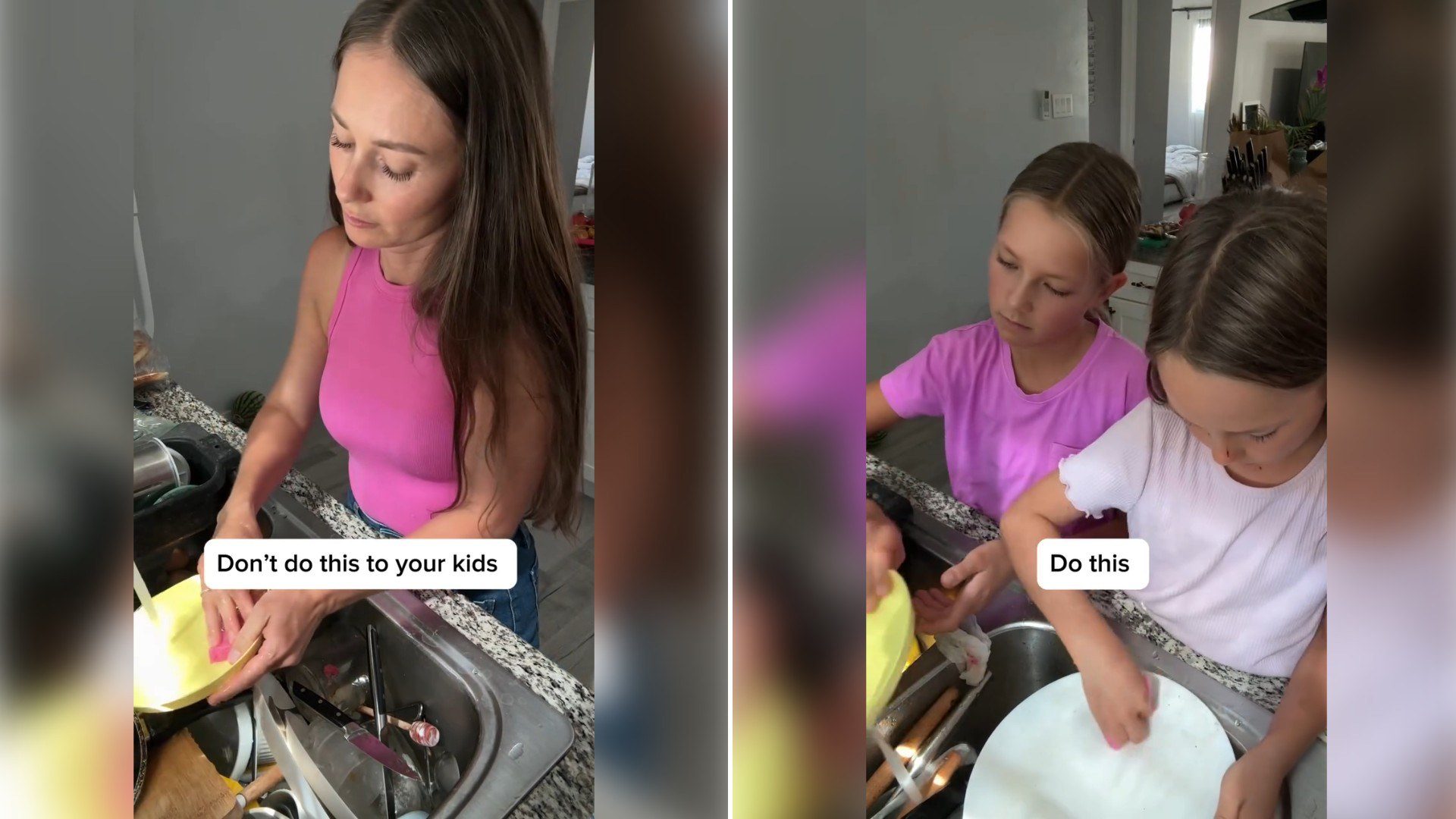
Then she walks off to the kitchen. For roughly the next 15 seconds the camera stays on her at a stainless steel sink set into a speckled granite counter, working a pink sponge over a yellow plate by herself. She looks up from the sink more than once in the direction she just came from. The label never leaves the screen.
The turn comes about 20 seconds in. She steps away from the sink, and the next shot is back in the living room, where she is now the one on the rug. She lifts the baby up, settles into a cross-legged seat with the baby in her lap, and the two older girls get to their feet. One of them, in a purple T-shirt, walks straight past the camera on her way out of the frame while her mom stays put on the floor.
The label changes to two words, “Do this,” and the final stretch of the reel shows where the girls went. They are shoulder to shoulder at the same kitchen sink. The one in the purple shirt has the yellow plate. The other, in a pale pink top, is wiping a white plate with the pink sponge. Both have their heads down over the basin, and their mom is nowhere in the shot.
That is the whole reel. Nothing else is written on the screen, and the caption is three laughing emojis followed by the hashtags #funny, #family, #comedy, #mom and #momlifehacks. She is presenting it as a joke, and the joke lands on the word “to.” The thing a parent should not do “to” the kids, in her telling, is leave them holding the baby. Handing them the dishes is filed under good parenting.
It is a bit, and it is also a fair observation about how chores get divided when there is a baby in the house. The default in the first half is one most parents of more than one child will recognize. The adult takes the housework and the nearest older sibling gets the baby, because it feels like the smaller ask. The reel reverses that and makes a quiet argument along the way that watching a baby is the bigger job of the two.
There is something to that. A sink of plates is a contained task. It has an obvious start and an obvious finish, the worst outcome is a streaky plate, and a child can tell when she is done. Minding a baby has none of those edges. It asks for constant attention, it has no finish line, and the person doing it cannot wander off halfway through. Seen that way, the swap in the video hands the open-ended job to the adult and the finite one to the kids.
The second half also shows a few details that make the handoff workable. The girls are doing the dishes together, side by side, which turns a chore into something closer to a shared project. What is in their hands is plates and a sponge. Nothing sharp and nothing heavy shows up in the sink while they are at it. And the tools are the same ones their mom was using a few seconds earlier, the same sponge and the same yellow plate, so the job they are given is the real one and not a pretend version of it.
For a parent who wants to try the same trade at home, the reel points to a simple order of operations. Start with the dishes that are easiest to handle, like plates and cups, and keep knives and anything fragile for an adult. Put two kids on the job at once if there are two available, one washing and one rinsing or each with a plate. Then take the baby and actually sit down, the way she does on the rug, instead of hovering at the kitchen doorway to supervise.
That last part is the one her video plays for laughs, and it may be the most useful. In the “Don’t do this” half, she is the one glancing up from the sink toward the living room. In the “Do this” half, the camera stays on the girls at the sink and she is out of the frame entirely. The swap only works as a break if the parent lets the plates be washed the way a kid washes them.
None of it needs a chore chart. Her version takes 35 seconds, two labels and a pink sponge, and the idea behind it fits in one line. When there is a baby and a pile of dishes, the kids can take the dishes.