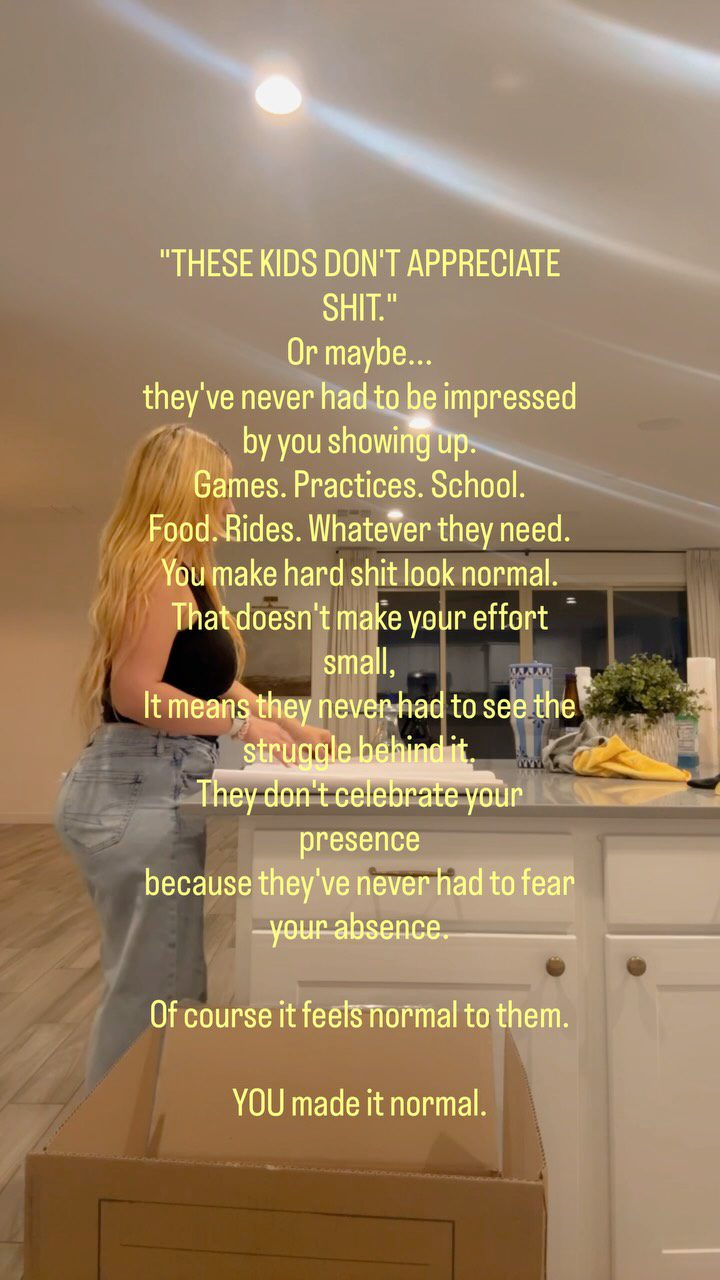
The video is 17 seconds of a mom putting things in a box. @lmnuxx stands at a white kitchen counter in a black tank top and jeans, picks up something wrapped in white paper, bends to set it inside a large cardboard box in front of her, straightens up and reaches for the next one. It is dark outside the windows behind her.
The reason to watch is the block of yellow text laid over the whole frame. It opens in capital letters with a line plenty of parents have muttered to themselves, “THESE KIDS DON’T APPRECIATE SH*T,” and then turns on two words: “Or maybe…”
What follows is the other way to read the same evidence. “They’ve never had to be impressed by you showing up,” the text continues. “Games. Practices. School. Food. Rides. Whatever they need.” Then: “You make hard sh*t look normal. That doesn’t make your effort small, It means they never had to see the struggle behind it.”
The line that carries the most weight comes next. “They don’t celebrate your presence because they’ve never had to fear your absence.” The message closes with two short sentences set apart from the rest: “Of course it feels normal to them. YOU made it normal.”
The text does not scroll or change. It sits on screen for the full clip while she keeps packing. In her caption she notes that another creator wrote the words, and then she adds her own. “I’ve learned so much along the way. I try to be a better mom every single day,” she wrote. “I lose my patience, I argue, a slip, I forget. But one thing my kids can never say is that I wasn’t there. I’ve been there day in day out and I’m never skipping a beat.”
The pairing of the words and the chore is what makes the post work. Nothing in the frame is remarkable. There is a counter with a potted plant, a blue and white vase and a yellow cloth on it, a row of white cabinets, and a woman doing a job that has to get done. That is exactly the kind of effort the message is describing, the kind nobody claps for because it has always been there.
For a parent who has said the first line out loud this week, the message offers a useful swap. A child who shrugs at a ride to practice has not weighed the ride and found it lacking. The ride has simply never failed to show up. Seen from the receiving end, reliability looks like nothing at all, and the text asks parents to count that as the win.
Her caption adds a standard that is easier to live with than thanks. She does not claim to be patient or calm or organized. She lists the ways she falls short and then names the one thing she will not give up, which is being there. That is a bar a tired parent can clear on a bad day, and it does not depend on anyone noticing.
None of this means kids should never learn to say thank you. It means the lesson goes better when it is taught rather than demanded. A few ways to do that at home:
Say what went into something, plainly and without guilt. “I left early so I could get you to the game” is information. Kids cannot appreciate work they have never been shown.
Hand over a piece of the job. A child who packs the snack bag or carries the gear to the car learns what “whatever they need” takes, far faster than one who is told about it.
Thank the other adults in the house where the kids can hear it. Gratitude that children see traded between grown-ups for dinner, rides and laundry becomes the way people in the family talk.
Get your own acknowledgment somewhere else. A partner, a friend or another parent can say “I see how much you do” in a way a ten-year-old cannot, and asking for that is not weakness.
And on the nights when the first line of the video feels truer than the rest of it, keep the last one handy. If it feels normal to them, somebody made it normal.