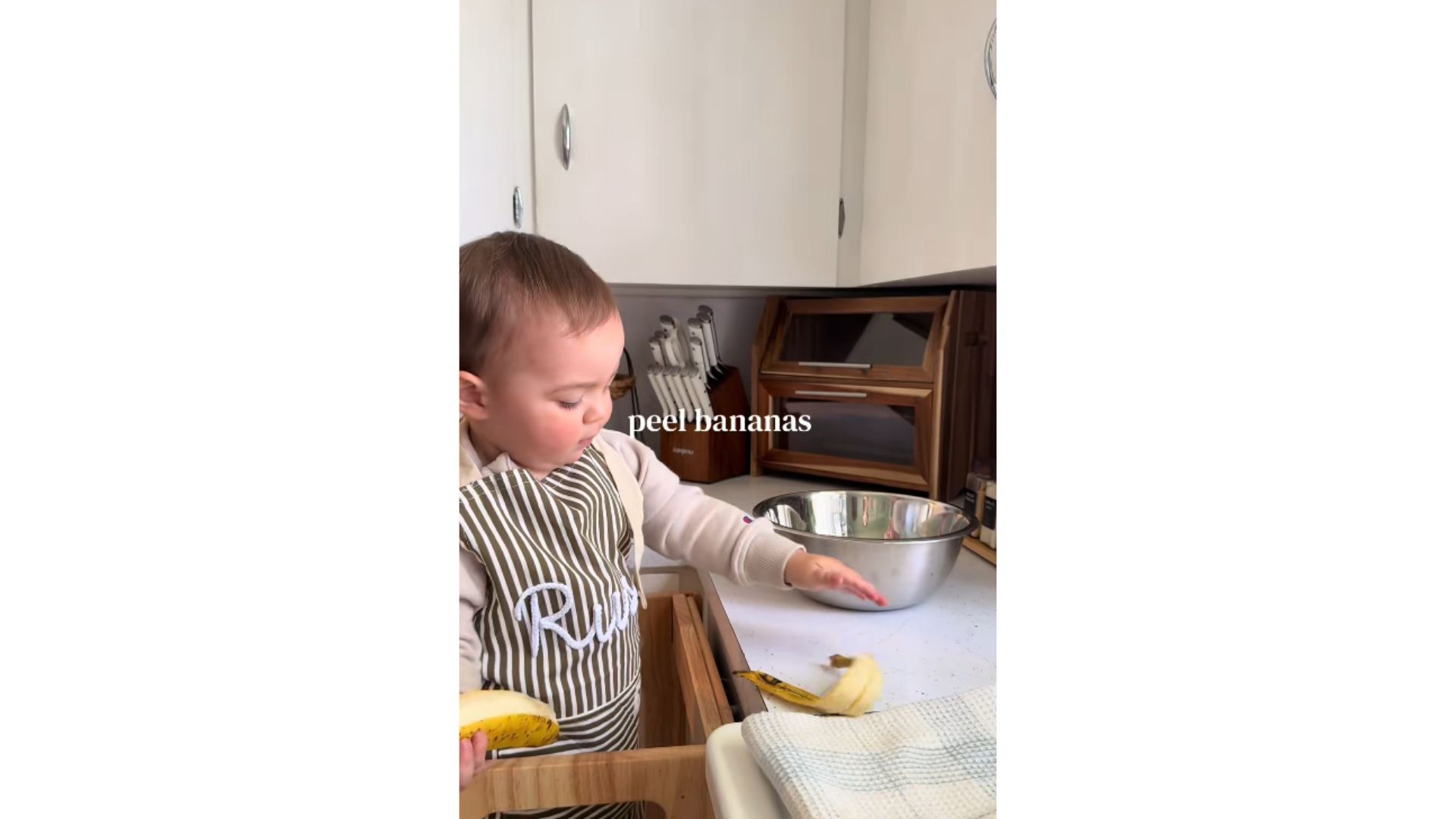
Deanna Knight started teaching her son basic kitchen skills when he was just 12 months old, and the videos she’s shared on TikTok as @knightfamilycontent show a toddler handling simple cooking tasks that surprise a lot of viewers who assume kids that young aren’t capable of much in the kitchen.
In her videos, Knight shows her son working through age-appropriate tasks — pouring, stirring, mixing pre-measured ingredients — using tools designed specifically for small hands, like child-safe knives and stable step stools that let him reach the counter safely. She says she’s gradually increased his responsibility over time as he’s grown more capable, rather than handing him complex tasks all at once.
What comes through clearly in the videos is the presence of constant, close supervision. Knight is shown directly alongside her son throughout each task, guiding his hands when needed and stepping in immediately around anything sharp, hot or otherwise requiring an adult’s direct control. The videos don’t depict a toddler cooking unsupervised — every task shown involves an adult within arm’s reach, actively managing the parts of the process that would be unsafe for a child his age to handle alone.
That distinction is central to how the content is meant to be understood. Starting kitchen skills early, according to Knight, isn’t about independence in the sense of a toddler operating a stove or handling anything dangerous on his own — it’s about building familiarity and confidence with food preparation through small, safe, closely supervised tasks that scale up gradually as a child demonstrates readiness for more.
Knight has said in her videos that toddlers are generally capable of far more than adults tend to assume, provided the tasks are matched to their actual developmental stage and the right safety setup is in place. A one-year-old stirring a bowl with an adult holding it steady is a very different scenario than a young child using a real knife unsupervised, and Knight’s content draws that line explicitly by showing exactly which tools and safeguards are in use at each stage.
The videos have sparked plenty of parenting debate, with some viewers enthusiastic about the early independence-building approach and others expressing hesitation about introducing kitchen tasks so young at all. That kind of split reaction is common for parenting content that departs from a more conventional timeline, and Knight’s response has generally been to point back to the specific safety measures shown in each clip — the child-safe tools, the constant supervision, the incremental pacing — as the actual substance of her approach, rather than the headline detail of the starting age alone.
The Takeaway
Introducing kitchen tasks early can be a genuinely engaging way to build a child’s confidence and fine motor skills, but the safety setup matters far more than the specific age you start. If you’re considering something similar, invest in tools actually designed for small hands — child-safe knives, stable stools, pre-measured ingredients — and never leave a young child unsupervised around anything sharp, hot or otherwise hazardous, regardless of how capable they seem. Start with the simplest possible task, like stirring or pouring, and let a child’s own demonstrated readiness, not a timeline you saw online, guide how quickly you add responsibility. Every child develops at a different pace, and what works safely for one family’s toddler won’t necessarily translate directly to another’s without the same level of hands-on supervision.