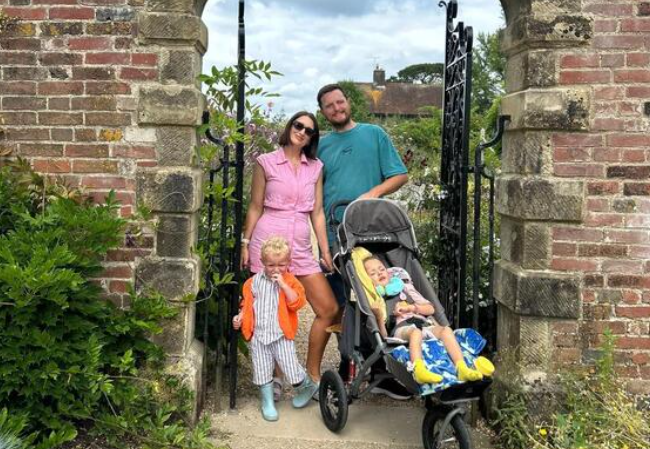
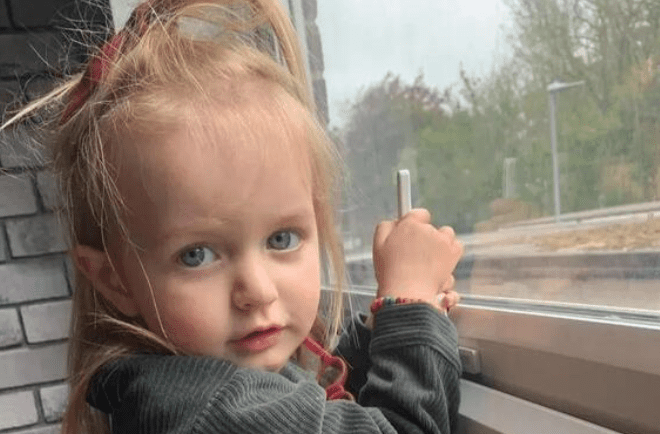
A year ago, Megan Gillett’s heart was full as she listened to her daughter Nellie break into a fit of giggles, a sound so ordinary, so effortlessly joyful, that no one in that room could have known they were hearing it for the last time. That laugh is gone now. And so is nearly everything else that once made Nellie, now six years old, the little girl her mother had imagined raising. She is slowly becoming paralyzed, losing her memory, and according to doctors, she is not expected to live past the age of eight. What makes this story so difficult to sit with is not just the grief of a family watching their daughter disappear, it is the knowledge, painful and permanent, that it did not have to happen this way. As reported, Nellie could have been saved if her condition had been caught before it took hold.
Nellie Oakshott was diagnosed at two years old with infantile metachromatic leukodystrophy, a rare inherited disorder that quietly destroys the white matter of the brain and cuts off the signals the brain sends to the rest of the body. There is no noise when it begins. No dramatic moment that sends parents running to a hospital. It arrives in whispers, a slightly unusual way of moving, a subtle developmental difference that can too easily be explained away. And that is exactly what happened to Nellie. MLD can be cured if caught before symptoms appear. The window is real. The treatment exists. But Nellie was already symptomatic by the time anyone put a name to what was happening inside her body, and by then, that window had closed.
The Signs That Were There All Along
It was Megan’s own mother who first sensed something was off. When Nellie was just ten months old, her grandmother noticed that her movements seemed a little unusual not dramatically wrong, but different enough to stay in the back of her mind. Megan, 38, who lives in Eastbourne, England, has been honest about why she didn’t see it herself at first. Nellie was born during Covid, she was Megan’s first child, and without other babies to compare her to, the subtle signs simply didn’t register. When Megan followed her mother’s instinct and took Nellie to their GP, the doctor was also puzzled and referred her to a physiotherapist. The physio reassured the family that nothing was wrong, Nellie was just more flexible than average. A pediatric consultant later reached the same conclusion, telling Megan and her partner Tom Oakshott, 41, that there was nothing to worry about.
Those reassurances are not uncommon in stories like these, and they are not given carelessly. MLD is extraordinarily rare, and its early signs can mimic hypermobility, developmental variation, or a dozen other things that resolve on their own. But the consequence of missing it is absolute and irreversible. Tragically, within just three months of Nellie’s eventual diagnosis, she lost the ability to move, talk, eat, or sit up. A brain scan revealed that significant damage had already been done. As Megan put it plainly: if MLD had been caught at ten months old, they could have saved her.
A Disease That Moves Without Warning
Metachromatic leukodystrophy is caused by a faulty gene that prevents the body from producing an enzyme called arylsulphatase A. Without it, a harmful substance builds up in the brain and nervous system, gradually blocking the signals that allow the body to function. The infantile form, which Nellie has, is the most common and the most aggressive. Children who go untreated long enough will face paralysis, deafness, blindness, and dementia. Megan has spoken about watching Nellie move in and out of awareness , some moments present and responsive, others lost to the fog the disease creates. “The dementia is incredibly tough,” she said. “Sometimes she’s there, and sometimes she’s not.” And yet, despite all of this, Megan is clear that Nellie is not defined by her illness. She describes her daughter as happy, aware, and a joy, a little girl who has somehow never let what is happening to her body diminish who she is.
There is a treatment called Libmeldy that can halt MLD by inserting healthy copies of the faulty gene into a patient’s stem cells. But it only works before the disease becomes symptomatic. Nellie’s condition was already too far advanced. When Megan became pregnant with her son Ozzy after Nellie’s diagnosis, he was tested for MLD in the womb and was clear. A second family , Ally and Jake of Northumberland were not so straightforwardly fortunate. Their older daughter Nala had MLD and was too advanced for treatment, while their younger daughter Teddi was caught in time and was able to receive Libmeldy. The contrast between those two children one saved, one not is the most precise illustration of what newborn screening could mean.
The Fight for Earlier Detection
Nellie’s case was raised in Parliament by Boris Johnson in 2022, and yet nothing has changed for families navigating MLD in the years since. Charities including ArchAngel MLD Trust, MLD Support Association UK, and MPS Society are actively campaigning for MLD to be added to the newborn heel prick screening test offered to all babies in the UK. That test, given in the first days of life, already screens for several rare but treatable conditions. MLD advocates argue that adding it to that list would give families the earliest possible chance of catching the disease before it causes irreversible harm. The NHS currently only tests the siblings of children already diagnosed — meaning that unless a family already has a child with MLD, there is no systematic way to find it before damage is done.
Megan has channeled her grief and her anger into advocacy and documentation. She shares moments from Nellie’s life on her Instagram, @megan_mumma_sunshine, not to perform suffering but to show that there is life and love and joy happening even in the middle of something devastating. She also has hopes of writing a book — one that is not about dying, but about living. When Nellie was first diagnosed, every resource Megan found was focused on loss. She wants to write the version that wasn’t there when she needed it. In the meantime, she and Tom are focused on the time they have. Nellie is still here. She is still, in her mother’s words, a wonderful little girl and a joy. And every moment with her, Megan holds onto.
More from Decluttering Mom: