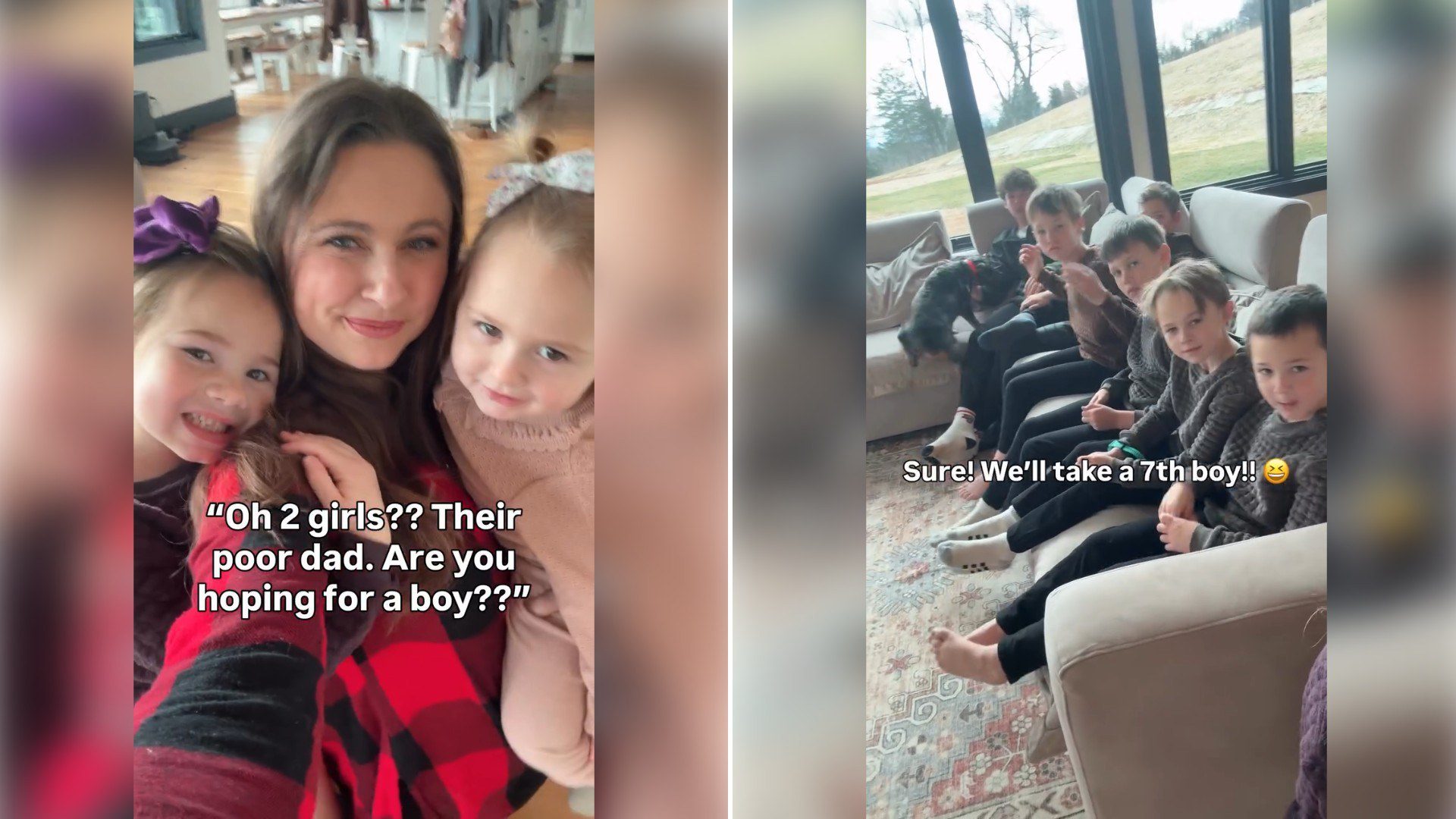
There’s a question that follows mothers of multiple boys around like a shadow, asked by strangers, acquaintances, and sometimes even family members with an assumption baked right into the phrasing: “Are you going to keep trying for a girl?” It’s a question that carries a lot more judgment than most people realize, implying that a house full of sons is somehow an incomplete outcome rather than simply a family. One mother decided to answer that exact question head-on, in a video that pulled no punches and needed only a single, undeniable fact to make her point: she has six sons.
Filmed on what looks like an ordinary evening out with her two youngest while the older six were off at football, the video frames the moment with a kind of weary but confident humor. She’s not defensive so much as simply done — done justifying her family, done fielding a question that treats her children as an outcome to be corrected rather than a family to be celebrated. The caption laid it out plainly: “POV: Me tonight out with just the youngest two while the older 6 are at football. Why are the commen…” — the trailing thought clearly gesturing toward the exact kind of intrusive question she’s addressing in the clip itself.
The response was massive. The video reached roughly 1.6 million views on an account with around one million followers, a strong performance even relative to an already sizable audience, suggesting the message resonated well beyond her usual followers and into the broader conversation about how society talks to parents of same-gender sibling groups. As @arielctyson made clear in her post, six sons isn’t a phase she’s working through on the way to some other desired outcome — it’s simply her family, full stop.
There’s also something worth noting about how the visibility of her family’s scale — six sons old enough to attend football practice together — carries its own kind of quiet authority. It’s difficult to look at a family that large and functioning and still frame it as somehow incomplete, and the video’s simple, confident presentation let that reality do most of the persuading on its own.
The “trying for a boy” or “trying for a girl” question, while often intended as harmless small talk, touches on something researchers and parents alike have pushed back on for years: the implication that a family isn’t complete until it includes a specific gender balance. For parents of multiple children of the same sex, that question can start to feel less like curiosity and more like a subtle critique, suggesting their family is unfinished business rather than a deliberate, loved unit exactly as it is. Mothers in particular tend to bear the brunt of this line of questioning, often repeatedly, sometimes from complete strangers who feel entitled to comment on family size and composition as though it were public property.
What makes this video land so effectively is the tone. Rather than responding with anger or a lengthy explanation, she lets the sheer scale of her family speak for itself. Six sons, plus whatever the football schedule implies about the logistics of raising them, is its own kind of answer — a life clearly full, structured, and by every visible indication, working. The humor in showing up to an evening out with “just” two kids, treating that as a rare and notable event, underscores just how large and demanding her day-to-day reality actually is, without needing to spell it out in a single word of complaint.
For parents who have faced similar comments about their own family size or gender makeup, this kind of public pushback offers a useful script worth borrowing. Responding to intrusive questions with simple, confident facts — rather than a defensive justification — tends to shut down the underlying assumption more effectively than trying to explain or apologize for a family that needs no explanation. It also reframes the conversation in a healthier direction: from “why don’t you have a daughter” to “here’s what my actual life looks like,” which is a far more accurate and respectful way to engage with any family’s makeup.
It’s also worth noting how this kind of video functions as a small but meaningful cultural correction. For years, media narratives around families with multiple children of the same gender have leaned into a kind of running joke about “trying again” for the opposite sex, often without much thought for how that framing actually lands on the people living it. A mother directly and confidently addressing that narrative, in her own words and on her own terms, chips away at an assumption that has gone largely unchallenged in casual conversation for a very long time.
There’s a broader lesson here, too, about the casual comments people make regarding other people’s families without much thought to how they land. Family size, gender composition, and reproductive choices are deeply personal, often shaped by circumstances, health, finances, and preference that outsiders have no visibility into. A mother of six sons doesn’t owe anyone an explanation for why there isn’t a seventh child chasing a different outcome, and this video, watched by well over a million people, served as a clear, confident reminder of exactly that.