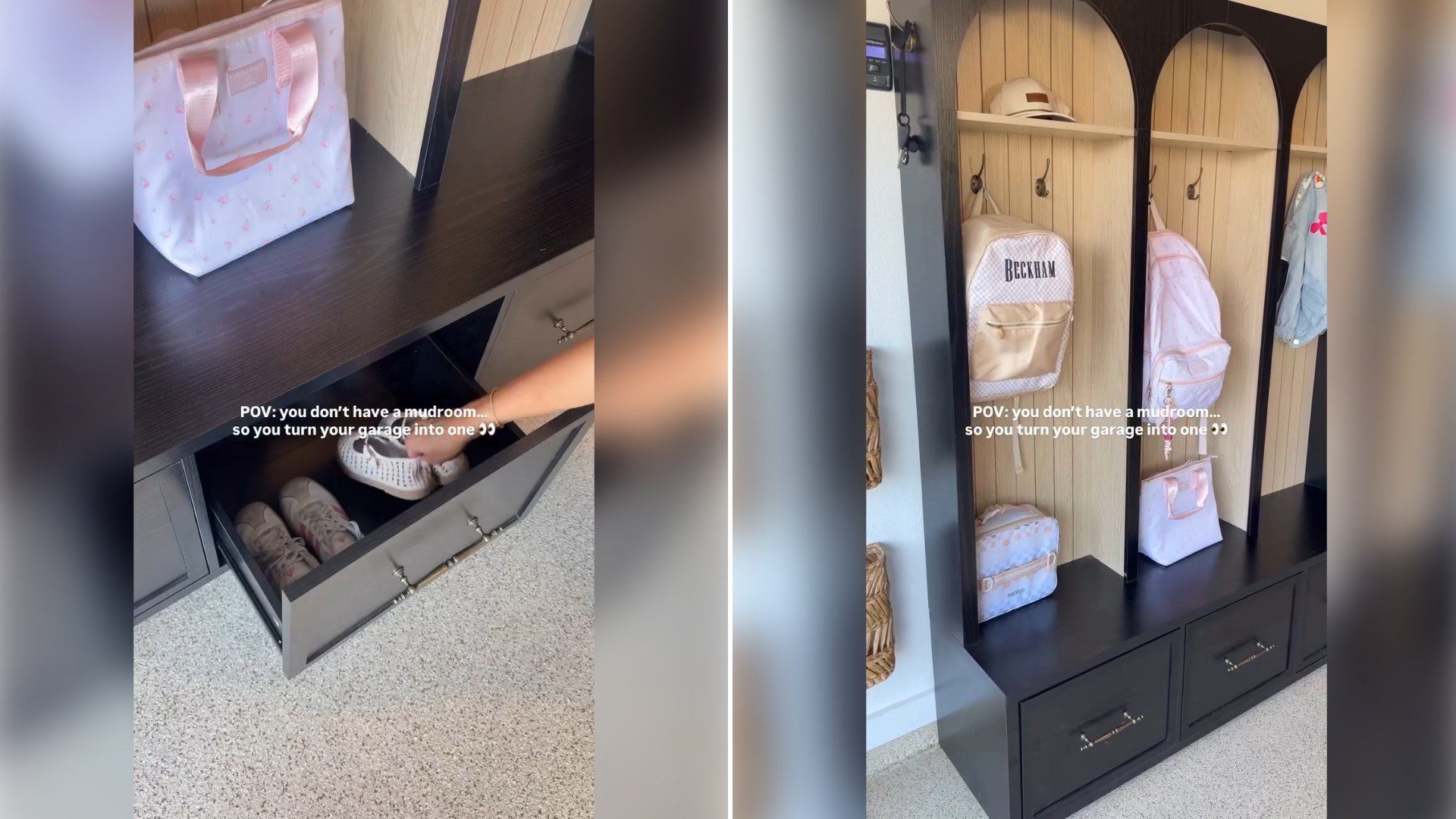
Anyone with school-age kids knows the daily gauntlet that happens the second everyone walks through the front door: backpacks dropped in the middle of the hallway, shoes kicked off wherever they land, sports bags abandoned on the stairs, and jackets that never quite make it to a hook. It’s a scene so universal it barely registers as a problem until it piles up into a full-blown entryway disaster. One family decided to tackle that chaos head-on, turning a section of their garage into a full mudroom complete with a built-in locker system, and the transformation clearly struck a chord with viewers.
The project, shown as a joint effort between parent and child, walks through the process of converting an ordinary, underused garage corner into a dedicated drop zone — a place where every backpack, cleat, and jacket finally has an assigned home instead of drifting wherever it happens to fall. Built-in lockers, in particular, have become a favorite feature among home organization enthusiasts precisely because they solve a problem that generic hooks and baskets rarely fix: they give each family member individual, contained space, cutting down on the daily scramble to find a missing shoe or a specific backpack buried under someone else’s gear.
The caption leaned into the relatable chaos that prompted the whole project in the first place: “makeshift drop zone for all the school & sport chaos 😅,” inviting followers to comment for design details. That kind of direct engagement — turning a home project into an interactive resource rather than just a showcase — is a big part of why the video performed so well, pulling in roughly 1.7 million views from an account already sitting at nearly a million followers. Even for a creator with that level of existing reach, a result well beyond typical engagement signals that this particular project tapped into something a huge number of parents are quietly struggling with.
As @sierra.honeycutt showed in her post, the appeal of a mudroom or locker system goes beyond aesthetics. It addresses one of the most persistent friction points in family life: the daily transition between “outside world” and “home,” which for households with kids in school and sports can happen multiple times a day, each time depositing another layer of gear near the front door. Without a designated system, that gear tends to migrate — backpacks end up on kitchen chairs, shoes end up in the living room, and what should be a five-second drop-off turns into a running source of household tension.
What also stands out about this particular project is that it was a shared effort between parent and child rather than something done entirely behind the scenes. Involving kids in building or setting up their own designated space tends to make them more invested in actually using it, according to many parenting and organization experts. A locker that a child helped build or personalize is far more likely to get used consistently than one simply assigned to them after the fact. That small shift — from imposed system to co-created solution — can make the difference between an organizational upgrade that sticks and one that quietly falls apart within a few weeks.
For families dealing with their own version of entryway chaos but not ready to take on a full garage build-out, there are smaller-scale versions of the same principle worth borrowing. Assigning each family member a specific hook, bin, or shelf — rather than one shared catch-all space — mirrors the individualized logic of a locker system without requiring construction. Placing that drop zone as close as possible to the actual entry point families use most, whether that’s a garage door, side door, or mudroom, also matters more than people tend to expect; even a great system fails if it’s inconveniently located relative to how a family actually moves through their home. And building in a regular reset, even a quick five-minute pass each evening to return the drop zone to a baseline of order, helps prevent the kind of slow pileup that eventually demands a full weekend cleanout.
It’s also worth pointing out how much this kind of project reflects a broader shift in how families think about garage space in general. Garages have traditionally been treated as overflow storage — a place for tools, seasonal decorations, and whatever doesn’t fit inside the house proper. Repurposing even a section of that space into a functional, everyday-use mudroom signals a growing recognition that the transition zone between “outside” and “inside” deserves just as much intentional design as any other part of the home, especially for families juggling the constant in-and-out rhythm that comes with school and extracurricular activities.
Ultimately, what this video captures is something a lot of parents feel but rarely solve: the daily war against gear that has nowhere designated to go. A built-in mudroom won’t eliminate the chaos of school and sports schedules, but it gives that chaos somewhere contained to land, which, for a lot of exhausted parents scrolling past this video, looked like nothing short of a small miracle.