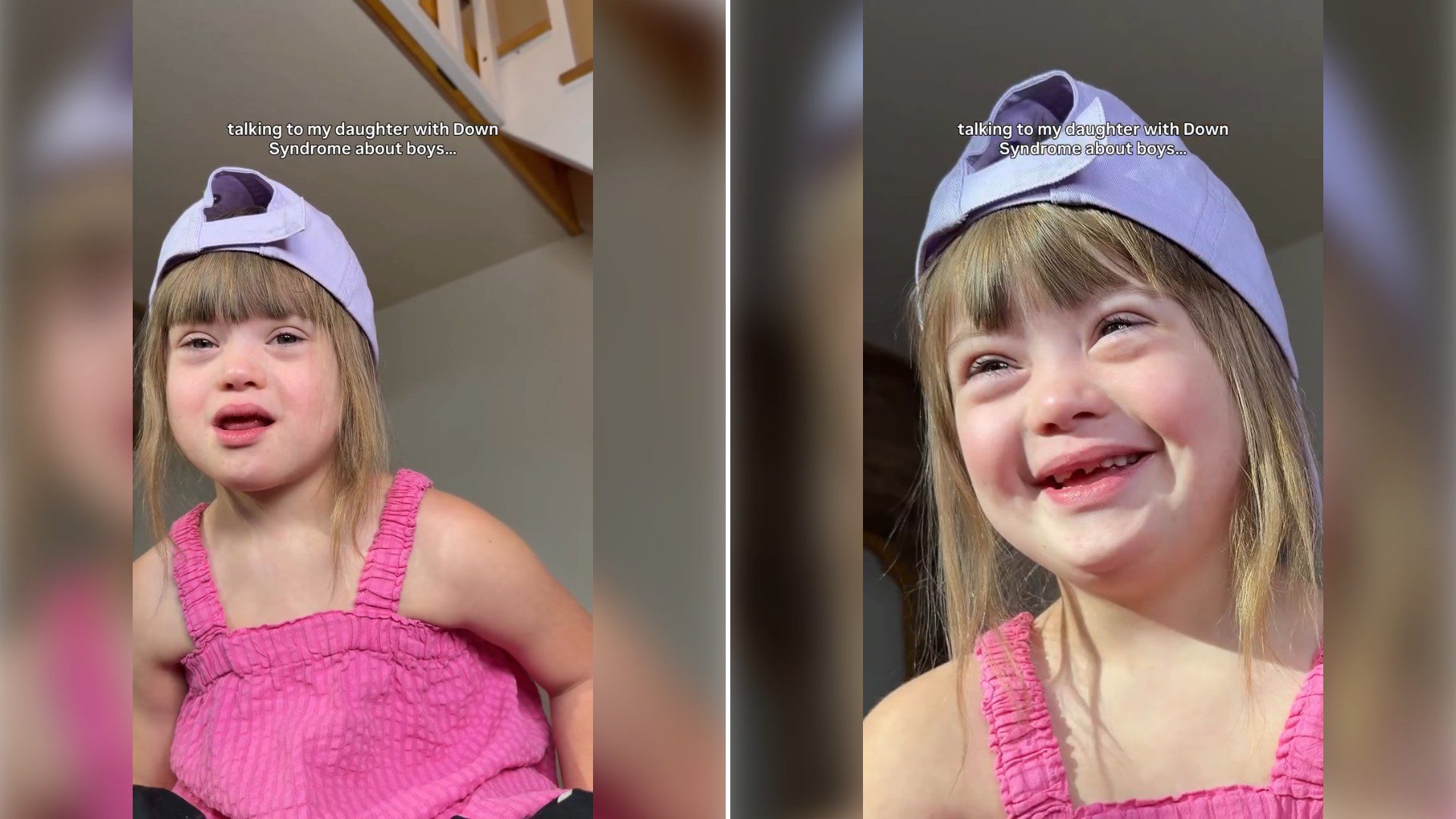
Some conversations as a parent you rehearse for years without ever quite feeling ready when they arrive. That’s exactly what happened to creator @thesponslercrew, who shared an unforgettable moment of talking with her daughter, who has Down syndrome, about boys. Her caption said it all: “my life flashed before my eyes.” In just a few seconds of video, she captured something so many parents of kids with disabilities rarely see represented online — the universal, slightly terrifying, deeply tender territory of watching your child grow into someone with crushes, curiosity, and a whole inner world of their own.
What makes this clip resonate so widely isn’t just the humor of the moment, though there’s plenty of that in the mortified-mom energy she brings to the retelling. It’s the quiet reminder that kids with Down syndrome experience the same milestones, emotions, and social curiosities as their peers, even though representation of that reality is still rare in mainstream parenting content. For years, disability representation online skewed toward either inspirational montages or clinical milestones — first steps, therapy wins, diagnosis days. What’s refreshing about this video is that it’s simply a mom having an ordinary, slightly awkward talk with her daughter about boys, the same conversation millions of parents have had regardless of their child’s abilities.
Parenting a child with Down syndrome comes with its own learning curve, and much of it has nothing to do with medical appointments or developmental charts. It has to do with navigating the same growing-up moments every family faces — just sometimes on a different timeline, and almost always without a roadmap for how to talk about them. Conversations about crushes, friendship, and boundaries are part of that terrain, and parents in these communities often say they crave exactly this kind of content: unscripted, funny, real, and free of the saccharine “inspiration porn” tone that so often gets applied to disability stories.
There’s also something powerful in the specific phrase she chose: “my life flashed before my eyes.” Any parent of a tween or teen, disabled or not, knows that feeling. It’s the moment you realize your child is becoming a person with private thoughts, preferences, and an interior life you don’t fully have access to anymore. For parents of kids with intellectual or developmental disabilities, that realization can hit with extra weight, because society so often infantilizes these children well past the age when their peers are granted independence and privacy. Seeing a mom react to her daughter’s blossoming social awareness with humor rather than alarm models something valuable: treating the moment as normal, because it is.
The comments section on posts like this tends to fill quickly with other parents of kids with Down syndrome or other disabilities, many of whom say they’ve never seen their exact experience reflected online before. That sense of recognition matters enormously in a parenting landscape that can feel isolating for families raising kids outside the “typical” developmental script. A thirty-second video can do what years of advocacy campaigns sometimes struggle to: it normalizes a lived experience simply by showing it, without narration or explanation, letting the humor and tenderness speak for themselves.
It’s also worth noting how this fits into a broader shift in how disability and parenting intersect on social media. A decade ago, content about raising a child with Down syndrome was far more likely to center around therapy milestones, fundraising, or awareness campaigns tied to specific observances. Today, creators like @thesponslercrew are folding disability into the regular rhythm of family content — the chaos, the humor, the mundane dramas of daily life — rather than treating it as a separate category. That shift matters because it tells other parents, and the wider public, that families like hers aren’t defined solely by diagnosis; they’re defined by the same love, worry, and comic timing every family runs on.
For readers who are new to parenting a child with an intellectual or developmental disability, clips like this can also be quietly instructive. They offer a glimpse of what ordinary conversations can look like further down the road — not scripted talking points from a pamphlet, but real exchanges full of laughter, surprise, and love. That kind of modeling, even in thirty seconds, can ease some of the anxiety new parents feel about whether their child will get to experience “normal” milestones like crushes and friendships. The answer, this video suggests, is a resounding yes — just on their own terms and timeline.
There’s a broader lesson here for all parents, too, regardless of their child’s abilities: the instinct to want to freeze time, paired with the equally strong instinct to laugh at the absurdity of it all, is something nearly universal. Watching a child step into new social awareness is disorienting no matter the circumstances. What @thesponslercrew captured is a reminder that humor is often the most honest response to those milestones — not because the moment isn’t meaningful, but because meaning and comedy are rarely mutually exclusive in family life.
Ultimately, this clip works because it refuses to make its subject either a punchline or a lesson. It simply shows a mother and daughter in a relatable, funny, slightly panicked moment — the kind that belongs to every family, disability or not. That’s the quiet power of good representation: not grand statements, but ordinary scenes finally being allowed to include everyone.