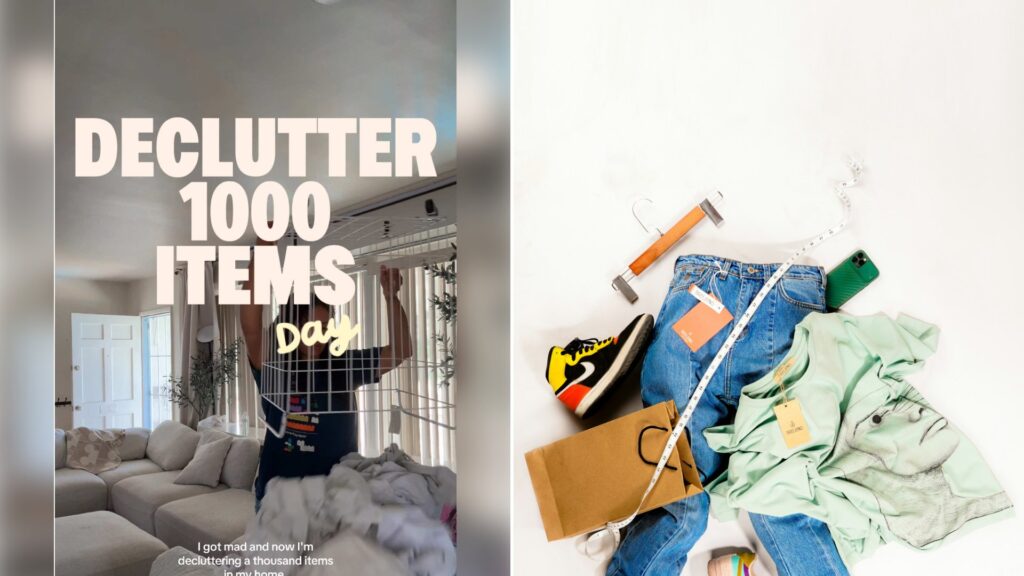
If you have ever stood in front of a closet, a garage shelf or a kitchen cabinet and talked yourself into keeping something “just in case,” this one is for you. Organizing creator @organizedchaos4 says she cleared out 70 percent of her possessions using just two steps, and the first one is a single question that most of us ask in the wrong way.
Her message is simple. The usual question, “Do I need it?”, almost always loses, because with a little imagination you can find a reason to keep anything. The better question changes who has to make the case. Here is how she explains it.
@organizedchaos4
Why “Do I Need It?” Is the Wrong Question
She begins by saying that when most people declutter, they ask the wrong question. As she puts it, you can always find a need for anything. She lists the excuses we all know by heart: you might need it in case of a snowstorm, in case you have another baby, or in case you host a big dinner party.
Those “what if” scenarios are the reason so many homes are full. Each one sounds reasonable on its own. Put together, they fill every shelf, drawer and storage bin in the house.
Her “Magic Question” Flips the Burden of Proof
Her fix is what she calls the magic question, and she describes it as a total mindset shift. Instead of you working to prove why an item deserves to stay, the item has to prove to you why it deserves a place in your home.
That is a different way to stand in your own house. Rather than defending every object you own, you become the one who decides what earns its spot. She says this one question should get you through most of your decluttering challenges.
It is worth noting how this plays out in real life. Think about the last time you held a rarely used item and felt guilty about letting it go. The guilt usually comes from feeling that you must justify getting rid of it. When the question is turned around, the item has to justify itself, and many things simply cannot.
Step Two: The SUM Method
For days when one question is not enough, she adds a second tool she calls the SUM method. The letters stand for space, utilization and maintenance. For each item, you ask three questions, and if you cannot answer yes to all three, the item goes.
- Space: Do I have space for it?
- Utilization: Do I use it?
- Maintenance: Can I maintain it?
She gives two examples. The first is a punch bowl. There is a spot on her shelf where it always sits, so it passes the space test. But she uses it only once or twice a year, which she says is not frequent enough to justify keeping it.
The second is a dry clean only shirt. She has room for it and she wears it, but she cannot maintain it, because dry cleaning piles up and she never makes time to take it to the cleaners. The shirt fails the third question, so it has to go.
Her promise at the end is bold: use the magic question and the SUM method, and she says your house will be decluttered in no time.
How to Put These Two Steps to Work
Rules like these are only helpful if you actually try them, so here are some practical ways to bring them into your own home, especially if you are not sure where to begin.
Start small and pick one spot
Do not tackle the whole house on day one. Choose a single drawer, one shelf or one corner of a closet. Taking everything out and asking the magic question about each piece builds confidence quickly, and a finished small space gives you the energy to keep going.
Be honest about “once or twice a year” items
The punch bowl example is a good reminder. Many households hold on to big serving pieces, specialty gadgets and holiday extras that are used a couple of times a year at most. Ask whether borrowing or renting could cover those rare occasions. A neighbor, a friend or a family member may happily lend you a punch bowl, and you will get a whole shelf back.
Watch the maintenance question
Maintenance is the part most people forget. Clothing that needs special care, decor that needs constant dusting, appliances that need cleaning after every use and collections that need polishing all carry a hidden time cost. If you know you will not do the upkeep, the item is a chore waiting to happen, not a treasure.
Use the “what if” list as a warning sign
When you catch yourself saying “in case we ever…”, pause. A snowstorm, a new baby or a big dinner party are real possibilities, but you can usually solve them when they arrive, often with something you already own in a simpler form. Keep what you can honestly say you use, and let go of the rest.
Decide where the extras go right away
Items that fail the test should leave the house quickly. Put them in a bag or box, set a date, and take them to a donation center, or offer them to a friend or a local community group. Letting a donation box sit in the garage for months gives the “just in case” thoughts time to creep back in.
Why This Approach Works for Many Families
What makes this method appealing is that it takes the emotion out of the process without asking you to be harsh with yourself. The magic question gives you a clear starting point, and the SUM method gives you three plain, practical checks you can run in seconds. There is no need to sort items into a dozen categories or to follow a complicated system.
It also lines up with something many longtime homemakers already know. A house works best when it holds the things you use and love, and when everything has a place. Fewer belongings means less to clean, less to move, less to repair and less to worry about. For anyone thinking about downsizing in the years ahead, getting a head start with these questions can make that future move far easier.
You do not have to remove 70 percent of your belongings to feel the difference. Even clearing out one drawer by asking whether each item has earned its place can make a home feel lighter. Try it this weekend with the smallest space you can find, and see how many things fail to make their case.