As we enter an era where nostalgia and vintage style dominate interior design trends, Pyrex promotional sets have found their place in the spotlight. These charming kitchenware pieces are not just remnants of the past; they have become valuable collectibles. However, not all Pyrex promotional sets are created equal. Some are rare finds, called ‘grails’, that can fetch hefty sums at auctions.
This list is curated based on real-world trends, data gathered from various sources, expert interviews and surveys, and results from auctions. We aim to help you distinguish the grails from the rest, providing you with the knowledge needed to build your own valuable Pyrex collection. Expect to learn about the most sought-after sets, their unique features, and why they matter today.
The 1961 Zodiac Casserole
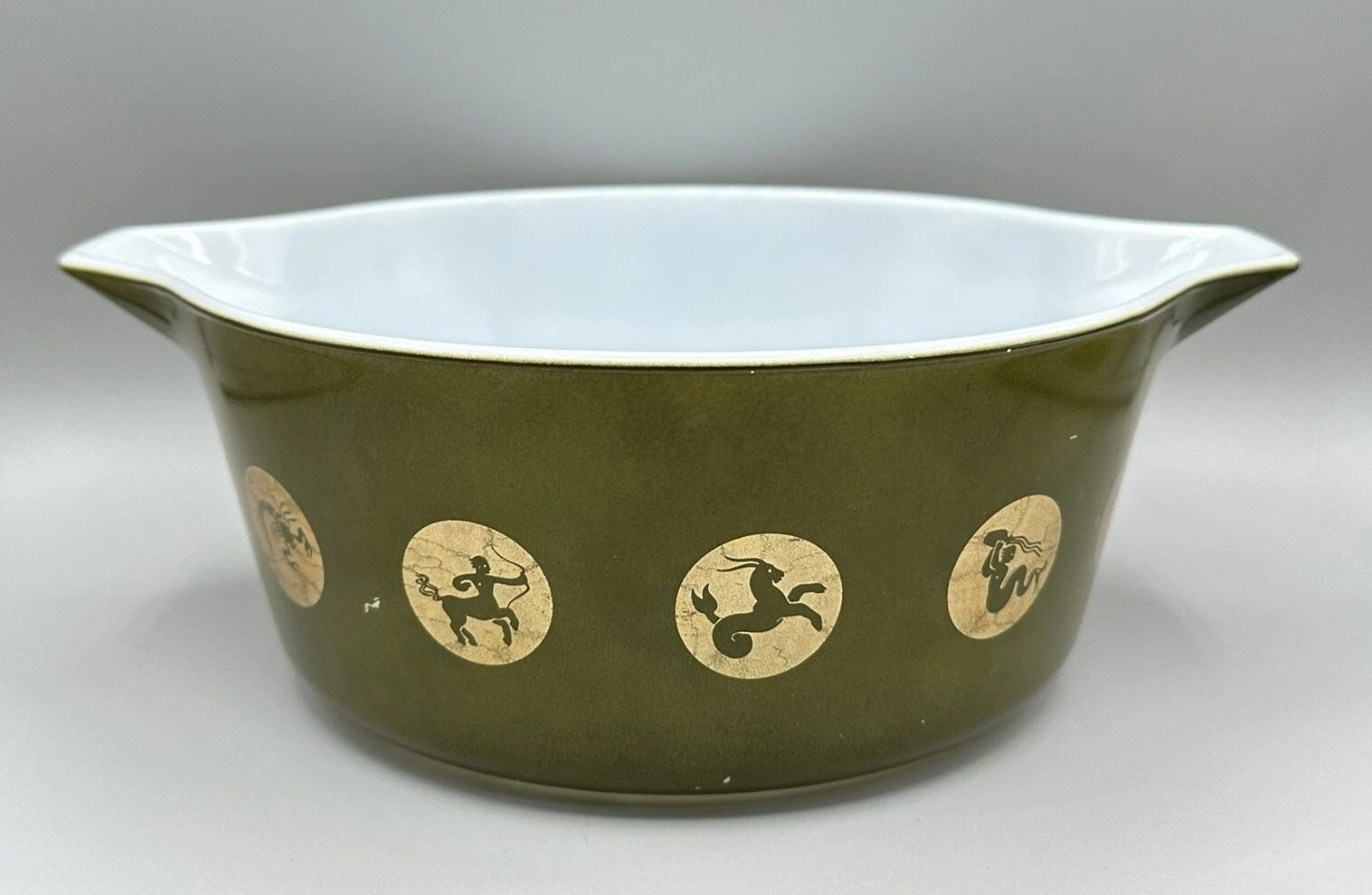
The Zodiac was a limited-time holiday promotional set featuring a forest-green 2½-quart #475 round casserole with a decorated clear lid and a candle-warmer trivet. It’s prized for its ring of twelve gold zodiac icons and short production window.
How to identify: look for the deep green opal body with crisp metallic gold printing and a matching clear lid printed with a horoscope wheel. Many sets are missing the original warming stand; complete packages command premiums. Care tip: never dishwash—gold decoration dulls quickly. Learn more at the Corning Museum of Glass Pyrex Pattern Library here.
The 1958 Golden Scroll Chip and Dip Set
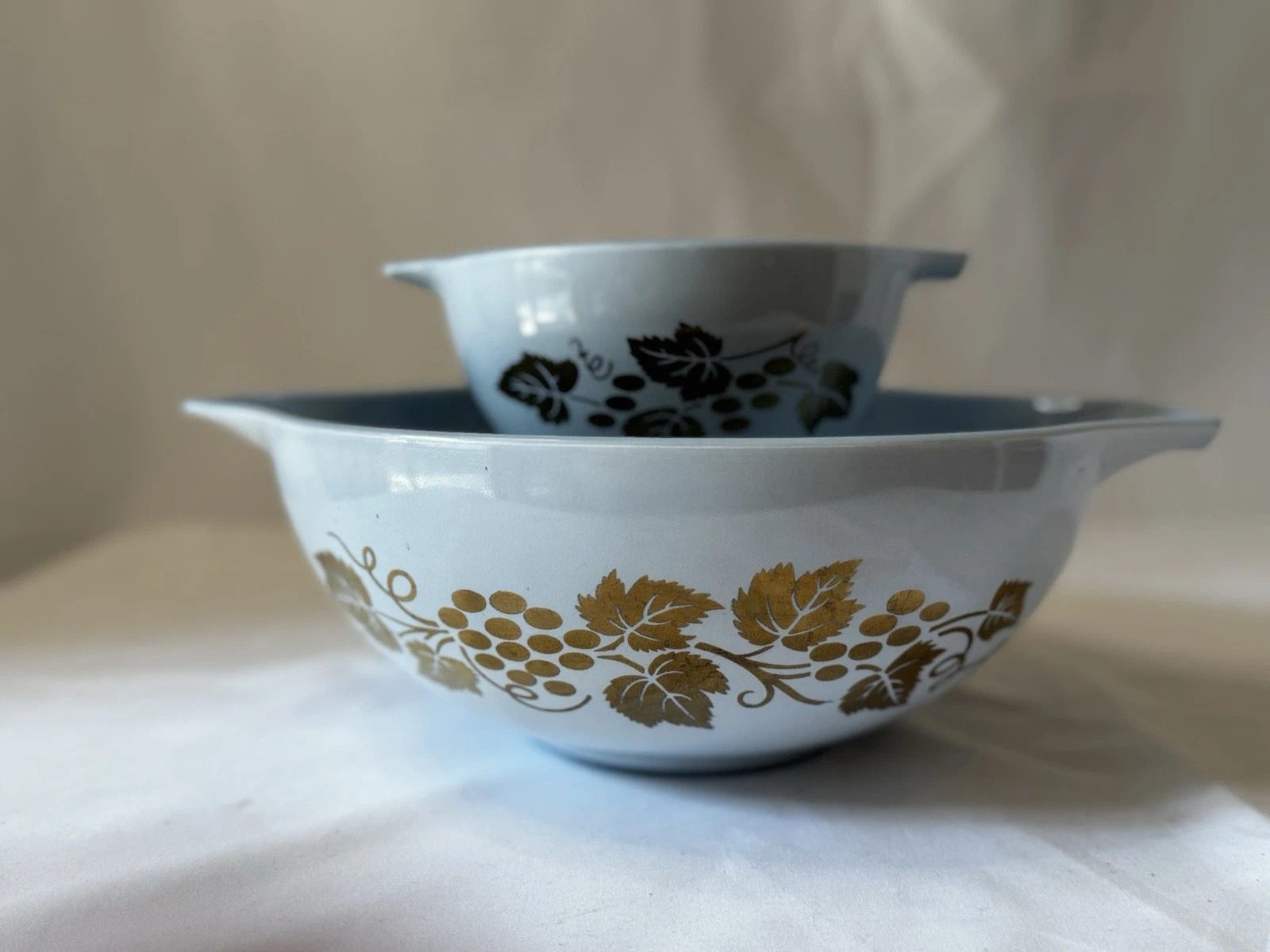
Released as the “Deluxe Chip and Dip Set Gold on Ivory,” collectors know this promo as Golden Scroll. The set pairs a #441 1½-pint Cinderella bowl with a #444 4-quart Cinderella bowl and a metal hanging bracket so the small bowl nests on the rim of the large one—mid-century party perfection.
How to identify: creamy ivory opal glass with ornate gold scrollwork and the distinctive pour-spout “Cinderella” handles. The metal bracket is often missing; verify it hangs securely without bending the big bowl’s rim. Condition watch-outs: rim chips, bracket rust, and rubbed gold. Details are in CMOG’s Pattern Library here.
The 1960 Golden Acorn Divided Dish
Golden Acorn brought elegant oak leaves and acorns in metallic gold to decorator shapes, notably the #063 1½-quart Cinderella divided casserole. The line also appeared on space-saving casseroles, making it both practical and formal-table friendly.
How to identify: white opal body, central divider inside, and delicate repeating gold acorn sprays. Complete sets include a fitted clear lid. Collector note: gold designs show wear first on high-touch areas—clean, even gold and unscratched lids are key. See the official entry here.
The 1965 Foulard (Navy Blue) Oval Casserole
Often called “Blue Foulard,” this crisp geometric star-and-fleur motif appears on oval casseroles (#043 1½-qt and #045 2½-qt) and companion mugs. The restrained navy-on-white graphic suits modern displays while staying firmly mid-century.
How to identify: tight, repeating navy icons printed sharply with consistent inky coverage; handles are the smooth non-Cinderella oval style. Buying tip: check for even color (no gray “dishwasher haze”) and correct oval lids. Explore CMOG’s entry here.
The 1959 Constellation Promotional Divided Dish
Collectors nickname this early promo “Constellation”: lively gold starbursts scattered across a #063 divided Cinderella casserole. Short-run gift releases like this are highly displayable and increasingly hard to find with bright, intact metallics.
How to identify: white opal body with asymmetric starbursts (not uniform dots), clear fitted lid, and the interior glass divider. Condition tip: hold at an angle—gold loss shows as patchy matte areas. Pattern Library page is here.
The 1963 Golden Honeysuckle Oval Casserole
Introduced in 1963 and produced into 1965, Golden Honeysuckle mixes delicate floral scrollwork with warm metallic accents on decorator ovals. It pairs beautifully with brass, walnut, and other period finishes.
How to identify: white opal body, flowing gold honeysuckle vines, oval (non-Cinderella) handles, and a clear lid. Collecting tip: look for sets with original sleeves/boxes—gift packaging boosts provenance. See dates and shapes here.
The 1959 Golden Hearts Oval Casserole
Sold as the “Deluxe Cinderella Casserole,” Golden Hearts is quintessential late-’50s giftware: romantic gold heart motifs on opal glass, marketed for weddings and holidays. Limited availability makes high-grade examples scarce.
How to identify: metallic heart garlands and Cinderella-style handles/pour spouts. Condition tip: verify even gold and lid fit; mismatched lids are common on gift-set styles. CMOG’s Pattern Library entry is here.
The 1968 Blue Ivy Promotional Casserole
Blue Ivy brings a cool botanical to the promo lineup. Its crisp ivy trail works in both country and minimalist kitchens, and the motif photographs well—one reason it’s a social-media favorite among Pyrex decorators.
How to identify: bright medium-blue ivy sprays on white opal. Promos are most often seen on 1½- to 2½-quart casseroles with clear lids. Buying tip: prioritize strong blue (not faded to slate) and chip-free handles. Browse the pattern page here.
The 1960 Golden Leaf Promotional Casserole
Golden Leaf offered a dressier, foliage-forward alternative at the dawn of the ’60s. It reads formal without being fussy and pairs nicely with other gold-decor Pyrex for coordinated tablescapes.
How to identify: stylized leaf sprays in metallic gold on white opal. Care tip: hand-wash only; avoid abrasives that turn gold matte. Pattern details are here.
The 1980 Trailing Flowers Promotional Casserole
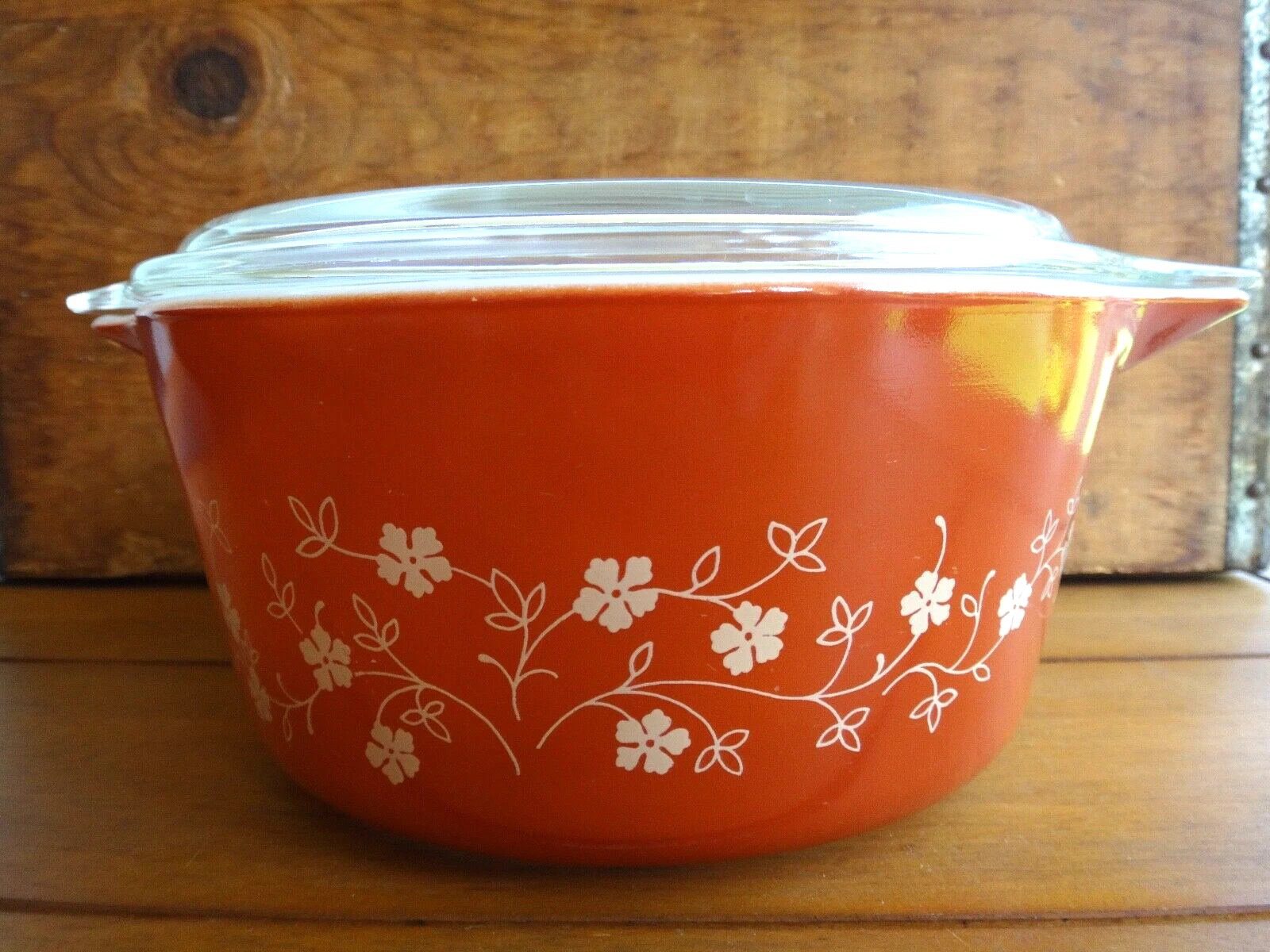
Part of a Bake ’N’ Carry promotion (1980), Trailing Flowers swaps the earlier gold-on-white look for a rich rust field with stylized floral sprays. It bridges late-mid-century and early-’80s palettes, making it a standout on open shelves.
How to identify: warm rust/orange body with cream/gold flowers, often on a #474 1½-qt casserole with clear lid. Condition tip: inspect corners and rims for paint wear; saturated colors show scuffs easily. See the CMOG entry here.