A few years after burying her husband, a woman realizes the person she trusts most with her grief, her daughter’s homework meltdowns, and her broken kitchen faucet is the same man her husband called his closest friend. She is not looking for permission to feel what she feels. She is looking for a way forward that does not blow up the only stability her child has left.
Stories like hers surface regularly in grief-support communities and therapists’ offices. As of early 2026, widowed Americans number roughly 11 million, according to the U.S. Census Bureau, and research consistently shows that many who repartner do so with someone already in their social orbit. When that someone is the late spouse’s best friend, the emotional stakes and the social risks multiply.
Why the Late Husband’s Best Friend Feels Like the Safest Choice
Grief does not follow a schedule, but it does follow patterns. Dr. Katherine Shear, founder of the Center for Prolonged Grief at Columbia University, has written extensively about how bereaved people gravitate toward figures who share their loss because those figures require less emotional translation. A widow does not have to explain who her husband was, what she lost, or why a particular song still levels her. The friend already knows.
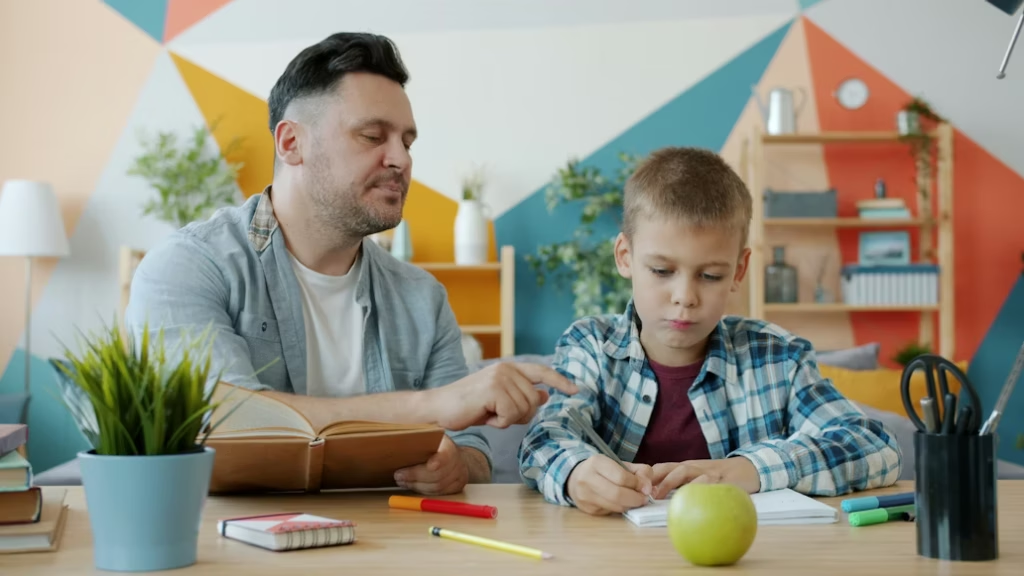
That shared shorthand extends to parenting. When a child has lost a father, the adults who knew him become living links to his memory. A best friend who shows up for soccer games and remembers Dad’s favorite pizza order is not just helping out; he is holding a piece of the child’s identity in place. Grief counselors at The Dougy Center, a nationally recognized resource for grieving families, note that children benefit from continuity with people who knew the deceased parent, which can make the friend’s presence feel irreplaceable long before romance enters the picture.
For the widow, attraction in this context often builds slowly, layered on top of gratitude, safety, and a kind of intimacy that dating apps cannot replicate. It is not a lightning bolt. It is a gradual realization that the person sitting across the kitchen table after bedtime might be someone she wants to keep sitting there.
The Backlash: Loyalty to the Dead vs. Life for the Living
If the emotional logic is quiet, the social reaction is often loud. Friends, in-laws, and even strangers can treat the pairing as a betrayal, as though the widow and the friend conspired against someone who is no longer alive to object.
Online forums capture the intensity of that reaction. In a widely discussed Reddit thread, one commenter imagined dying young and declared they would be “so angry” if their partner and best friend got together, calling it a failure of respect. In a separate discussion, a sibling confronted her widowed sister for dating the friend and called it inappropriate, only to face pushback from others who argued that “they are both adults” and had known each other for years.
The anger is real, but therapists say it often reflects the family’s unresolved grief more than any genuine ethical violation. Dr. Phyllis Kosminsky, a clinical social worker and fellow of the Association for Death Education and Counseling, has noted that when bereaved families object to a widow’s new relationship, they are frequently protecting their own bond with the deceased rather than the widow’s well-being. The friend-turned-partner becomes a symbol of the family’s fear that their loved one is being forgotten or replaced.
What Clinicians Actually Recommend
Mental health professionals who specialize in bereavement tend to be less interested in whether the relationship is “appropriate” and more interested in whether it is honest.
The key clinical questions, according to grief literature reviewed by the American Psychological Association, center on motivation and timing. Is the widow drawn to this person specifically, or to the relief of not being alone? Would she choose him if they had met in a completely different context? Is the friend processing his own grief separately, or is the relationship functioning as a mutual escape hatch?
Rebound dynamics are a genuine concern. Gratitude for someone who showed up during the worst period of a person’s life can feel indistinguishable from romantic love, especially when loneliness is acute. Clinicians recommend that both people spend time, ideally with a therapist, separating the comfort of shared grief from the foundation of a sustainable partnership.
There is also the question of the friend’s own emotional position. In one online discussion, a late husband’s best friend confessed he had been “waiting” for the widow, which prompted other commenters to urge caution. Being “many steps ahead” emotionally can create a power imbalance, and therapists flag this as a dynamic worth examining before anyone commits.
What About the Kids?
The child in the middle of this equation is often the person with the most to gain and the most to lose. Child psychologists emphasize that kids who have lost a parent are highly sensitive to changes in their remaining parent’s emotional state and household structure.
Dr. Robin Goodman, a clinical psychologist who has worked extensively with bereaved children through the National Child Traumatic Stress Network, has stressed that children need to feel that their grief is respected and that a new relationship does not erase the parent who died. When the new partner is someone the child already knows and trusts, the transition can be smoother, but only if the adults handle it with transparency appropriate to the child’s age.
The risk is that a child who sees the friend as “Dad’s buddy” may feel confused or even betrayed if that role shifts without explanation. Conversely, a child who has already formed a secure attachment to the friend may welcome the change, especially if it means the household feels more complete. There is no universal answer, which is why clinicians urge parents to pay close attention to the child’s behavior and to involve a family therapist if needed.
Taking a First Step Without Breaking Everything
For the widow who has weighed all of this and still wants to explore what she feels, the practical advice from both therapists and people who have been in her position is consistent: go slowly, stay honest, and protect the friendship as a fallback.
One commenter in a recent thread offered advice that grief counselors would likely endorse: “Keep it super casual. Ask if he’d like to go to dinner on a Friday or Saturday. Get a babysitter. Don’t frame it as a Date.” The idea is to create space for both people to test their feelings without the pressure of a declaration, so that if either one pulls back, the friendship and the child’s routine survive intact.
Therapists add a few more layers. Tell at least one trusted person outside the relationship what is happening, so you have a sounding board who is not emotionally entangled. Be prepared for the late husband’s family to react badly, and decide in advance how much of their reaction you are willing to absorb. And talk to the friend directly about the elephant in the room: the man whose absence made this connection possible in the first place.
None of this guarantees a smooth outcome. But the widow who approaches the situation with self-awareness, professional support, and genuine care for her child is not betraying anyone. She is doing what grief eventually asks of every survivor: figuring out how to live.
More from Decluttering Mom: