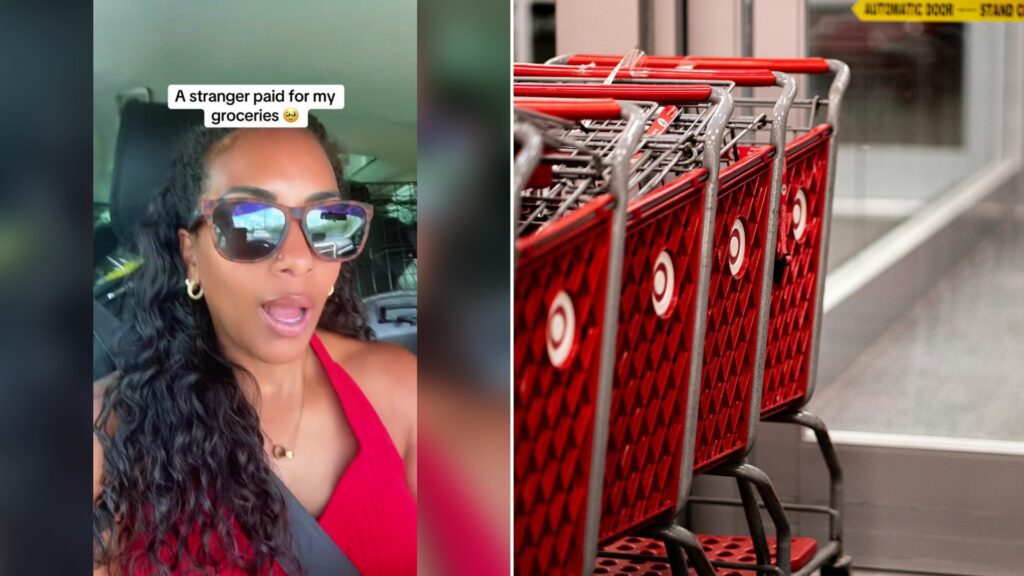
Anyone who has ever worked a cash register knows the fear of a single wrong keystroke. For a retail worker who posts as @biggsybiggs, that fear became real. She shared the first part of a story about how she says she is at risk of losing her job, and it starts with a customer who handed her $30 and a number she typed incorrectly.

@biggsybiggs
She tells the story while getting ready for work, blow drying her hair as she talks, in the popular get ready with me style. She does not name her employer, and neither will we. What she does explain is how strict the rules can be for a cashier.
Her Job on the Front End
She says she works in a front end position, which can mean cashier, cashier assistant, receipt checker at the door, folding clothes or working the floor. About six months ago, she says, managers noticed she is fast at cashiering and offered her a cashier only position for one extra dollar an hour. She is behind the register usually eight hours a day, sometimes five, five days a week.
It is a stressful spot, in her telling. She says the receipt checkers at the door are really trying to catch cashier mistakes, such as overcharging, undercharging, double scanning and missing items, rather than stopping theft.
The Rules She Describes
The rules she lays out are tight. According to her, a cashier is allowed only three mistakes in a seven day period, and there is a $100 limit on the value of mistakes in that period. If one missed item pushes the total over $100, she says, it is automatically a write up. After four write ups, a cashier is suspended.
She says she already had two write ups after a stretch of audits. One week there were four audits, and the next week there were about five.
The $300 Mistake
Then came the mistake that she says started the biggest trouble. A customer handed her $30. She typed the cash amount into the register as $300 and gave the customer more than $200 in change. She does not dodge responsibility. In her words, she takes full responsibility for what she calls a stupid mistake.
She says the store contacted the customer, whom she calls a member, to ask for the money back, and she says people usually do not return it. Her manager gave her another chance and kept her working as a cashier.
Another Slip and a Suspension
After that, she says, she made one more mistake. A second mistake in the same week, added to the earlier one, came to more than $100 in total, which triggered another write up. By her count it was her fourth. Her supervisor asked whether she was going too fast, and she felt supervisors could have thrown away the slip. She says the company waited a full week before giving her the write up and suspending her.
The result, she says, was a three day suspension and a rule that she cannot work as a cashier for six months. After that period she can get the position back.
A Separate Issue with Tardies
She then turns to a second problem. She says employees are allowed three tardies in a 30 day period. She was 15 minutes late once because she thought her shift started at 12:30 when it actually started at 12:15. Another day she left 45 minutes early for a commute of 20 to 25 minutes and was still late because of traffic, which she counts as her second late. She mentions that you are only allowed three before the write up. Her story stops there, and it is the first part of a longer series, so the rest is not known.
What Other People Said
Responses were not all sympathetic. One person said they were with her all the way until the $300. Another asked how a person does not notice that handing back $200 is not correct. Several former cashiers said that mistakes like that are not hard to avoid. Since we have only her account, we cannot judge how the store applies its rules.
Lessons for Anyone Working a Register
Whatever you think about the rules, her story has practical lessons for cashiers and for anyone who handles money.
Say the numbers out loud. When a customer hands you cash, repeat the amount and look at the bills. A quick check of $30 against the $300 on the screen can catch a keying error before it matters.
Look at the change due before you count it out. Most registers display the change owed. If the number seems far too high for a small purchase, stop and check it. A change amount of more than $200 on a simple sale is a signal to pause.
Slow down when you are being audited. It is human to feel pressure when management is tracking mistakes, but speed is where errors creep in. Being accurate matters more than being the fastest cashier in the building.
Leave the bills on the drawer until the sale is complete. Many experienced cashiers keep the customer’s money visible, set on the edge of the drawer, until the change is handed back. That makes errors easy to spot.
Report an error right away. If you realize you made a mistake, tell a supervisor immediately and document the details, including the time, register and customer if you can. Early honesty is usually viewed better than a mistake that is discovered later.
Know Your Workplace Policies
If you work in retail, ask for a copy of the written attendance and cashier policies. Read how write ups are counted, how long they stay on your record and what the appeals process is. Keep your own notes about dates and conversations. If a rule seems unclear, ask for it in writing.
Also check your schedule. Her mix up between a 12:30 and a 12:15 start shows how a small misunderstanding can lead to a tardy. Confirm your shifts through the official schedule, set an alarm, and build in extra time for traffic.
A Reminder About Pressure
Her story is an honest look at what it feels like to work under tight rules and constant checks. Mistakes happen, and she owns hers. At the same time, it shows how a single moment at the register can ripple through a person’s job.