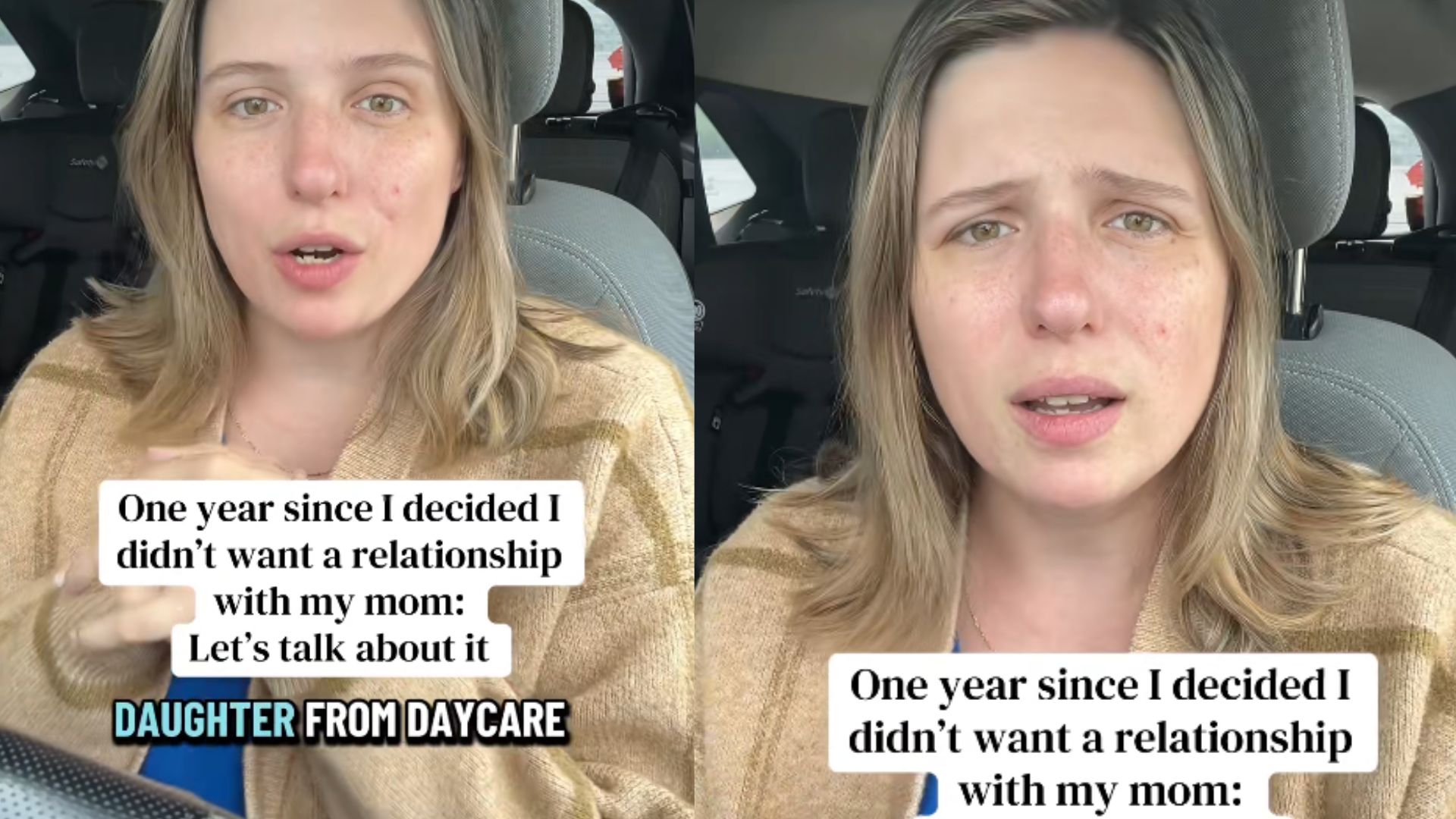
@porchchats marked the one-year anniversary of a day she says changed her relationship with her mother permanently — the day, she explains on camera, “my mother made the decision to put my daughter in the front seat of her car with no seatbelt.”
At the time, she and her mom were already low-contact. Her husband had asked her mother, as a favor, to pick their daughter up from daycare because he was running late. Her mother said yes. Then it looked like they might make it in time after all, so her husband tried to call and text to say, essentially, never mind — you don’t need to go. Her mother didn’t respond. Ten minutes later, @porchchats got a notification that someone who wasn’t her and wasn’t her husband had already checked their daughter out of daycare.
Her husband called to ask if her mom had gotten his message. “Oh, no, sorry, I didn’t see it,” her mother said — despite two missed calls. They picked up their granddaughter, and the group decided to grab food on the way home. There was no car seat in the car. So her mother and stepfather put the baby in the front seat, unbuckled, on her stepfather’s lap.
“When my husband called and told me that,” she says, “I thought I was going to run my car off the road.” She drove straight to the restaurant. Walking in, she saw her one-year-old daughter in a high chair with her mother and stepfather. Her first words to her mother were direct: “Did you drive her here without a seatbelt in the front seat?” She says she’ll never forget her mother’s answer: “Well, I didn’t have a choice.”
“I’ll never forget the shock of that,” she says, “the sheer lack of accountability.” Her mother did have a choice, she points out — she could have called, could have asked the daycare if they had a spare car seat (they did, at the time), or waited for the parents to arrive. Instead, according to @porchchats, her mother got “louder and louder” in the restaurant, insisting it was unreasonable to expect her to have called first, before landing on what @porchchats calls “the real zinger”: “All I knew was that William was stuck at a job, and you won’t talk to me.”
That line — turning her granddaughter’s safety into a grievance about being ignored — was the moment @porchchats says she understood something clearly about her mother’s capacity for accountability. A year later, her feelings haven’t changed. “I was really disappointed in her,” she says, “and I was very grateful that my daughter was okay. And I knew right then that I didn’t want to have a close relationship with her anymore.”
Why One Incident Can Be the Tipping Point
Family therapists often describe estrangement or low-contact decisions as the result of accumulation, not a single event — but they also acknowledge that one concrete, undeniable incident can function as the moment a person finally trusts their own read of a relationship. For @porchchats, the seatbelt incident wasn’t really about the seatbelt. It was proof, in a way that was hard to argue with afterward, of a pattern she’d likely sensed for a long time: a relative who prioritized her own feelings of being wronged over the immediate safety of a child in her care.
Car seat and seatbelt safety isn’t a matter of generational preference — laws requiring young children to be properly restrained, and specifically not in the front seat, exist because children under a certain age and weight are significantly more vulnerable to injury in a crash without one. “She grew up in a different time” doesn’t really apply to someone who raised her own kids under seatbelt laws and, as @porchchats notes, owned car seats specifically for her grandchildren — she simply didn’t have one with her, and chose not to say so.
The bigger lesson for anyone watching who recognizes a similar dynamic is about the difference between an apology and a deflection. “I didn’t have a choice” and “you won’t talk to me” are both ways of making the incident about the accused rather than the outcome. Genuine accountability sounds different — it names the mistake plainly and doesn’t pivot to a counter-grievance. When it’s consistently absent, going low-contact isn’t an overreaction; it’s often the only way a parent can guarantee their child’s safety isn’t left up to someone else’s excuses.
You can watch the full video and follow @porchchats on TikTok for more.