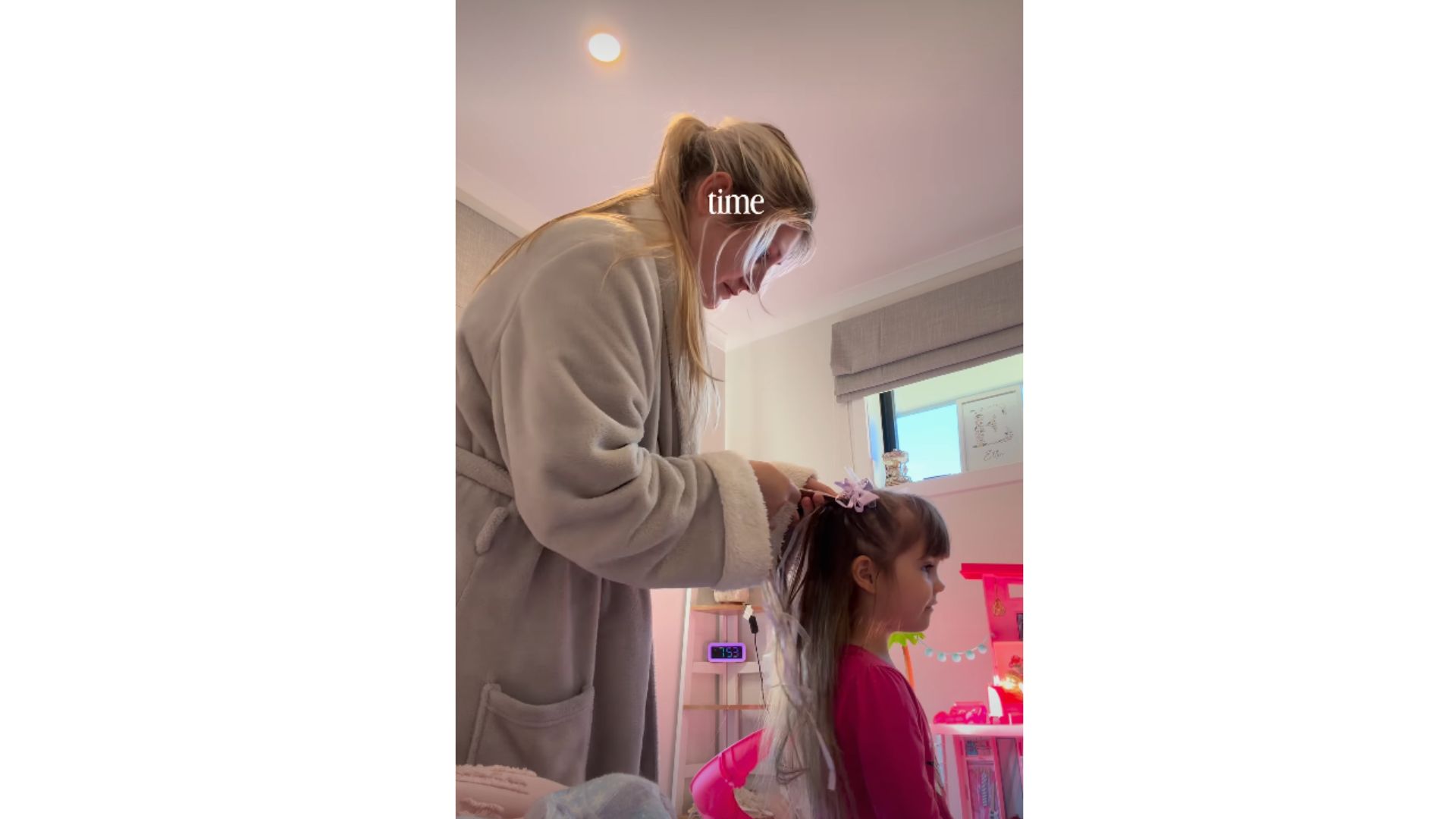
Few conversations are harder for a parent to sit through than the one where a child describes being hurt by their peers. A video from @annalise.lovett shows exactly that kind of moment.
While styling her daughter’s hair — a quiet, everyday ritual for many parents and kids — the creator voices her frustrations about her daughter being bullied by classmates. The caption describes the weight of it plainly: “The conversation we had after kindy broke my heart… if you think it doesn’t happen even at the age of…”, suggesting the incident came as a surprise given how young her daughter is.
The video doesn’t go into the specifics of what was said or done to her daughter, keeping the focus instead on the mother’s emotional reaction and her decision to speak publicly about it. That restraint gives the clip a grounded, protective tone rather than a sensational one.
It has reached 244,700 views, with many viewers responding to the universal, uncomfortable truth at the center of it: that unkindness among children can start far earlier than many parents expect, even in the earliest years of school.
By pairing the difficult subject matter with the tender, ordinary act of doing her daughter’s hair, the video captures both the hurt of the situation and the quiet care a parent offers in response to it.
The video was surfaced through an engagement-outlier search that flags videos performing far beyond what a creator’s usual audience size would predict. With 2.8K followers on Instagram, the creator’s reach on this particular post — 244.7K views and counting — far outpaced what a typical post from an account that size usually draws, a sign that the story tapped into something a much wider audience wanted to see.
The comment section on Instagram has filled in around the video the way it usually does with content like this — a mix of people sharing their own nearly identical experiences, others offering advice or a differing opinion, and plenty simply reacting to how closely the moment mirrors something from their own household. In the original post, the creator captioned it: “The conversation we had after kindy broke my heart… if you think it doesn’t happen even at the age o…” — a short line that, for a video like this, tends to carry as much of the story as the footage itself.
Like a lot of the parenting content that breaks through online, this clip didn’t need elaborate production or a dramatic twist to hold people’s attention — just an honest, specific moment that a lot of viewers recognized from their own homes. It’s a reminder of how much appetite there still is for real, unpolished glimpses into what family life actually looks like, day to day, rather than a curated version of it.
When Bullying Starts Young: How Parents Can Support Their Kids
Many parents are caught off guard to learn that bullying and social exclusion can begin as early as preschool or kindergarten, well before the tween and teen years most people associate with it. Child psychologists note that even young children are capable of excluding, teasing, or being unkind to peers, often without fully understanding the impact of their behavior.
Experts generally recommend that parents respond to a child’s disclosure with validation first — acknowledging the hurt feelings before problem-solving — since feeling heard is often what a child needs most in that moment. From there, staying in close communication with teachers or school staff can help identify patterns and put age-appropriate support in place, whether that’s classroom intervention or simply extra check-ins.
It’s also worth remembering that a single tough interaction doesn’t necessarily mean a pattern of bullying, though it should still be taken seriously and followed up on. Encouraging a child to keep talking openly — and modeling that home is a safe place to bring hard feelings — tends to matter more, long term, than any single conversation ever could on its own.
None of this is about getting every decision right on the first try. Parenting, more than almost anything else, rewards consistency over perfection — showing up again the next day, adjusting what didn’t work, and staying willing to have the harder conversations when they come up. That’s true whether the topic is a bedtime, a boundary, a bad morning, or a much bigger family decision playing out over years rather than a single afternoon.
There’s no single formula that works for every family, and experts in family/parenting topics tend to agree on that above almost everything else. What matters most is staying engaged, staying honest about the hard parts, and giving yourself — and the people around you — some grace on the days that don’t go as planned.
You can watch the full video and follow @annalise.lovett on Instagram for more.