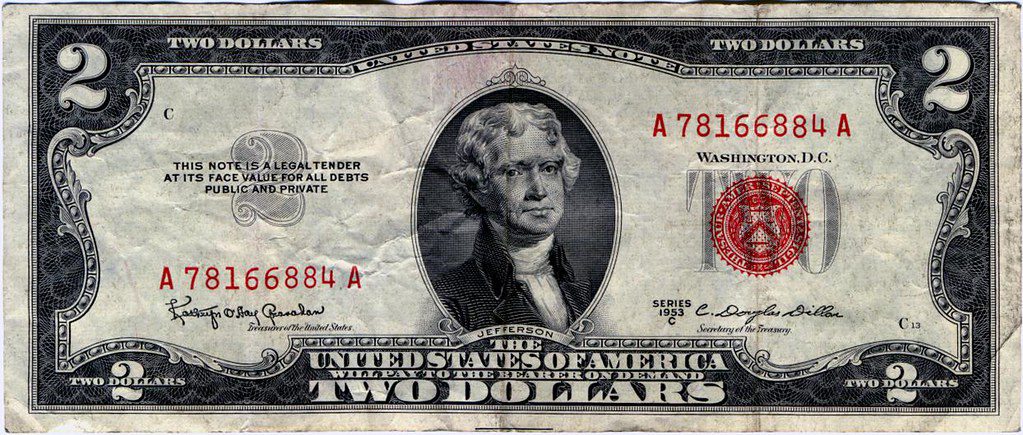
You probably treat $2 bills like pocket change, but some of them quietly carry collector value far above face amount. A few $2 notes—depending on age, condition, and especially their serial numbers—can sell for hundreds or even thousands of dollars.
This article shows what to watch for and why certain series and serial patterns matter, from crisp red-seal notes to rare star and error examples. Keep your eye on age, preservation, and unusual serials; those details often determine whether a bill stays spent or becomes a prized find.
1928 Red Seal $2 Bill in Crisp Condition
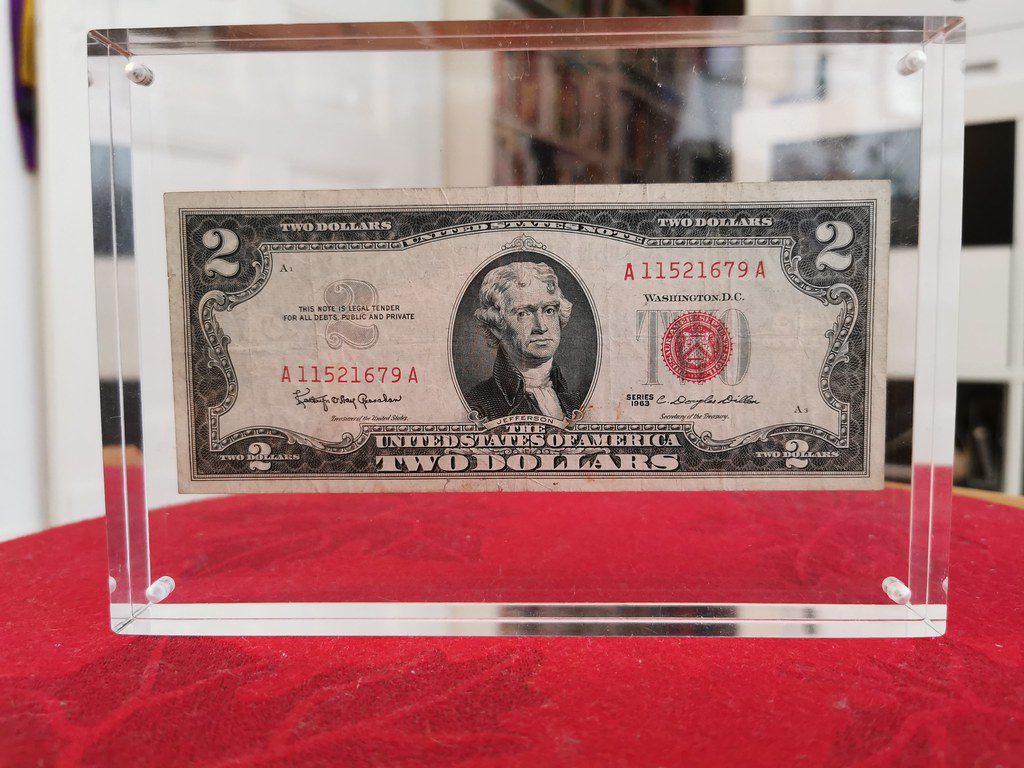
If you hold a 1928 red seal $2 bill that’s nearly uncirculated, collectors will notice immediately. Condition drives value; crisp edges, bright ink, and no folds can push a note well above face.
Check for series and star replacements—some variants command higher prices. For examples of values and identifying features, see the 1928 $2 Legal Tender Notes values guide.
1976 $2 Bill with Low Serial Numbers
If you find a 1976 $2 bill with a low serial number, check it closely because collectors pay attention to those.
Very low numbers (like 00000001 or other single‑digit starts) can command premiums in high grade.
Condition matters a lot. A crisp, uncirculated note with a low serial will sell for more than a worn example.
Look up recent sales and compare similar serial ranges to set realistic expectations; values vary widely.
See a detailed value guide for comparisons at 1976 $2 bill values.
2003 $2 Federal Reserve Star Note
If you find a 2003 $2 bill with a star at the end of the serial number, it’s a replacement note collectors watch for.
Most circulated examples sell near face value, but uncirculated 2003A star notes — especially from Atlanta or Minneapolis with low serials — can command hundreds or more.
Check condition and bank letter to narrow value. Use a dedicated database like the 2003 $2 Federal Reserve Notes value guide to compare recent sales.
1918 $2 National Bank Note with Serial Below 1000
If you find a 1918 $2 National Bank note with a serial under 1000, expect higher collector interest. Low-serial examples often stayed uncirculated, which drives prices up.
Values vary by condition and issuing bank, so a crisp note can sell for thousands while a circulated one may sit much lower. Check specialty guides and auction records for recent comparable sales like those listed on antique money sites.
Uncirculated 1928 $2 Bills with Star Serial Numbers
If you find a 1928 $2 bill in uncirculated condition with a star serial number, you should pay attention. These “star notes” replaced damaged sheets and are scarcer than regular notes, which raises collector interest.
Condition matters as much as rarity; pristine, uncirculated examples command the highest prices. Check catalogs and recent sales to gauge value, and consider a professional grade if you plan to sell.
1976 $2 Bill with Ladder Serial Number
If your 1976 $2 bill shows a ladder serial like 12345678, collectors pay attention.
Ladder serials are visually appealing and can command premiums, especially in uncirculated condition.
Value depends on demand, grade, and whether the note is a star or replacement.
Check detailed value guides and recent sales to gauge a realistic price, for example this 1976 $2 Bill Value Chart.
2003 $2 Bill with Single-Digit Low Serial Number
If you find a 2003 $2 bill with a single-digit serial number, you hold a collectible that many buyers seek. Condition matters a lot; crisp, uncirculated notes command higher prices.
Star notes and low serials from certain Federal Reserve districts can push value into the hundreds or more for top-condition pieces. Check pricing guides like the 2003 $2 Federal Reserve Notes value guide for comparable sales.
$2 Bill with Serial Number 00000001
If your $2 bill shows serial number 00000001, you hold the first note from that printing run and collectors notice that immediately. It’s a rare serial and can raise a bill’s value, especially for popular series like 1976.
Condition matters a lot; crisp, uncirculated examples attract the highest bids. For more on specific series and market interest, check this guide to rare 1976 Bicentennial $2 bills.
Rare Error $2 Bills with Printing Mistakes
If your $2 bill shows misaligned printing, off-center portraits, or doubled serial numbers, it can catch collectors’ attention. Condition and how dramatic the error is determine value, so a tiny smudge usually won’t fetch much.
Severe errors like major miscuts, missing ink areas, or mismatched seals can push a note into higher-value territory. Check listings and guides to compare similar errors before assuming a big price.
Uncirculated Crisp $2 Bills from Any Series
If your $2 bill looks and feels brand new, collectors call it uncirculated and value rises.
You’ll see interest even for modern series notes when edges are sharp and the paper shows no folds.
Condition matters more than the year for these pieces.
A crisp 2003 or 2017 note can fetch a premium compared with its worn counterparts.
Keep bills in sleeves and avoid handling them by the faces.
That preserves value and makes them easier to sell to collectors.
More from Decluttering Mom: