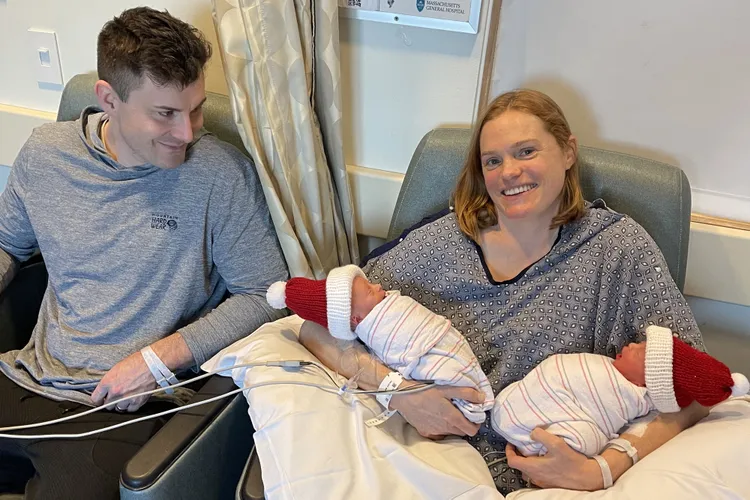
By the time Abby Wood went into labor with twins, she had already spent years living with a heart condition that could quietly turn dangerous. The elementary school teacher knew that carrying two babies at once would push her body to its limit, and she was convinced that limit might be fatal. She stayed scared right up until the moment her sons arrived, then watched in real time as the pregnancy she thought might kill her instead helped her heart start to heal.
Her story is not a neat, inspirational poster. It is a messy mix of cardiology reports, high-risk scans, sleepless nights, and a delivery room where every beep mattered. It is also a reminder that behind every “miracle twins” announcement is a stack of medical charts and a family quietly doing the math on risk and hope.
From Premature Heartbeats to a Life-Changing Diagnosis

Abby Wood’s journey into high-risk motherhood started long before she ever saw two lines on a pregnancy test. In 2020, she began feeling premature heartbeats that were impossible to ignore, the kind of skipped and fluttering rhythms that make a person suddenly aware of every thud in their chest. Those symptoms led doctors to diagnose her with dilated cardiomyopathy, a condition where the heart’s main pumping chamber stretches and weakens, leaving it struggling to push blood through the body with each beat. For a young teacher who had built her life around the energy of a classroom, the label landed like a warning sign over every future plan.
That diagnosis did not just change her medical chart, it rewired how she thought about time. Cardiomyopathy is not the sort of thing a person can wish away with clean eating and a new yoga mat, and Abby had to learn to live with the idea that her heart might not cooperate with the milestones she had imagined. Years later, when she and her partner started talking seriously about kids, those early premature heartbeats were still part of the conversation. Dilated cardiomyopathy meant pregnancy would never be routine, and every doctor’s visit came with the unspoken question: could her heart handle it at all?
“Terrified” of Twins, Even as She Chose to Continue
When Abby finally did become pregnant, the news that she was carrying twins did not land as a cute surprise. It landed as a medical curveball. She was six weeks into the pregnancy when she learned there were two babies, and the reality hit fast that a twin gestation would demand even more from a heart that was already compromised. Her cardiology team laid out the risks in blunt terms, and Abby had to sit with the possibility that continuing the pregnancy could shorten her life. She later described herself as “terrified,” not in a vague way, but in the specific sense of lying awake and wondering if her heart would simply give out in the delivery room.
That fear did not disappear just because she decided to move forward. Abby kept teaching, kept showing up for her students, and kept going to appointments where specialists tracked every change in her heart function. The pregnancy became a high-wire act, with her cardiologist and maternal-fetal medicine team watching for signs that the strain was too much. She worried that having twins could kill her, and that worry stayed with her until the moment she gave birth, a detail she has repeated because it captures how long she lived in that in-between space. Her experience as a teacher with a was not just about medical charts, it was about trying to plan a future for two babies while quietly wondering if she would be there to see it.
High-Risk Pregnancy, Constant Monitoring, and a Narrow Path Forward
Carrying twins with dilated cardiomyopathy meant Abby’s pregnancy was treated as high risk from day one. Her care team monitored her heart function with the kind of intensity usually reserved for patients in cardiac rehab, not young women picking out cribs. Every scan of the babies came with a parallel scan of her own heart, and each appointment was a balancing act between protecting the fetuses and protecting the person carrying them. She had to weigh simple daily choices, like how much she could walk or whether she could keep up with a full day in the classroom, against the possibility of triggering heart failure symptoms.
At the same time, the twins themselves needed close watching. Multiple pregnancies can come with complications even in people with perfectly healthy hearts, and Abby’s doctors were tracking growth, blood flow, and any signs that the babies were under stress. She knew that if her heart function dipped too low, the plan could shift quickly to early delivery, with all the risks that brings for premature infants. That constant sense of “we might have to move fast” shaped the final months of her pregnancy, as she tried to prepare for every scenario while still showing up as the steady adult her students expected. Her story, as detailed in reporting on Abby, shows how thin the line can be between ordinary prenatal care and a full-scale medical operation.
The Delivery Room: Fear, Emergency Protocols, and Two New Heartbeats
By the time Abby went into labor, everyone in the room knew the stakes. Twin deliveries are often more complicated than single births, and her cardiomyopathy added another layer of risk. The team had emergency protocols ready, from rapid-response cardiology support to plans for a fast surgical delivery if her heart showed signs of failing under the stress of contractions. For Abby, the fear she had carried for months peaked in those hours, when every contraction felt like a test of whether her heart could keep up.
Stories from other twin births underline just how quickly things can turn. In one account of “miracle twins,” a midwife could not find the heartbeat of the first baby, the mother experienced serious blood loss, and the situation escalated into a CAT 1 emergency, the highest level of urgency, with immediate intervention to restore oxygen flow and save both mother and child. That kind of scenario, described in detail by Tiny Tickers, is exactly what high-risk teams train for when someone like Abby arrives in labor. Her own delivery unfolded under that same cloud of “what if,” with everyone prepared for the possibility that the day her twins were born could also be the day her heart finally gave out.
When the Risk Becomes Reality for Other Families
Abby’s story ends in a place of relief, but not every family facing heart complications around childbirth gets that outcome. In another case shared publicly, a husband described how, within just hours after delivering their twins, his wife suffered a major heart attack. What should have been the happiest day of their lives turned into a medical emergency that required intensive care, fundraising for treatment, and a crash course in cardiac medicine for a family that had expected to be learning how to swaddle instead. His account, captured in a video that begins with the words “Within just hours after delivering our twins, my wife suffered a major heart attack. What would have been the happiest day of our…,” shows how quickly celebration can flip to crisis when the heart is already under strain.
That story, shared through an ImpactGuru appeal, sits in the same universe as Abby’s experience, even if the outcomes are different. Both families walked into the maternity ward knowing that heart trouble could change everything, and both had to trust teams of specialists to navigate that risk in real time. Their stories highlight why cardiologists and obstetricians are increasingly focused on the intersection of pregnancy and heart disease, and why conversations about family planning for people with conditions like dilated cardiomyopathy are so layered and intense.
More from Decluttering Mom: