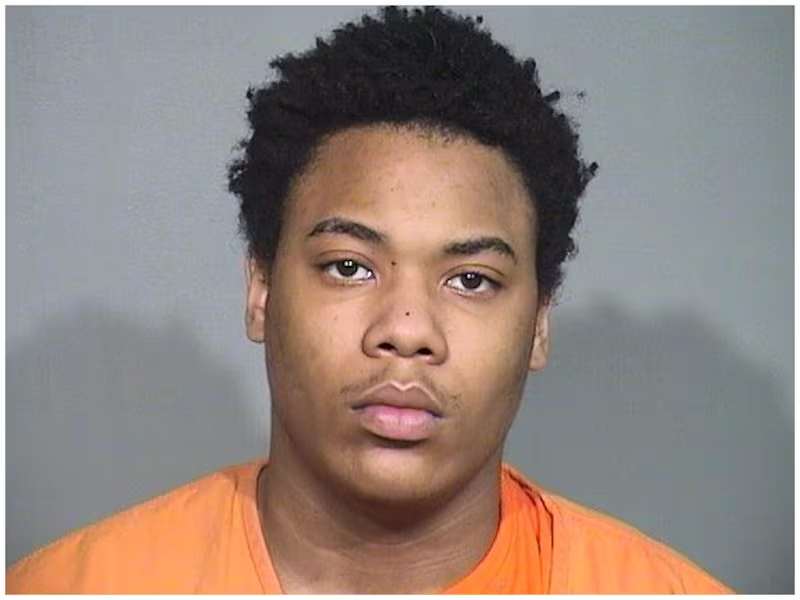
An Illinois teenager already facing serious charges for a violent attack at a Walmart is now accused of threatening to kill a baby in a stream of graphic Snapchat messages. Court records say the 18-year-old, Keon Harris, allegedly taunted the child’s father with vivid descriptions of the infant dying, all while Harris was supposed to be following the rules of pretrial release.
The case pulls together two threads that usually stay separate in public debate: the promise of giving young defendants a second chance, and the reality of what happens when that trust collides with violent behavior and social media bravado. It also raises a blunt question for judges, parents, and tech companies about how much danger can unfold inside a chat window before anyone steps in.
The Snapchat threats that shocked a family

According to police and court filings, the latest allegations center on a private exchange on the social app Snapchat between Harris and the father of an infant boy. Investigators say Harris sent a series of messages that went far beyond trash talk, allegedly telling the man to “imagine your son leaking” and asking if he had “ever seen a baby die.” The wording, as described in charging documents, was not vague or impulsive in the way online arguments often are, but specific and focused on the child’s suffering, which is why officers treated it as a direct threat rather than a heated argument that got out of hand.
Police say the messages did not stop at morbid questions. Harris is accused of threatening to use a rifle on the baby, describing how he would shoot the child and leave the infant bleeding, language that investigators say was detailed enough to leave the father convinced his son was in real danger. The alleged threats were delivered while Harris was already under court supervision, which prosecutors argue shows a willingness to ignore legal boundaries even when he knew he was being watched. That combination of graphic detail and timing is what pushed the case from disturbing to urgent in the eyes of law enforcement.
A violent Walmart attack that set the stage
The Snapchat case did not appear out of nowhere. Earlier in 2025, police in Woodstock, Illinois, say Harris was involved in a brutal attack on a 15-year-old shopper at a local Walmart. According to a criminal complaint, the then 17-year-old Harris was charged with felony battery after he and another teen allegedly punched the younger boy in the face, leaving him with a broken jaw and nose, injuries that were serious enough to require significant medical care and that prosecutors cited when they filed the original felony battery charges.
Police say Harris did not act alone in that Walmart incident. Officers identified another teen, Fernando Torres, 19, also of Woodstock, as a co-defendant, and say Harris and Torres continued to hit the 15-year-old even after he fell to the floor. According to investigators, the pair stomped on the victim while he was down, leaving him with visible bruising and other injuries that officers documented in their reports on the 15-year-old shopper. That case, still working its way through the courts, is the backdrop for the new accusations and the reason Harris was on pretrial release in the first place.
Pretrial release, violated in the most public way
After the Walmart beating case, a judge allowed Harris to remain in the community while his charges moved forward, a standard use of pretrial release meant to balance public safety with the presumption of innocence. Court records indicate that while on that release, Harris was supposed to follow strict conditions, including avoiding new criminal conduct and, in some instances, staying away from weapons. According to a complaint reviewed by local reporters, those expectations collided with reality when Harris allegedly used social media to send the violent messages about the infant, prompting police to seek new charges and argue that he had blown his chance at supervised freedom.
In filings tied to the new case, officers describe Harris as an 18-year-old Woodstock man who was already facing the Walmart battery case when he allegedly sent the Snapchat threats. The complaint, summarized in local coverage, says the McHenry County Sheriff’s Office documented the messages and used them to support fresh counts that now sit on top of the earlier felony battery case. The same records identify Harris by name and age and include a booking image labeled as a photo provided by the McHenry County Sheriff’s Office, underscoring that authorities now see him as a repeat risk rather than a first-time defendant who made a single bad decision.
Graphic language, a rifle, and a terrified parent
The details of the alleged Snapchat exchange are chilling even by the rough standards of online arguments. Police say Harris not only asked the father if he had “ever seen a baby die” but also described the infant “leaking from his forehead,” a phrase that investigators say referred to a gunshot wound. According to the complaint, Harris referenced using a rifle, language that officers interpreted as a threat to shoot the child, and that the father took seriously enough to contact law enforcement immediately. Those specifics appear in a summary of the case that quotes police describing the messages as explicit and targeted.
Another account of the case notes that Harris, already known to officers from the Walmart incident, allegedly used the same aggressive tone online that he was accused of using in person. In that telling, the teen is said to have taunted the father with the image of his son bleeding from the head, while reminding him of the earlier violence tied to the Walmart attack. That report, which also cites the involvement of Fernando Torres in the original beating, frames the Snapchat threats as part of a pattern of escalating behavior rather than a one-off outburst, and attributes the description of the messages to police who reviewed the screenshots.
What the case says about social media, safety, and second chances
For people in Woodstock, the allegations land at the intersection of two familiar debates: how to handle young defendants accused of serious violence, and how to treat threats made through a smartphone screen. The Walmart case already had residents asking why a 15-year-old ended up with a broken jaw and nose in the middle of a big-box store, and why, according to police, two teens felt comfortable stomping on him in public. Now, with Harris accused of using Snapchat to threaten an infant, the conversation has shifted to whether pretrial release rules and digital monitoring are keeping up with the way threats are actually delivered. Local coverage of the new arrest notes that the case unfolded in Woodstock, Ill, the same community where the Walmart attack was first reported, and that officers again turned to the father’s video evidence to build their case.
There is also a quieter, more personal layer to the story that does not show up in charging documents. A parent who opens a chat and reads a stranger describing how their baby might die is not parsing legal standards or thinking about pretrial policy, they are reacting to fear. The law will sort out whether Harris is guilty of the new charges, but the fact that an 18-year-old already facing a felony battery case is now accused of sending rifle threats about an infant on a mainstream app is enough to make a lot of people rethink what “just talking online” really means. For judges weighing future release decisions, for parents deciding how much freedom to give their teens on social platforms, and for companies like Snapchat that host these conversations, the Woodstock case is a reminder that the line between digital drama and real-world danger can be thin, and sometimes it is crossed in a single late-night message.
More from Decluttering Mom: