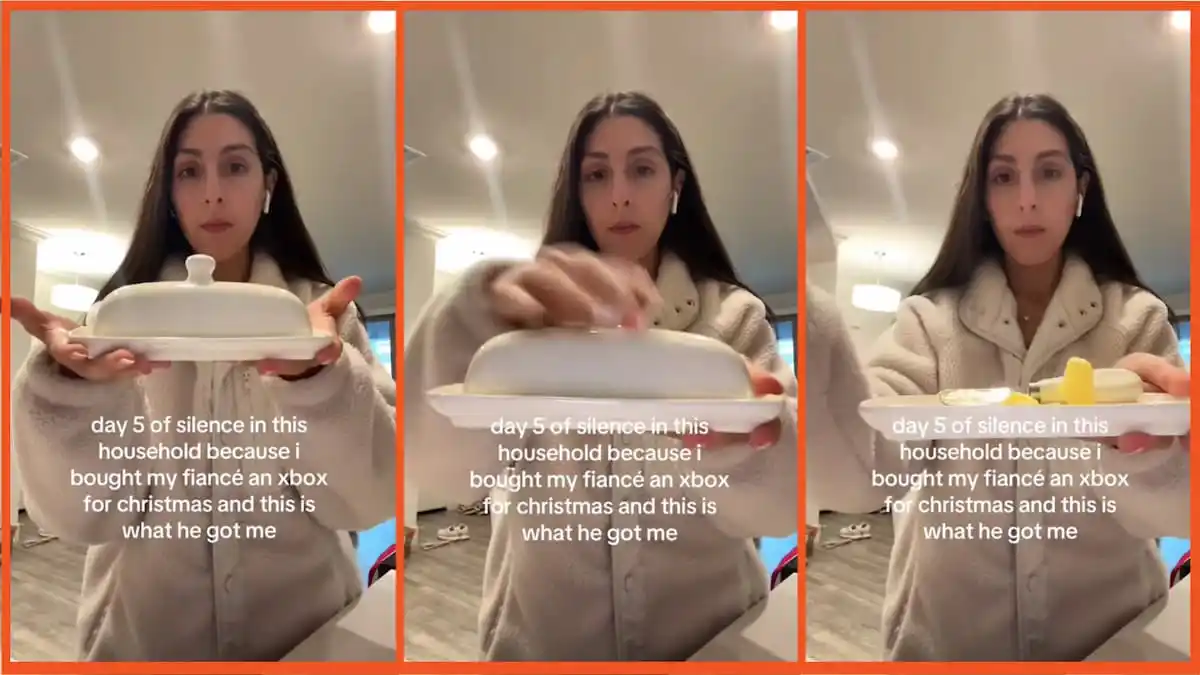
TikTok has turned everyday gift exchanges into public spectacles, and few scenarios capture that tension better than a clip of a woman proudly buying her husband an Xbox while unwrapping a modest butter dish in return. The video’s real sting is not the ceramic dish itself but the chorus of strangers insisting, “your husband doesn’t love you,” turning a private moment into a referendum on an entire marriage. It is a snapshot of how online audiences now weigh in on love, loyalty, and “bare minimum” behavior with the confidence of close friends, even when they are only seeing a few curated seconds.
What plays as lighthearted content on the surface quickly becomes something heavier once the comments roll in. Viewers project their own histories and hurts onto the couple, reading deep meaning into the price tag of an Xbox versus a kitchen accessory. The result is a familiar modern drama: one person’s attempt at a relatable joke becomes a viral case study in relationship red flags, with millions of onlookers convinced they can diagnose a stranger’s emotional life from a single holiday exchange.
When TikTok Turns Gift-Giving Into a Relationship Verdict

The outrage that follows clips like the Xbox and butter dish exchange rests on a simple equation: expensive equals effort, and effort equals love. On TikTok, that logic is reinforced by a culture that already assigns cash value to virtual affection, where digital “roses” and “galaxies” are tallied like receipts. Guides to the platform’s economy spell out that TikTok gifts can range from a few cents to luxury-level items worth up to $600, and that there are more than 100 g different options to choose from. When viewers are used to seeing love quantified in coins and leaderboards, it is not surprising that they treat an Xbox as proof of devotion and a butter dish as evidence of neglect.
That same mindset shows up in the way audiences talk about money on live streams. Commonly used TikTok gifts are priced on a sliding scale, with some costing just pennies and others climbing to £48.99 or more, and the most dedicated fans can spend thousands of coins in a single session. When that kind of spending is normalized as a show of loyalty, a spouse who opts for a practical kitchen item instead of a high-end gadget is instantly cast as uncaring. The problem is not the butter dish itself, it is the way TikTok has trained viewers to see every gift as a public metric of how much someone is valued.
Projection, Parasocial Drama, and the Rush to Call Out “Red Flags”
What makes the “your husband doesn’t love you” comments so potent is how quickly strangers project their own experiences onto a couple they have never met. The same pattern appears whenever a personal story goes viral, whether it is a streamer’s health scare or a celebrity divorce. In one recent case, unverified rumors about creator Will Austin’s fate spread so widely that People on TikTok treated speculation as fact, even as the underlying claims remained unproven. The same certainty shows up in comment sections under relationship clips, where viewers confidently diagnose emotional abuse or loveless marriages based on a single gift or facial expression.
Celebrity posts amplify that dynamic. When Billy Ray Cyrus’ former partner shared her account of surviving a painful relationship, the upload drew a flood of responses, with One commenter after another offering their “two cents” about what she should have seen sooner. That same energy powers the TikTok verdict on the Xbox and butter dish: people are not just reacting to a mismatched present, they are reliving their own disappointments and warning a stranger not to repeat their mistakes. The result is a feedback loop where personal pain becomes public content, and every small slight is framed as a glaring red flag.
Self-Help Culture Meets Viral Judgment
The language viewers use under these videos often borrows from therapy and wellness trends, with commenters diagnosing attachment styles and urging creators to “set boundaries” or “raise their standards.” Advice columns about spotting warning signs in other areas of life, such as guides to red flags in a New Year’s diet, encourage people to be skeptical of quick fixes and to notice when something that looks healthy is actually harmful. That vigilance can be empowering, but on TikTok it sometimes morphs into a hair-trigger instinct to label any imperfect moment as toxic, including a lopsided gift exchange that might have a perfectly mundane backstory.
There is also the simple reality that conflict and heartbreak travel farther online than quiet contentment. Viral clips that spark debate about whether a partner is selfish or unloving tap into the same appetite for drama that fuels trending lists like Top Talkers, where a single Study or story can dominate conversation, and even topics as far-flung as Outer space become fodder for hot takes. In that environment, a woman unwrapping a butter dish while her husband boots up a new console is not just a private disappointment, it is content. The challenge for viewers is to remember that a viral clip is rarely the full story, and that love cannot be measured as neatly as a TikTok gift menu or a comment section verdict might suggest.
More from Decluttering Mom: