
The Trump administration has redrawn America’s nutrition roadmap, unveiling a new food pyramid that flips decades of diet advice on its head. Meat, cheese and vegetables now share the top tier, while sugary and ultra-processed products are pushed to the margins. The shift is billed as a “historic reset” of federal nutrition policy and a direct response to the country’s chronic disease crisis.
At the center of the overhaul is a simple slogan: eat real food. The new visual guide and companion dietary guidelines elevate protein, full-fat dairy and whole foods, while softening long-standing warnings about saturated fat. Supporters frame it as a long overdue correction; critics see the heavy emphasis on animal products as a political and industry-friendly pivot that could clash with other public health goals.
What the new pyramid actually promotes
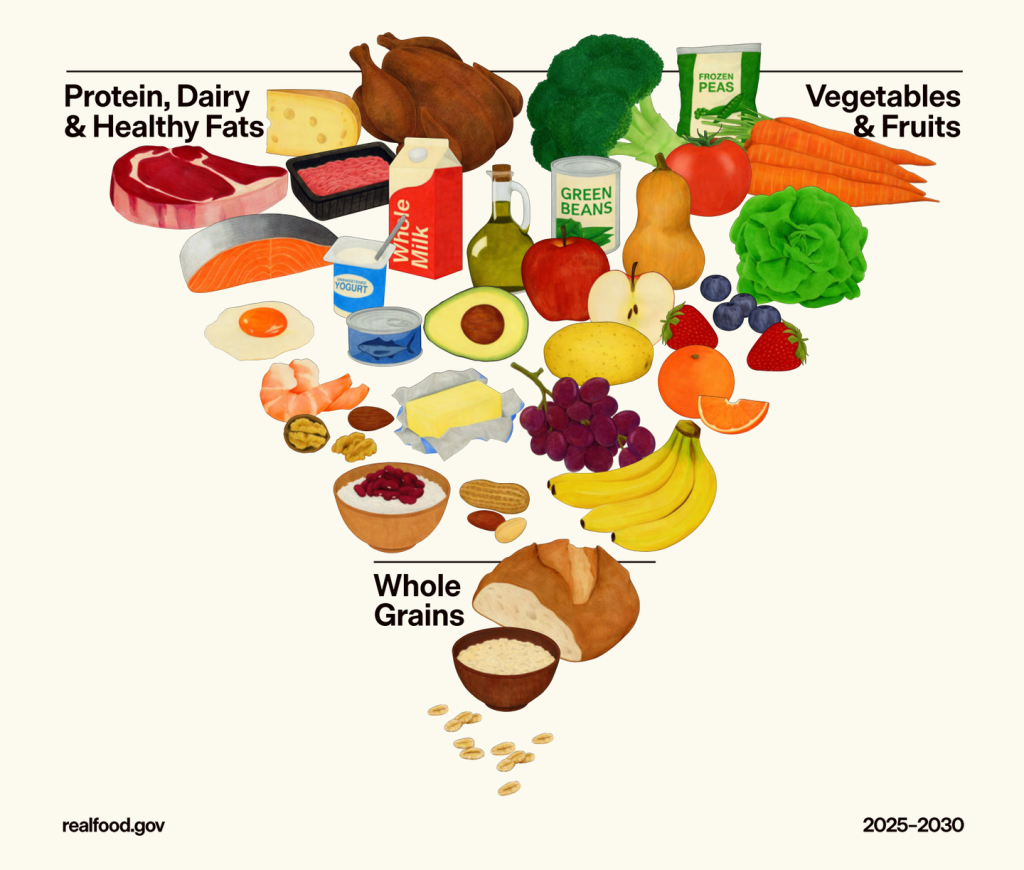
The Trump administration’s graphic is an inverted triangle that puts meat, cheese and vegetables at the top, a striking reversal from the grain-heavy pyramids that dominated the 1990s and 2000s. Officials describe it as part of a broader effort to “Flips Food Pyramid, Promote Protein, Cut Added Sugar,” with the top layers filled by steak, eggs, yogurt, leafy greens and colorful produce, while sugary drinks and snacks are squeezed into a narrow base that signals scarcity rather than abundance. The Trump administration has said the goal is to “Promote Protein, Cut Added Sugar” without abandoning long-standing advice to eat fruits and vegetables, a balance that is reflected in the new layout that pairs animal protein with plant foods in the most prominent tier, as detailed in the updated guidelines that Flips Food Pyramid.
Behind the graphic is a sweeping rewrite of federal nutrition standards that the Department of Health and Human Services describes as a “historic reset” of how Washington talks about food and health. A detailed fact sheet from HHS frames the new pyramid and guidelines as a coordinated push to reduce diet-related disease by steering Americans toward minimally processed meals, higher protein intake and fewer refined carbohydrates, part of what the agency calls a “historic reset” of federal nutrition policy in its historic reset. The Department of Agriculture, working with the Medical Advanced Health Administration, has echoed that language, saying the new standards are meant to “put real food back at the center of health” and to align school meals, military rations and nutrition assistance with the inverted pyramid’s priorities, a message underscored when USDA leaders and MAHA officials jointly described the changes as a “historic reset” that would “put real food back center health” in a historic reset.
Protein, fat and the end of the war on steak
The most controversial feature of the new pyramid is its embrace of meat and dairy as everyday staples rather than occasional indulgences. Health Secretary Robert F. Kennedy Jr. has been explicit about that shift, with RFK Jr.’s new food pyramid putting meat, cheese and vegetables at the top and arguing that previous guidelines overstated the dangers of saturated fat while understating the risks of ultra-processed carbohydrates, a stance he laid out when Health Secretary Robert Kennedy Jr. argued that the real threat comes from foods “that are harmful to health.” The Trump administration’s own messaging reinforces that point, with one official saying the new recommendations “essentially turn the old pyramid upside down” by focusing on “eating real food, nutrient dense foods, saturated fats in context,” a narrative captured in an interview where the agriculture secretary described the guidelines as “flipping the narrative” on fat and carbs in a flipping narrative.
The written guidelines that accompany the pyramid spell out what that means on a plate. They urge Americans to eat more protein, including red meat and full-fat dairy, while cutting back on added sugars and highly processed foods, a shift that The Trump Administration on Jan. 7 framed as a direct response to “America’s chronic-disease epidemic” in its call for Americans to prioritize protein and reduce ultra-processed intake in a document where The Trump Administration links diet to chronic illness. The Trump administration has also emphasized that these standards are not abstract: they will shape what appears on cafeteria trays and in commissaries across the country, with one official noting that “These standards affect 45 m school lunches every day, meals for 1.3 m active-duty service members and food packages for low-income families,” a reminder that the new pyramid will influence everything from public school menus to military dining halls, as spelled out in guidance that highlights how “45 m” and “1.3 m” daily meals will be reshaped by the protein-heavy approach in the updated standards that affect 45 m.
Real food rhetoric, real-world stakes
Supporters argue that the new pyramid finally aligns federal advice with emerging science on ultra-processed foods and metabolic health. The guidelines single out ultraprocessed products for reduction from early childhood through age 10 and recommend three servings of vegetables and two servings of fruits per day for a typical 2,000-calor diet, a combination that aims to pair higher protein with a steady baseline of produce, as laid out in the updated recommendations that specify “three servings of vegetables and two servings of fruits per day for a typical 2,000-calor” intake in the new 2,000-calor framework. A companion visual campaign leans heavily on the “Eat Real Food” banner that tops the new inverted pyramid, signaling that the administration wants Americans to think less about grams and percentages and more about whether what is on their plate looks like something that came from a farm rather than a factory, a message that appears in coverage of the revised guidelines where an “Eat Real Food” banner literally crowns the new graphic in an Eat Real Food themed rollout.
Critics, however, warn that the real food rhetoric masks a strong tilt toward the beef and dairy industries. Reporting has documented that the panel behind the new dietary guidelines had financial ties to beef and dairy interests, raising questions about whether the prominence of meat and cheese at the top of the pyramid reflects science or lobbying, a concern highlighted in an investigation that noted the “diet advice released Wednesday” came from a committee with documented connections to those sectors before the Department of Agriculture finished the process in a review that scrutinized financial ties. Opinion writers have also argued that “Putting aside that animal products, most of which come from factory farms, are arguably the most processed foods on Earth,” the new pyramid’s emphasis on meat conflicts with guidance from “every credible health-related organization,” and that the Department of Agriculture may be elevating industry priorities over independent science, a critique laid out in an analysis that opens with “Putting aside that animal products” and questions whether the Trump administration has made industry influence a priority in the Putting of meat at the top.
Politics, culture wars and what lands on the plate
The politics around the new pyramid are as layered as the graphic itself. Coverage framed the rollout as part of a broader culture clash over what counts as “processed,” with one analysis noting that “New US Dietary Guidelines Announced by MAHA, Trump Admin: What We Know” is that the USDA Dietary Guidelines Chart now gives animal products a far more central role than in previous iterations, a change that has become a flashpoint in debates over climate, animal welfare and public health, as summarized in a breakdown of the New US Dietary Guidelines Announced. Another widely shared piece captured the online reaction with the headline “Sooo, The Trump Administration Just Unveiled A New Food Pyramid,” complete with a “Remember her? Joe Raedle” photo callback to the old grain-based pyramid and a breakdown of how nuts, seeds, olives and avocados now sit higher in the hierarchy, reflecting the administration’s friendlier stance toward dietary fat in a viral story that opened with “Sooo, The Trump Administration Just Unveiled” and asked readers to “Remember” the old chart while crediting photographer Sooo and Joe Raedle.
The Trump administration has leaned into that culture-war framing, with one radio segment bluntly stating that “The Trump administration has unveiled a new food pyramid that puts meat and cheese at the top, alongside fruits and vegetables, and effectively ends the war on saturated fats,” a line that crystallized how supporters see the change as a repudiation of low-fat orthodoxy in a broadcast that opened by noting that “The Trump administration has unveiled a new food pyramid that puts meat, cheese and vegetables at the top” and declared an end to the “war on saturated fats” in its The Trump segment. Conservative commentators have praised the guidelines for “targeting ultra-processed foods” while easing up on red meat and saturated fats, noting that sugary snacks and refined grains are now at the narrow bottom of the pyramid, a shift that one report described as the Trump administration’s new nutrition guidelines that “target ultra-processed foods, ease up red meat, saturated fats” and place those items “at the narrow bottom” of the chart in a breakdown of how the new standards target ultra-processed foods. At the same time, health reporters like Isabella Cueto have chronicled how the “Eat Real Food” message is landing with clinicians and patients, while also noting that You can reach Liz on Signal at LizC.22 if you have stories about how the new pyramid is reshaping care, a reminder that the debate is not just academic but deeply personal for those living with diet-related disease, as captured in coverage that quotes “You can reach Liz on Signal at LizC.22” and credits Isabella Cueto with tracking how the new visual guidance is affecting American diets in an Isabella Cueto.
From policy to grocery aisles
The new pyramid will not stay on paper for long. Retailers and food companies are already positioning themselves around the protein-forward message, with some large grocers pointing to existing partnerships with USDA nutrition programs as a foundation for promoting “real food” baskets that match the guidelines. Walmart, for example, has highlighted its role in the USDA’s SNAP Online Purchasing Pilot as evidence that it can help translate federal nutrition advice into accessible options for low-income shoppers, pointing customers to the USDA press release that describes how the retailer joined the pilot and invited readers to “For more information, read the USDA press release” about the program in a corporate statement on its participation in the USDA pilot. As the new pyramid filters into school lunch contracts, hospital menus and food marketing, the question will be whether the promised “historic reset” delivers measurable improvements in obesity, diabetes and heart disease or simply rearranges the icons on a familiar chart.
For now, the Trump administration is betting that a bold visual break with the past, coupled with a louder call for protein and a crackdown on added sugar, will move the needle where decades of incremental tweaks have not. The coming years will test whether Americans embrace a plate that looks more like a steakhouse salad than a bowl of cereal, and whether the country’s sprawling food system, from MAHA policy shops to supermarket apps, can make that new pyramid a practical reality rather than just a provocative infographic.
Supporting sources: RFK Jr. rolls out new dietary guidelines backing more protein ….
More from Decluttering Mom: