When Sarah, a software engineer in the Midwest, toured the Lutheran preschool two blocks from her house in early 2025, she liked almost everything: the small class sizes, the patient teachers, the little garden out back where kids grew tomatoes. The one thing that gave her pause was the crucifix above the cubbies. Sarah and her husband are atheists. Their daughter had just turned three.
“We kept asking ourselves, are we hypocrites if we send her here?” Sarah wrote in a parenting forum that March. She is far from alone. According to a 2023 report from the National Center for Education Statistics, roughly 29 percent of all private preschool and pre-kindergarten enrollment in the United States is in religiously affiliated programs. In many communities, especially rural ones and small cities, a church-run preschool may be the only licensed, affordable option within a reasonable drive.
For the growing share of American parents who identify as religiously unaffiliated — about 28 percent of U.S. adults, per Pew Research Center’s 2024 survey — the question is not abstract. It is a Tuesday-morning logistics problem with real emotional stakes.
Why the worry goes deeper than Bible stories
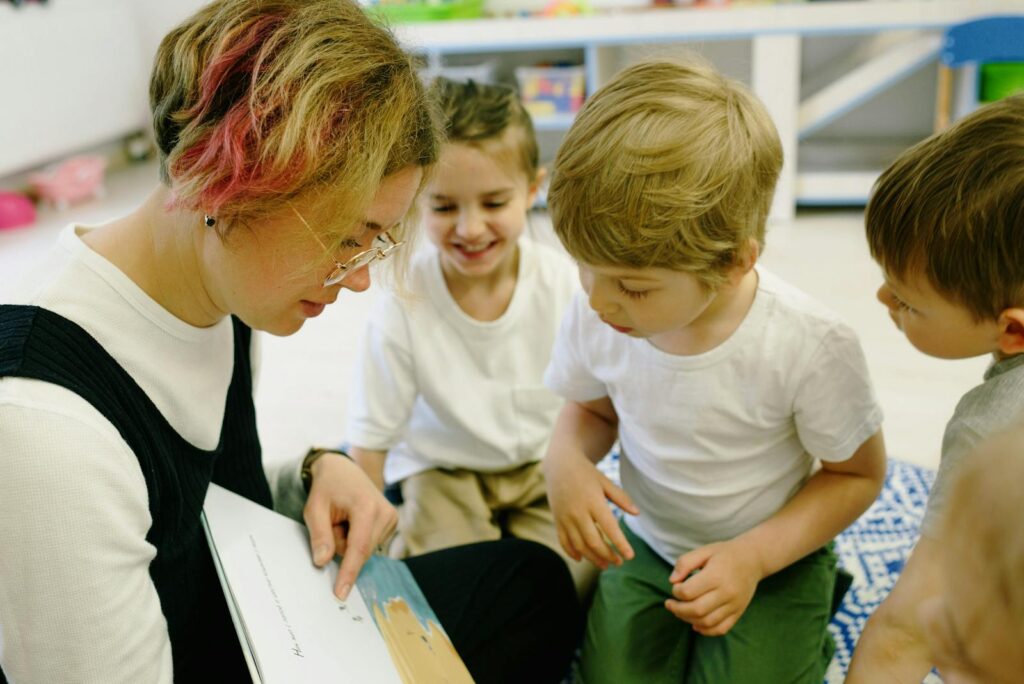
Most nonreligious parents are not concerned that their toddler will hear about Noah’s Ark. What keeps them up at night is the possibility that a well-meaning teacher will frame the world in terms of sin, punishment and exclusion before a child has the cognitive tools to push back.
“There is nothing more traumatic than telling a 3-year-old they could make a mistake that would result in being tortured for eternity,” one parent wrote in a Reddit thread about religious preschools, adding that the fear compounds when children absorb the idea that non-Christian friends or family members are in spiritual danger. A former Catholic parent in the same thread described carrying those early messages well into adulthood.
For families with LGBTQ+ members, the concern is even more pointed. In a Facebook discussion among parents evaluating private school options for nonreligious families, a commenter named Jan argued that a school’s real values show not in its mission statement but in how its staff treat queer families, children of other faiths, and kids who are struggling. “The words they worship mean nothing to them if they do not live by those words,” she wrote.
Developmental psychologists tend to agree that context matters more than content at this age. Dr. Christy Buchanan, a professor of psychology at Wake Forest University who studies adolescent development, has noted that young children are concrete thinkers. They are not parsing theology; they are reading the emotional tone of the adults around them. A warm teacher who mentions God in passing registers very differently from one who uses fear as a disciplinary tool.
Not all Lutheran preschools teach the same thing
One of the biggest gaps in the “should we or shouldn’t we” conversation is that parents often treat “Lutheran” as a single category. It is not. The two largest Lutheran bodies in the United States occupy very different theological ground.
The Evangelical Lutheran Church in America (ELCA), the larger of the two with roughly 3 million baptized members, ordains women and LGBTQ+ clergy and generally takes a more progressive approach to social issues. Its preschool curricula tend to emphasize kindness, community and broad spiritual themes rather than doctrinal instruction.
The Lutheran Church–Missouri Synod (LCMS), with about 1.8 million baptized members, holds more conservative positions on gender roles, sexuality and scriptural authority. Its early childhood programs are more likely to include explicit catechetical content, though individual congregations still vary.
Knowing which denomination runs the preschool is a starting point, not an endpoint. But it can help parents calibrate their questions before the first tour.
What families who have done it actually report
Anecdotal accounts from nonreligious parents cluster into two broad camps, and the split is instructive.
In a widely discussed thread on r/Parenting about Lutheran preschools, a user named Mar recalled that their own mother, who was “very much not religious,” chose a Lutheran program because it was nurturing, affordable and walkable. As an adult, Mar remembers hearing about God at school, but what stuck was the framing their mother used at home: “This is what your teacher believes, not what I believe.” That simple sentence turned religious content into information rather than instruction.
In the same thread, another parent offered a sharp counterpoint. “Surely that is not the experience everyone has,” they wrote, before describing a religious school where fear and shame were routine. That parent said it would now “take a lot” to send their own child to a faith-based program, though they acknowledged that their son had once attended a church preschool where the staff “did not seem to care” about converting anyone and mostly focused on naps and snacks.
The gap between those two experiences is exactly what makes this decision so difficult to crowdsource. A preschool’s denomination, curriculum documents and stated policies tell you something. The actual classroom culture tells you more.
A practical checklist for the tour
Parents who have navigated this decision — and early childhood educators who work in faith-based settings — tend to recommend the same handful of concrete steps:
- Ask to see the daily schedule and curriculum. Find out how much time is devoted to religious instruction versus play, academics and social-emotional learning. Some programs limit faith content to a short chapel time once a week; others weave it through every activity.
- Ask how teachers handle questions about other beliefs. A program that responds to “My family doesn’t go to church” with curiosity rather than correction is signaling something important about its culture.
- Ask about LGBTQ+ families directly. If the school hesitates or hedges, that tells you what the mission statement may not.
- Check accreditation and licensing separately from affiliation. Programs accredited by the National Association for the Education of Young Children (NAEYC) meet developmental standards regardless of their religious identity.
- Talk to current families, especially nonreligious ones. Ask the director to connect you with a parent who does not share the school’s faith. If they cannot or will not, that is data.
- Plan your home conversation before the first day. The parents who report the smoothest experiences are the ones who, like Mar’s mother, had a simple, consistent script ready: “Some people believe this. We believe something different. You get to learn about all of it.”
The decision is not really about religion
At its core, the question atheist parents are asking is the same one every parent asks about every school: Will the adults in this building treat my child with respect, keep them safe and help them grow? The religious wrapper makes the question feel higher-stakes, but the evaluation criteria are the same.
In a thread on r/atheistparents, one parent summed up the pragmatic approach many families land on: do your homework, make sure “the education outweighs the religious component,” and then talk openly at home about what your child is hearing. That parent’s situation was constrained by a state policy requiring formal preschool or daycare hours for kindergarten entry, leaving few secular alternatives.
No preschool, religious or otherwise, will align perfectly with every family’s values. The families who report the best outcomes are the ones who walked in with clear questions, watched how teachers actually interacted with children, and treated the experience as a chance to start teaching their kids something valuable: that the world is full of people who believe different things, and that is worth understanding, not fearing.
More from Decluttering Mom: